
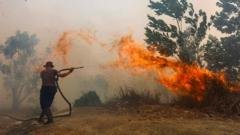
Borneo toxic haze crisis chokes Southeast Asia
When the sun hits the smog enveloping Indonesian Borneo, it turns everything the color of rust. Cars, houses, and streets appear and disappear out of a dim russet fog. There are few better words than apocalyptic to describe the way this looks. But it is at night, in the quiet darkness, that mother-of-three Dianyra Eka Nastiti grows most fearful. The ongoing Borneo toxic haze has transformed everyday life into a constant medical vigil.
The Borneo toxic haze is an ongoing environmental and public health crisis driven by relentless peatland wildfires across Indonesia, exacerbated by a severe Super El Nino drought. The resulting smoke has blanketed Southeast Asia, triggering hundreds of thousands of respiratory illness cases and forcing widespread school closures.<\/p>
- Massive Geographic Toll: Wildfires have torched roughly 1.9 million hectares across Indonesia since the start of the year, equalling the landmass of New Jersey.
- Severe Public Health Impact: Indonesia's Health Ministry has recorded over 277,000 cases of chronic coughs and acute respiratory infections.
- Underground Smoldering: Firefighters face unique challenges as peat fires burn deep underground, requiring massive amounts of scarce water to extinguish.
- Climate Amplification: A Super El Nino weather pattern has drastically prolonged the dry season, worsening drought conditions and delaying vital rainfall.
Sometimes at night, her baby’s chest makes a rattling sound. Hospitalized for bronchopneumonia at just a month and a half old, every single night brings the haunting question: Will my child cough tomorrow? Those thoughts linger relentlessly, mirroring the anxiety felt by hundreds of thousands of families across the region.
The Anatomy of an Environmental Catastrophe
Dastiti lives in Palangkaraya, sitting directly at the frontline of a months-long environmental disaster that has blanketed large parts of Southeast Asia in a noxious cloud. Wildfires have torched roughly 1.9 million hectares across Indonesia since the start of the year, according to open-access satellite platforms like the Nusantara Atlas. This devastated footprint is roughly the size of the US state of New Jersey, with an estimated one million hectares burning in September alone.
The fallout is staggering. Swathes of smoldering forest, swamp, and carbon-rich peatlands have turned the air thick with microparticles and carbon monoxide. This toxic brew has not only swaddled Indonesia but drifted northward, choking populations in Singapore, Malaysia, and the Philippines.
As of mid-October, Indonesia’s Health Ministry recorded more than 277,000 cases of people suffering from chronic coughs and acute respiratory infections. More than 62,000 of those victims were infants and toddlers under the age of five. Industry insiders note that official figures often underreport the true scale of community exposure, as many rural residents lack immediate access to healthcare facilities.
The sky has turned yellow and hazy. What are the residents actually breathing in? It’s not fresh oxygen; it’s carbon dioxide and pollutants. — Riduan, Head of the Palangkaraya Health Office
The Unseen Toll on Human Health
The haze and smoke from peat fires contain a complex mixture of pollutants that pose immediate and long-term biological risks. Among these hazards are tiny microparticles capable of penetrating deep into human lung tissue and entering the bloodstream. This intrusion causes systemic inflammation, chronic lung diseases, and a significantly increased risk of premature death.
Beyond particulate matter, the atmosphere is saturated with greenhouse gases and carbon-heavy emissions. Children, older adults, and pregnant women remain exceptionally vulnerable to these conditions. Prolonged exposure leads to cumulative health damage, forcing medical professionals to sound the alarm on a brewing public health crisis.
In places like Palangkaraya, official directives urge residents to stay indoors. Yet, for working-class families, such guidance proves entirely detached from reality. Dastiti points out the simple logistics of survival:
“I still need to buy vegetables, stock up on food, purchase school supplies, and take care of other necessities. It’s simply not possible, and I feel like the people who say things like that have no idea what is actually happening here.”
Ground Zero: Living Inside the Smoke
Life in rural villages surrounding the urban centers is equally grim. Lola Macitri, a 37-year-old resident of Ramang village, 50 kilometers north of Palangkaraya, has spent weeks housebound. As the smog deepens from dusty grey to amber yellow and burnt orange, outdoor existence becomes virtually impossible.
Her children attend school online, mirroring pandemic-era disruptions, while local adults attempt to manage abbreviated workdays amidst poisonous air. Farmers, daily-wage earners, and small vendors face a cruel dilemma: sacrifice their livelihoods or risk acute poisoning.
Comparing the Crisis: Surface Fires vs. Peatland Blazes
| Fire Characteristic | Standard Forest Fire | Peatland Fire |
|---|---|---|
| Combustion Zone | Surface vegetation and trees | Underground organic soil layers |
| Extinguishing Difficulty | Moderate (hours to days) | Extreme (weeks to months) |
| Water Requirement | Standard volume | Massive subsurface injection |
| Carbon Emission Profile | High | Catastrophic carbon bomb |
According to international environmental reports, the persistence of these peat fires stems from their subterranean nature. Firefighters can easily knock down visible surface flames, but the carbon fuel beneath the surface continues to bake, fueling endless cycles of resurgence.
The Exhausted Frontline Responders
Government authorities face mounting public backlash over perceived inaction. Officials insist they have exhausted multiple strategies, from aerial waterbombing to experimental weather modification seeding. Last week, the Indonesian government deployed over 60,000 personnel for land operations, claiming an 80% success rate in halting new ignitions.
However, field experts argue that conventional tactics fall short against unprecedented drought conditions.
- Aerial Waterbombing: Effective for surface containment but fails to reach underground peat fires.
- Weather Modification: Highly dependent on atmospheric moisture, which is severely lacking during intense droughts.
- Ground Trenching: Requires heavy machinery and manpower in hard-to-reach swampland.
- Subsurface Injection: The only viable method to douse peat beds, yet severely hampered by local water shortages.
Dr. Nisa Novita, a forestry expert and peatland researcher at Yayasan Konservasi Alam Nusantara (YKAN), emphasizes the urgency of the moment. Comparing the situation to a sinking ship, she notes that responders must utilize every safe and effective tool available to prevent irreversible ecological collapse.
The Super El Nino Factor
Seasonal fires are certainly not new to Indonesia. However, a powerful Super El Nino climate phenomenon has drastically amplified regional drought conditions this year, withholding the critical rainfall needed to snuff out underground peat fires. Firefighters like Juni, who has spent over 100 days battling relentless blazes, report severe physical exhaustion, chronic coughs, and persistent eye irritation.
Fauzi Rahman, another frontline firefighter in Palangkaraya, highlights the unique physics of peat as the primary obstacle. While regular land allows teams to clear large acreage quickly, peatland requires deep water injection over extended periods—a near-impossible feat when local water sources are drying up entirely.
Ultimately, while communities, volunteers, and military personnel work around the clock, the immediate salvation of the region relies on a force of nature. Until heavy seasonal rains finally break the prolonged dry spell, the residents of Borneo remain trapped in an exhausting battle for every breath of clean air.
<button type="button" onclick="this.parentElement.innerHTML='✓ Thank you, we will refine our analysis!‘” style=”background:#ffffff; border:1px solid #cbd5e1; border-radius:6px; padding:4px 12px; font-size:12px; cursor:pointer; color:#334155;”>👎 No
