
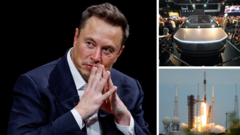
Elon Musk’s SpaceX Tesla merger: Inside the trillion-dollar deal
For well over a decade, Elon Musk has operated two distinct economic gravity wells. On one side sits Tesla, redefining modern personal transport through electric vehicles and scaling humanoid robotics. On the other stands SpaceX, rewriting the economics of orbital flight and beaming global connectivity down from the stars. Now, the architect of these trillion-dollar empires is seriously considering pulling them together into a single, colossal entity.
Elon Musk is exploring a trillion-dollar SpaceX Tesla merger to combine automotive manufacturing, artificial intelligence, robotics, and aerospace capabilities. Special committees have been formed to assess the deal, though shareholder approval remains a significant hurdle for the combined technology giants.<\/p>
- Unprecedented Scale: Combining Tesla's $1.5 trillion valuation with SpaceX's $2 trillion creates the largest corporate merger in history.
- Strategic Synergy: The deal unites Tesla's chips, self-driving tech, and Optimus robots with SpaceX's rockets, satellites, and data centers.
- The Mars Mission: The consolidation directly accelerates Musk's long-term vision of establishing a self-sustaining city on Mars.
- Shareholder Hurdle: Securing the necessary 50% backing from Tesla shareholders represents a massive governance challenge.
Asked bluntly during a recent public appearance whether an SpaceX Tesla merger makes strategic sense, Musk delivered an unequivocal answer: “Yes.”
This is no idle daydream. Behind closed corporate doors, special committees have quietly taken shape to evaluate the mechanics of a transaction that would dwarf any corporate pairing in human history. With Tesla hovering around a $1.5 trillion valuation and private-market titan SpaceX valued near $2 trillion, a consolidation would eclipse the largest historical mergers by a wide margin. Yet, as Musk himself wryly admitted during a quarterly earnings call, walking this tightrope feels less like corporate strategy and more like tap-dancing through a minefield.
A Symbolic Unveiling and Strategic Convergence
If you need a physical manifestation of this corporate convergence, look no further than the recent unveiling of the futuristic Tesla Roadster. Powered in part by actual SpaceX rocket thrusters, the vehicle serves as a high-octane symbol of what happens when two engineering cultures bleed into one another. Industry insiders recognize this as more than just a marketing stunt; it is a preview of a deeply integrated product pipeline.
During recent investor updates, Musk emphasized that the internal cross-pollination between the two firms regarding advanced silicon chips, heavy-duty artificial intelligence, and massive software architectures makes keeping them separate increasingly redundant. Bringing the companies under one roof unites Tesla’s terrestrial footprint—cars, self-driving neural nets, and Optimus humanoid robots—with SpaceX’s orbital mastery, sprawling data centers, and Starlink telecommunications grid.
“The question isn’t whether the technologies complement each other—they fundamentally rely on the same foundational AI and computing infrastructure. The question is simply how much priority traditional cars keep in a company increasingly driven by deep tech.”
To put the sheer scale of these operations into perspective, a side-by-side examination of the two entities highlights why analysts are scrambling to reprice the future:
Metric / Asset Tesla SpaceX Current Market Valuation ~$1.5 Trillion ~$2.0 Trillion Primary Hardware Electric Vehicles, Optimus Robots Rockets, Starship, Starlink Satellites Core Computational Focus FSD Neural Nets, Vision Processing Orbital Guidance, Telemetry, AI Datacenters Ultimate Strategic Goal Sustainable Transport & Automation Multi-Planetary Civilization As Reuters and other financial desks have reported, the market reaction was swift. SpaceX shares ticked upward in after-hours trading, while Tesla equities saw a modest bump as Wall Street analysts rushed to model the unprecedented financial architecture of a combined juggernaut.
Navigating the Shareholder Minefield
Despite the grand ambitions, getting this deal across the finish line requires clearing an exceptionally high bar. Any merger of this magnitude demands the explicit backing of at least half of Tesla’s public shareholders. Because Musk serves as chief executive of both organizations, strict governance rules bar him from participating directly in the internal negotiations.
Financial analysts note that while Tesla investors have previously shown a willingness to approve jaw-dropping compensation packages for their chief executive, a structural merger fundamentally changes the investment thesis. Tesla shareholders run the risk of holding a smaller slice of a vastly more complex, unpredictable balance sheet.
Furthermore, external pressures loom large. A shifting political landscape in Washington, coupled with regulatory scrutiny over market consolidation and Musk’s polarized public profile, means antitrust regulators will look at every single clause of the agreement under an electron microscope.
The Ultimate Destination: Mars
Strip away the balance sheets, the stock tickers, and the regulatory anxiety, and you arrive at the true north driving this entire maneuver: Mars. For years, Musk has maintained that his corporate endeavors are merely fundraising mechanisms for his ultimate mission in life—establishing a self-sustaining human civilization on the Martian surface.
Integrating Tesla’s autonomous robotics and mass-manufacturing prowess with SpaceX’s heavy-lift rocketry creates a singular, unbroken supply chain designed for interplanetary colonization. Whether everyday car buyers notice any immediate changes in their vehicles is largely irrelevant to the grand design. The pieces of the chess board are moving into place, and for the world’s richest man, a mega-merger might just be the most logical final move.
SUReported by SeeUY Tech & AI Research DeskSenior technology analysts and AI researchers at SeeUY investigating breakthrough algorithms, hardware developments, and enterprise software architectures.Was this investigation insightful?<button type="button" onclick="this.parentElement.innerHTML='✓ Thank you for your feedback!‘” style=”background:#ffffff; border:1px solid #cbd5e1; border-radius:6px; padding:4px 12px; font-size:12px; cursor:pointer; color:#334155;”>👍 Yes
<button type="button" onclick="this.parentElement.innerHTML='✓ Thank you, we will refine our analysis!‘” style=”background:#ffffff; border:1px solid #cbd5e1; border-radius:6px; padding:4px 12px; font-size:12px; cursor:pointer; color:#334155;”>👎 NoLatest Analytical Follow-up: For continuous developments on this subject, read our full investigation on Global Websites Offline After Massive PHP Security Flaw.
Latest Analytical Follow-up: For continuous developments on this subject, read our full investigation on Tesla Plans to Sell Cybercabs by End of Year.
Latest Analytical Follow-up: For continuous developments on this subject, read our full investigation on AI Infrastructure Debt Fears Are Overblown, Says Blackstone.
