
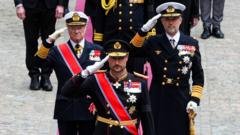
King Harald V State Funeral: Global Leaders Unite in Oslo
The King Harald V state funeral gathered monarchs, heads of state, and tens of thousands of citizens in Oslo to bid farewell to a leader whose 35-year reign bridged Norway’s post-war identity with modern social democracy. The solemn proceedings at the Oslo Cathedral memorial service marked not only the end of a transformative era in Scandinavian history but also the definitive consolidation of the Norwegian royal succession under King Haakon VIII.
The King Harald V state funeral in Oslo brought together European monarchs, heads of state, and thousands of Norwegian citizens to honor the late 89-year-old monarch's 35-year reign. The solemn ceremony at Oslo Cathedral concluded with a military procession to Akershus Fortress, formally initiating the reign of King Haakon VIII.<\/p>
- Historic Transition: The King Harald V state funeral concluded 13 days of national mourning, formally ushering in the reign of his son, King Haakon VIII.
- Unprecedented Diplomatic Presence: Over 30 international royals—including Nordic monarchs and Britain's Prince William—joined wartime leaders like Ukrainian President Volodymyr Zelensky in Oslo.
- Constitutional Continuity: The peaceful transfer of ceremonial power reinforces the stability of Norway's constitutional monarchy amid shifting European geopolitical alignments.
- Modernizing Legacy: King Harald V's 35-year tenure redefined the Scandinavian crown through radical inclusivity, civic empathy, and staunch democratic alignment.
1. Executive Summary & Strategic Importance
The King Harald V state funeral brought the Norwegian capital to a standstill as Europe observed an extraordinary display of continental unity, diplomatic solidarity, and sovereign tradition. King Harald V, who died at the age of 89, was laid to rest following 13 days of official European royal mourning, culminating in a ceremonial procession from the Royal Palace to Oslo Cathedral. The event drew monarchs from Scandinavia, Britain, and across the globe, alongside key democratic leaders navigating a fractured international security landscape.
Strategically, the funeral served as an inflection point for the Nordic region. In an era dominated by high geopolitical tension along NATO’s northern flank, the peaceful, dignified continuity of the Norwegian Crown reaffirms institutional stability. Norway’s monarch, while constitutionally non-partisan and holding largely ceremonial authority, functions as a linchpin of national unity and moral resolve. The presence of global leaders highlighted Norway’s outsized role in energy security, Arctic defense, and international peace diplomacy.
As the late monarch’s coffin was borne through the streets of Oslo, flanked by his heir, King Haakon VIII, sister Princess Märtha Louise, and grandchildren Crown Princess Ingrid Alexandra and Prince Sverre Magnus, the nation witnessed a generational shift. With the ascension of King Haakon and Queen Mette-Marit, the House of Glücksburg confronts both institutional modernization and complex socio-political dynamics within an evolving constitutional framework.
2. Historical Background & Contextual Evolution
To fully understand the profound public resonance of the memorial proceedings, one must examine the 35-year reign of King Harald V. Ascending to the throne in January 1991 following the death of his revered father, King Olav V, Harald took as his motto “Alt for Norge” (“All for Norway”)—a sacred pledge inherited from his grandfather, King Haakon VII, who stood as a symbol of resistance during World War II.
Harald’s reign was characterized by the systematic dismantling of royal aloofness. Having fought an arduous nine-year campaign to secure permission to marry commoner Sonja Haraldsen in 1968, Harald entered his kingship with an intrinsic understanding of modern societal shifts. Under his stewardship, the Norwegian monarchy evolved from an aristocratic relic into an empathetic civic institution. His defining moment came in the wake of the July 22, 2011 terror attacks, where his raw, compassionate leadership united a traumatized country under the banner of open democracy and pluralism.
His famous 2016 garden party address crystallized this ethos, defining Norwegians not by ancestry or creed, but by shared values: “Norwegians are girls who love girls, boys who love boys, and girls and boys who love each other… Norwegians believe in God, in Allah, in the Universe, and in nothing.” This moral clarity endeared him to generations of citizens, earning him the enduring title of the “Grandfather of the Nation.”
3. In-Depth Technical & Policy Breakdown
The state funeral adhered to precise constitutional, state, and military protocols developed across centuries, requiring months of intricate logistical orchestration between the Royal Court, the Ministry of Foreign Affairs, the Oslo Police District, and the Norwegian Armed Forces.
Protocol, Procession, and Security Mechanics
The operational framework of the state funeral comprised several interconnected phases designed to guarantee absolute security for high-profile foreign dignitaries while ensuring public accessibility:
- The Lying-in-State & Guard of Honor: Prior to the funeral, the late king lay in state within the Royal Chapel, guarded round-the-clock by members of His Majesty the King’s Guard (Hans Majestet Kongens Garde).
- The State Procession: The gun carriage bearing the monarch’s casket, draped in the Royal Standard of Norway, moved along Karl Johans gate. King Haakon VIII led the royal mourners on foot, adhering to traditional Scandinavian royal funeral rites.
- The Ecumenical and Civic Liturgy: Presided over by the Bishop of Oslo, the funeral liturgy balanced traditional Lutheran theology with civic addresses from Prime Minister Jonas Gahr Støre, who highlighted Harald’s delicate equilibrium between sovereign dignity and common humanity.
- Military Honors and Aerial Salute: At the conclusion of the cathedral service, four Royal Norwegian Air Force F-35 Lightning II aircraft conducted a flypast over central Oslo in a missing man formation, paying tribute to the late monarch’s status as Commander-in-Chief.
Diplomatic Mobilization and Foreign Delegations
The gathering at Oslo Cathedral presented an unprecedented diplomatic footprint. As reported by Reuters, the congregation included reigning heads of state and senior royals from more than a dozen dynasties. Flanking King Haakon VIII were his Nordic peers, King Carl XVI Gustaf of Sweden and King Frederik X of Denmark, exemplifying the unbreakable historical bonds between the Scandinavian crowns.
The British Royal Family was represented by Prince William, the Prince of Wales, acting on behalf of King Charles III, and Princess Anne, who attended both in her official capacity and as godmother to King Haakon. Non-royal heads of state—most notably Ukrainian President Volodymyr Zelensky and German President Frank-Walter Steinmeier—participated directly in the cortege, underscoring the deep geopolitical weight attached to Norway’s international standing.
4. Comparative Industry Framework
The transition within the Norwegian Crown highlights structural differences across Western Europe’s constitutional monarchies. While sharing common democratic ideals, each institution balances royal prerogative, modernization, and public accountability through distinct constitutional mechanisms.
| Constitutional Dimension | Kingdom of Norway | Kingdom of Sweden | Kingdom of Denmark | United Kingdom |
|---|---|---|---|---|
| Monarchical Role | Ceremonial Head of State, moral arbiter, non-political | Purely ceremonial; removed from formal government formation | Ceremonial; formal signatory to legislative acts | Constitutional Head of State; weekly Prime Minister audiences |
| Succession Principle | Absolute primogeniture (introduced 1990; applies to those born after) | Absolute primogeniture (adopted retroactively in 1980) | Absolute primogeniture (adopted via 2009 referendum) | Absolute primogeniture (via Succession to the Crown Act 2013) |
| Public Approval Baseline | Historically high (75–85%), facing slight modern headwinds | Consistent (65–75%), bolstered by steady longevity | Extremely high (80–85%) post-2024 peaceful abdication | Moderate (55–65%), demographic variance among youth |
| Crisis & Scrutiny Resilience | High civic trust, but challenged by recent peripheral family scandals | High structural resilience through narrowed royal house definition | Streamlined royal household mitigating financial scrutiny | Extensive institutional PR apparatus managing global media |
As illustrated in the comparative framework above, Norway’s crown relies heavily on civic trust rather than codified political power. While British and Swedish monarchies have navigated succession through structural streamlining, the Norwegian model leans on accessibility and emotional resonance. The challenge for King Haakon VIII will be preserving this unique bond while protecting the institution from emerging reputational pressures.
5. Socio-Economic, Enterprise & Global Ramifications
The passing of King Harald V and the ascension of King Haakon carry implications extending beyond palace walls. According to analyses cited by institutions like the World Bank regarding Scandinavian governance indicators, high institutional trust remains a foundational driver of Norway’s economic resilience, state-backed sovereign investments, and social cohesion.
Norway’s $1.7 trillion Government Pension Fund Global (the world’s largest sovereign wealth fund) operates under strict ethical guidelines approved by the Storting (Parliament), reflecting the same ethos of long-term stewardship championed by King Harald throughout his reign. The monarch’s lifelong advocacy for environmental preservation, Arctic science, and human rights has long served as soft-power leverage, opening doors for Norwegian enterprise in renewable energy, maritime shipping, and sustainable resource management.
However, the transition occurs amid complex domestic realities. In his final months, King Harald and his family faced acute personal challenges and heightened media scrutiny. The public reconciliation with past associations—including Queen Mette-Marit’s prior meetings with the late Jeffrey Epstein—alongside legal proceedings involving her non-royal son, Marius Borg Høiby, have tested public sentiment. Høiby’s presence at the cathedral under judicial furlough highlighted the delicate intersection between private familial loyalty and public accountability. Maintaining public trust while navigating these complex realities is the central institutional challenge facing the new reign.
6. Strategic Outlook & What Comes Next
With the lowering of the casket into the Royal Mausoleum at Akershus Fortress—where Harald now rests beside his forebears King Olav V, Crown Princess Märtha, King Haakon VII, and Queen Maud—the period of national mourning formally concluded. As Norwegian flags returned to full mast, the nation turned its attention toward the future.
Key Milestones and Watchpoints for the New Reign:
- The Royal Tour and Consecration: Following established precedent, King Haakon VIII and Queen Mette-Marit are expected to embark on a comprehensive nationwide tour (Fylkestur), reinforcing direct connections with Norway’s diverse municipalities and indigenous Sámi communities.
- Elevation of Crown Princess Ingrid Alexandra: As the immediate heir to the throne, Crown Princess Ingrid Alexandra will gradually assume elevated constitutional duties, representing the future of the Norwegian monarchy as its eventual first female sovereign since Queen Margaret I in the Middle Ages.
- Navigating Modern Public Relations: The Royal House must define a transparent communication strategy to address peripheral controversies while focusing public attention on civic duties, youth engagement, and technological adaptation.
- Geopolitical & Environmental Advocacy: King Haakon is anticipated to intensify his long-standing focus on global climate diplomacy, international development, and ocean health, serving as a trusted international ambassador for Norwegian values.
As tens of thousands cheered the new King and Queen from the palace balcony, the overwhelming consensus among historians and observers was clear: the foundation laid by King Harald V remains solid. The King Harald V state funeral was not merely an ending, but a reaffirmation of a monarchy designed to serve, adapt, and endure.
Latest Analytical Follow-up: For continuous developments on this subject, read our full investigation on Google Finland Investment: A €13B AI Infrastructure Leap.
