
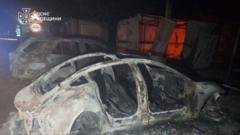
Ukraine Moldova Border Attack Shakes Regional Security
The geopolitical equilibrium of Eastern Europe has been severely shaken following a lethal Ukraine Moldova border attack that targeted the Starokozache-Tudora crossing, leaving two dead and forcing the immediate closure of this vital international transit corridor. This unprecedented strike on a civilian border post underscores the expanding geographical footprint of the conflict, directly dragging neighboring Moldova into the crosshairs of the war. As Russian loitering munitions incinerated civilian vehicles at the border, Ukrainian forces launched a massive retaliatory wave of drone strikes targeting the strategic Russian port city of Novorossiysk, killing four people and injuring dozens. This rapid escalation of violence occurs at a highly sensitive diplomatic juncture, directly challenging the nascent backchannel peace initiatives spearheaded by representatives of the incoming United States administration.
The Ukraine Moldova border attack refers to a lethal Russian drone strike on the Starokozache-Tudora crossing on December 2024. The attack killed two individuals, injured three others, and forced the immediate closure of this critical transit corridor, highlighting the expanding geographical footprint of the war into neighboring Moldova.<\/p>
- Lethal Border Escalation: The drone strike on the Starokozache crossing killed two people, injured three, and forced the complete closure of a vital logistical link between Ukraine and Moldova.
- Moldovan Sovereignty Threatened: Prime Minister Vasile Tofan confirmed that 17 drones struck Moldovan territory in August alone, highlighting the growing spillover risks for Chisinau.
- Symmetric Long-Range Warfare: Concurrently, Ukrainian drone strikes targeted Novorossiysk, killing four people and injuring 29, demonstrating Kyiv's expanded deep-strike capabilities.
- Diplomatic Friction: The escalation coincides with intense backchannel diplomacy involving US envoys Jared Kushner and Steve Witkoff, exposing a gap between battlefield realities and peace talks.
1. Executive Summary & Strategic Importance
The lethal strike on the Starokozache border crossing, situated approximately 500 kilometers (310 miles) south of Kyiv in the Odesa region, represents a dangerous phase of escalation. The Ukraine Moldova border attack not only disrupted a critical humanitarian and commercial artery but also resulted in the tragic deaths of two individuals and injuries to three others, including a Moldovan national. Images from the scene depicted a grim tableau of charred civilian vehicles, shattered concrete, and scattered debris, illustrating the high precision and destructive power of the modern loitering munitions deployed in the raid.
Simultaneously, the conflict saw a dramatic expansion on its eastern front. Ukrainian forces executed a highly coordinated, long-range drone offensive against Novorossiysk, a critical naval and commercial hub on Russia’s Black Sea coast. According to regional governor Veniamin Kondratiev, the strike killed four civilians, including a child, and injured 29 others, while damaging residential infrastructure, a church, and a preschool. The Russian Ministry of Defense claimed its air defense systems intercepted or destroyed 596 Ukrainian drones overnight, a figure that, if verified, represents one of the largest single-night drone deployments of the entire war.
These twin escalations highlight a profound disconnect between the intensifying violence on the ground and the diplomatic maneuvers occurring behind closed doors. Only hours prior to the strikes, Russian President Vladimir Putin held a telephone consultation with US President-elect Donald Trump. This call followed highly sensitive, face-to-face meetings in Moscow and Kyiv involving US envoys Jared Kushner and Steve Witkoff. The rapid intensification of hostilities suggests that both combatants are seeking to maximize their territorial and psychological leverage ahead of potential Reuters reported diplomatic peace negotiations, turning the borderlands of Eastern Europe into a high-stakes testing ground for military leverage.
2. Historical Background & Contextual Evolution
To understand the gravity of the recent border strike, one must examine the delicate geopolitical position that Moldova has occupied since the collapse of the Soviet Union. Sharing a long, porous border with Ukraine, Moldova has spent decades navigating a precarious neutrality, complicated by the presence of Transnistria—a breakaway, pro-Russian strip of land running along Moldova’s eastern border where approximately 1,500 Russian “peacekeeping” troops are permanently stationed.
Since the launch of the full-scale invasion of Ukraine in February 2022, Moldova has faced escalating security threats. The country’s pro-Western government, led by President Maia Sandu, has consistently warned that Moscow seeks to destabilize Chisinau to establish a land bridge to Transnistria. These fears are not merely theoretical; Moldovan airspace has been violated repeatedly by Russian cruise missiles targeting western Ukrainian infrastructure, and debris from intercepted drones has frequently landed on Moldovan soil.
However, the intensity of these incursions has reached unprecedented levels in recent months. Moldovan Prime Minister Vasile Tofan recently revealed a startling metric: in August alone, 17 Russian drones struck or crashed within Moldovan territory—a figure exceeding the total recorded during the entirety of the previous year. This rapid increase in kinetic incidents demonstrates that the war’s physical boundaries are dissolving, transforming Moldova from an anxious bystander into an active zone of collateral damage. The strike at Starokozache represents the first time a functional, joint border crossing has been directly targeted and closed due to lethal kinetic action, marking a qualitative shift in the threat level posed to Moldovan sovereignty.
3. In-Depth Technical & Policy Breakdown
The military operations executed by both sides over the past 48 hours reveal highly sophisticated tactical planning and a reliance on advanced unmanned aerial systems (UAS). Analyzing these strikes offers critical insights into the changing character of modern peer-to-peer conflict.
Technical Dimensions of the Ukraine Moldova Border Attack
The strike on the Starokozache crossing was carried out using low-altitude, one-way attack (OWA) drones, commonly identified as Shahed-136/Geran-2 loitering munitions. These systems are designed to bypass traditional air defense radars by flying at extremely low altitudes, utilizing pre-programmed GPS coordinates coupled with inertial guidance systems.
By targeting a border crossing located far from the primary front lines in eastern Ukraine, Russian forces exploited gaps in Ukraine’s air defense umbrella, which is heavily concentrated around major urban centers and critical energy infrastructure. The tactical objective of targeting Starokozache appears twofold:
- Logistical Disruption: Severing the transport links between Odesa and Moldova restricts the flow of dual-use goods, fuel, and civilian transport, forcing logistics networks to reroute through longer, more congested pathways.
- Psychological Coercion: By striking a border post shared with a sovereign, non-belligerent state, Moscow signals to European neighbors the high cost of supporting Ukraine, directly testing the resolve of the Moldovan government and its Western allies.
The Escalation of Drone Warfare in the Black Sea Basin
In response, Ukraine’s retaliatory strike on Novorossiysk demonstrated a highly evolved capability to conduct deep-theater interdiction. Novorossiysk is not only a vital commercial port for Russian oil exports but also serves as the primary refuge for the Russian Black Sea Fleet, which was largely forced to evacuate its historic base in Sevastopol due to persistent Ukrainian maritime and aerial drone attacks.
The deployment of hundreds of long-range Ukrainian drones in a single night indicates a highly streamlined domestic manufacturing capability. These drones, often constructed from lightweight composite materials and powered by simple internal combustion engines, are designed to saturate enemy air defenses through sheer volume. Even if a high percentage of these drones are intercepted, the remaining systems are capable of slipping through to strike high-value military and civilian infrastructure, as seen in the tragic casualties and damage reported in Novorossiysk.
4. Comparative Industry & Geopolitical Framework
To systematically evaluate the strategic divergence between these concurrent military operations, the table below outlines the key operational, tactical, and political dimensions of the latest strikes.
| Dimension | Starokozache Border Strike | Novorossiysk Port Strike | Kyiv TV Tower Strike |
|---|---|---|---|
| Primary Target | Civilian/Logistical Border Post | Military/Industrial Port City | Media & Communications Infrastructure |
| Weaponry Deployed | Shahed-136 Loitering Munitions | Long-range OWA UAVs (Swarms) | Precision Cruise Missiles / Drones |
| Casualties Reported | 2 Killed, 3 Injured | 4 Killed, 29 Injured | 5 Killed, Multiple Injured |
| Strategic Objective | Sever logistics; intimidate Moldova | Degrade naval assets; economic disruption | Disrupt information flow; psychological terror |
| Geopolitical Fallout | Direct threat to Moldovan sovereignty | Demonstrated vulnerability of Russian deep rear | Condemnation of attacks on civilian media |
The comparative data reveals a clear pattern: while Russia continues to focus its long-range strikes on critical infrastructure and border nodes to isolate Ukraine from its European neighbors, Ukraine is increasingly utilizing its domestic drone arsenal to strike deep within Russian territory. This symmetrical escalation of drone warfare indicates that both sides have integrated long-range unmanned systems as primary instruments of strategic attrition, bypassing conventional frontline stalemates.
5. Socio-Economic, Enterprise & Global Ramifications
The economic and social consequences of the Starokozache border closure are immediate and far-reaching. As a critical land corridor, the crossing plays a vital role in the regional economy of southwestern Ukraine and southern Moldova. The suspension of operations at this post immediately halts the transit of agricultural products, fuel shipments, and consumer goods, driving up transport costs and exacerbating supply chain bottlenecks in an already strained regional economy.
For Moldova, the economic shock is compounded by a profound sense of insecurity. The country is heavily reliant on international assistance to manage the influx of Ukrainian refugees and to transition its energy grid away from Russian dependency. Incidents like the Starokozache strike deter foreign investment and increase insurance premiums for commercial shipping and transport operating in the Danube and Black Sea regions. According to analysis published by Bloomberg, the persistent instability in the Black Sea basin has fundamentally altered global grain and energy shipping routes, forcing enterprises to adopt highly expensive contingency plans.
Furthermore, the political rhetoric emerging from Chisinau reflects a growing impatience with international hesitation. Prime Minister Vasile Tofan’s public statements represent a sharp departure from Moldova’s historically cautious diplomatic posture. By explicitly naming Russia as the sole aggressor and criticizing those who “ignore or downplay these threats,” the Moldovan leadership is signaling to its European partners that neutrality is no longer a viable shield against the physical realities of modern warfare. This shift is likely to accelerate Moldova’s integration into European security frameworks, potentially drawing a stronger defensive commitment from neighboring Romania and the wider European Union.
6. Strategic Outlook & What Comes Next
As the conflict enters this highly volatile phase, several critical indicators will determine the trajectory of both the military campaign and the parallel diplomatic tracks. The coming months are likely to be defined by a tense race between battlefield escalation and backchannel negotiations.
First, the role of the incoming Trump administration will be pivotal. The dispatch of high-profile envoys Jared Kushner and Steve Witkoff to Moscow and Kyiv indicates a desire to bypass traditional diplomatic channels and establish a direct line of communication between Vladimir Putin and Volodymyr Zelensky. However, the immediate surge in strikes following these meetings suggests that both Moscow and Kyiv are highly skeptical of a rapid diplomatic breakthrough. Instead, both capitals appear determined to establish a position of maximum strength on the ground, believing that territorial control and demonstrated strike capabilities will dictate the terms of any future ceasefire.
Second, the risk of a wider regional escalation remains dangerously high. If Russian drones continue to violate Moldovan airspace or strike border infrastructure with impunity, Western allies may face growing pressure to extend their air defense umbrella over western Ukraine and the Moldovan border. Such a move, while logistically challenging, would represent a significant step toward direct Western involvement in the management of the conflict’s airspace.
Ultimately, the tragic events at the Starokozache crossing and Novorossiysk demonstrate that the war has evolved far beyond a localized territorial dispute. It is now a highly dynamic, technologically advanced conflict of attrition with global economic and political ramifications. As the international community watches the diplomatic maneuvering in Washington, Moscow, and Kyiv, the citizens of the borderlands continue to bear the devastating physical cost of a war that shows no signs of an immediate end.
7. Frequently Asked Questions (FAQ)
What is the significance of the Starokozache crossing?
The Starokozache crossing is a vital international border post connecting southwestern Ukraine with Moldova. It serves as a major corridor for civilian transit, humanitarian aid, and commercial trade. Its closure due to the recent drone strike severely disrupts regional logistics and isolates communities on both sides of the border.
How has Moldova responded to the recent border attack?
Moldovan officials have strongly condemned the strike, with Prime Minister Vasile Tofan calling out those who downplay the threat and explicitly holding Russia responsible. The government is warning of severe Moldova security threats and calling for increased international support to protect its sovereignty and airspace.
Why are both sides escalating strikes during diplomatic talks?
In international conflict, military escalation often runs parallel to diplomatic peace negotiations. Both Russia and Ukraine are attempting to maximize their leverage and secure a stronger bargaining position on the ground before any formal ceasefire talks or negotiations begin under the mediation of the incoming US administration.
What types of drones are being used in these long-range strikes?
Russia primarily utilizes Iranian-designed Shahed-136 (Geran-2) loitering munitions, which are slow but highly effective at low altitudes. Ukraine has developed a diverse arsenal of domestically produced, long-range one-way attack drones capable of traveling hundreds of kilometers to strike strategic targets deep inside Russian territory, such as the port of Novorossiysk.
What are the economic impacts of the Black Sea drone strikes?
The persistent Black Sea drone strikes have disrupted commercial shipping, increased insurance premiums for maritime transport, and forced the rerouting of critical agricultural and energy exports. This ongoing instability continues to impact global commodity markets and regional supply chains across Eastern Europe.
Latest Analytical Follow-up: For continuous developments on this subject, read our full investigation on King Harald V State Funeral: Global Leaders Unite in Oslo.
