
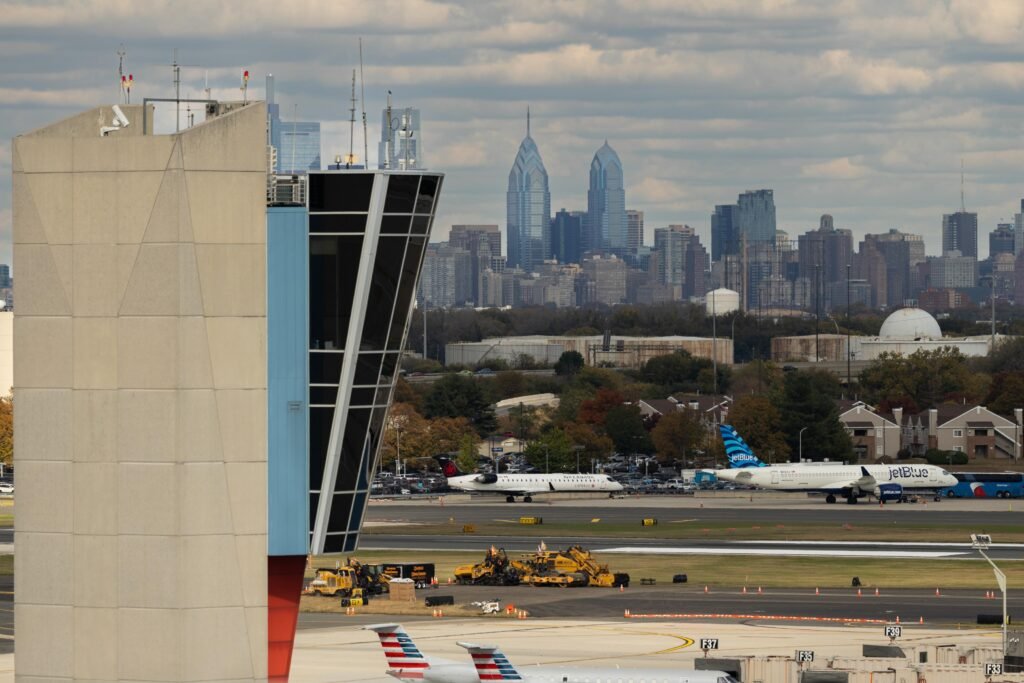
How an Air Traffic Control Outage Grounded US Flights
It takes surprisingly little to paralyze the world’s most sophisticated airspace. On Monday, a single backhoe in New Jersey proved this terrifying reality, triggering a massive air traffic control outage that brought the American Northeast to a grinding halt. Within minutes, the seamless flow of thousands of flights dissolved into chaos.
A major air traffic control outage occurred on Monday after a construction crew in New Jersey accidentally severed a critical Verizon fiber optic cable. This disruption halted communications between key FAA facilities, leading to ground stops at major Northeast airports and causing over 1,000 flight cancellations nationwide.<\/p>
- Physical Vulnerability: A single physical cut to a fiber optic cable in New Jersey paralyzed air traffic control communications across the entire Northeast corridor.
- The Redundancy Myth: Despite multi-million dollar backup systems, the incident exposed a lack of true geographic path diversity in critical aviation telecommunications.
- Interagency Finger-Pointing: Amtrak, New Jersey Transit, and private contractors traded blame over who authorized the excavation that caused the disruption.
Passengers sat stranded on tarmacs. Digital departure boards across the country flashed red. Air traffic controllers suddenly found themselves operating with degraded communication tools. It was a stark, uncomfortable reminder of just how fragile our highly interconnected world really is. We build redundant systems, or so we are told. Yet, a single physical slice through a bundle of glass fibers can still silence the skies.
The Anatomy of an Air Traffic Control Outage
The trouble began in the dirt of New Jersey. A construction crew, operating heavy machinery, dug into the earth and severed a critical Verizon fiber optic cable. This was not just any commercial internet line. It was a primary data artery used by the Federal Aviation Administration (FAA) to coordinate flights across the busy Northeast corridor. The resulting FAA communications failure sent shockwaves through the aviation network.
The fallout was instantaneous. The FAA quickly declared ground stops at the three major New York metropolitan hubs: John F. Kennedy International, LaGuardia, and Newark Liberty International. The ripple effects cascaded westward and southward. When New York stops, the rest of the nation feels the squeeze. According to flight tracking data, more than 1,000 flights were canceled outright, with thousands more delayed.
“We were just sitting at the gate in Boston when the captain came on,” says Marcus Vance, a business traveler caught in the disruption. “He told us the entire New York airspace was essentially blind to certain data feeds. It felt surreal that a local construction mishap in Jersey could keep me from getting to Chicago.”
As the hours ticked by, the backlog grew. What began as a localized issue quickly transformed into a nationwide logistical nightmare. Airlines scrambled to reroute planes, reassign crews, and placate thousands of increasingly angry passengers stranded in terminals from Miami to Los Angeles.
The Blame Game: Trains, Planes, and Backhoes
In the immediate aftermath of the incident, the blame game began in earnest. It was a masterclass in bureaucratic buck-passing. Verizon was quick to wash its hands of the incident. In a statement to CNBC, the telecommunications giant asserted it bore “no responsibility for this incident.” Instead, Verizon pointed the finger squarely at “construction contractors working in the area” who “dug up and cut our cable.”
But who hired those contractors? That is where the story takes an ironic, almost comical turn. Trains, it seems, managed to ground the planes. US Transportation Secretary Sean Duffy initially stated that an Amtrak crew was responsible for the severed line. Amtrak, however, was not about to take the fall. The rail operator quickly issued a counter-statement, shifting the blame to New Jersey Transit.
“This incident occurred on New Jersey Transit property and involved a New Jersey Transit contractor,” an Amtrak spokesperson told NBC4, clarifying their stance. This public squabbling highlighted a deeper issue: the lack of coordination among agencies sharing critical infrastructure corridors.
Railroad right-of-ways are incredibly common corridors for fiber optic cables because they offer long, continuous stretches of land without municipal zoning hurdles. However, this co-location means rail maintenance and telecom maintenance are inherently intertwined. When communication breaks down between these entities, the consequences can be catastrophic for the aviation sector.
The Illusion of Redundancy
Why did a single Verizon fiber cut cause such widespread Northeast flight delays? To understand this, we have to look at how the FAA structures its telecommunications network. The agency relies heavily on the FAA Telecommunications Infrastructure (FTI) program, which is largely outsourced to commercial telecommunications providers.
In theory, these networks are supposed to have built-in redundancy. If Path A is cut, traffic should automatically and seamlessly reroute to Path B. In practice, however, “last-mile” physical redundancy is notoriously difficult and expensive to maintain. Often, even if an organization purchases two separate lines from two different carriers, those lines might still run through the exact same physical conduit under the street. When a backhoe digs up that conduit, both the primary and the “redundant” backup lines are severed simultaneously.
Industry insiders have long warned about this physical-layer vulnerability. “We talk about cloud redundancy and software failovers, but we forget that the internet is ultimately made of physical wires buried in the dirt,” says a senior network architect who spoke on the condition of anonymity. “If you don’t have true physical path diversity—meaning the backup line runs along an entirely different geographic route—you don’t actually have redundancy.”
Comparing Recent Aviation Infrastructure Failures
To put this event into perspective, let us examine how it compares to other major technological failures that have grounded US aviation in recent years. The table below illustrates the vulnerability of our current systems.
| Date of Incident | Primary Cause of Disruption | Scope of Impact | Primary System Affected |
|---|---|---|---|
| January 2023 | Corrupted Database File | Over 10,000 flights delayed/canceled | NOTAM (Notice to Air Missions) |
| December 2022 | Severe Weather & Legacy Software | Over 16,000 flights canceled | Southwest Airlines Crew Scheduling |
| Current Incident | Physical Fiber Optic Cable Cut | Over 1,000 flights canceled; ground stops | FAA Air Traffic Control Communications |
As the data shows, while software glitches and weather are frequent culprits, physical infrastructure damage remains a highly potent threat. The physical vulnerability of our fiber networks represents a critical aviation infrastructure vulnerability that has yet to be fully addressed by federal regulators.
The Economic Toll of a Single Cut
The financial impact of Monday’s disruption will take weeks to fully calculate, but early estimates are staggering. For airlines, a canceled flight is not just lost ticket revenue. It represents a logistical nightmare of displaced aircraft, stranded flight crews who time-out under federal duty-hour limits, and mounting hotel and food voucher expenses for passengers.
According to data from Bloomberg, a single hour of nationwide ground stops can cost the aviation industry tens of millions of dollars. When delays stretch into the evening, the costs compound exponentially as airlines struggle to reset their networks for the following morning.
Furthermore, the incident highlights the broader economic vulnerability of our “just-in-time” transportation network. Modern business relies on the predictable, rapid movement of people and high-value cargo. When a communication failure halts that movement, supply chains stutter, business deals are delayed, and productivity plummets. The cost is borne not just by the airlines, but by the entire economy.
The Regulatory and Political Fallout
Washington is already demanding answers. Transportation Secretary Sean Duffy, while confirming that the lines had been repaired by Monday evening, warned that clearing the backlog of delayed flights would take time. The political pressure on the FAA to address these vulnerabilities is mounting rapidly.
Members of Congress are already calling for hearings into the FAA’s reliance on commercial telecom infrastructure. There is a growing consensus that the agency must do more to audit the physical routing of its critical data lines. Reports from Reuters suggest that lawmakers are considering legislation that would mandate stricter physical redundancy requirements for all critical transportation communication networks.
“We cannot have a situation where a single contractor with a backhoe can shut down the entire Northeast corridor,” said one congressional staffer familiar with the matter. “The FAA needs to prove that its backup systems are truly independent, not just different lines on the same map.”
This incident will likely accelerate calls for the FAA to modernize its communications infrastructure, potentially integrating satellite-based backup systems like Starlink or specialized military-grade wireless networks to act as a tertiary failover when physical fiber lines are compromised.
Lessons from the Dirt
What can other industries learn from this aviation crisis? First, physical security is just as important as cybersecurity. While organizations spend billions of dollars defending against state-sponsored hackers and ransomware attacks, they often neglect the physical security of their fiber paths. A backhoe can be just as destructive as a sophisticated malware strain.
Second, third-party risk management must extend to the physical layer. Companies must demand detailed geographic routing maps from their telecom providers to ensure that their redundant lines do not share a single point of failure. If your primary and backup lines cross the same bridge or run along the same railway track, you do not have a backup plan—you have an illusion.
Ultimately, the New Jersey cable cut is a wake-up call. As we transition to an increasingly digital and automated world, our dependence on physical infrastructure only grows. If we do not invest in true, geographically diverse redundancy, we will remain at the mercy of the next stray shovel.
<button type="button" onclick="this.parentElement.innerHTML='✓ Thank you, we will refine our analysis!‘” style=”background:#ffffff; border:1px solid #cbd5e1; border-radius:6px; padding:4px 12px; font-size:12px; cursor:pointer; color:#334155;”>👎 No
