
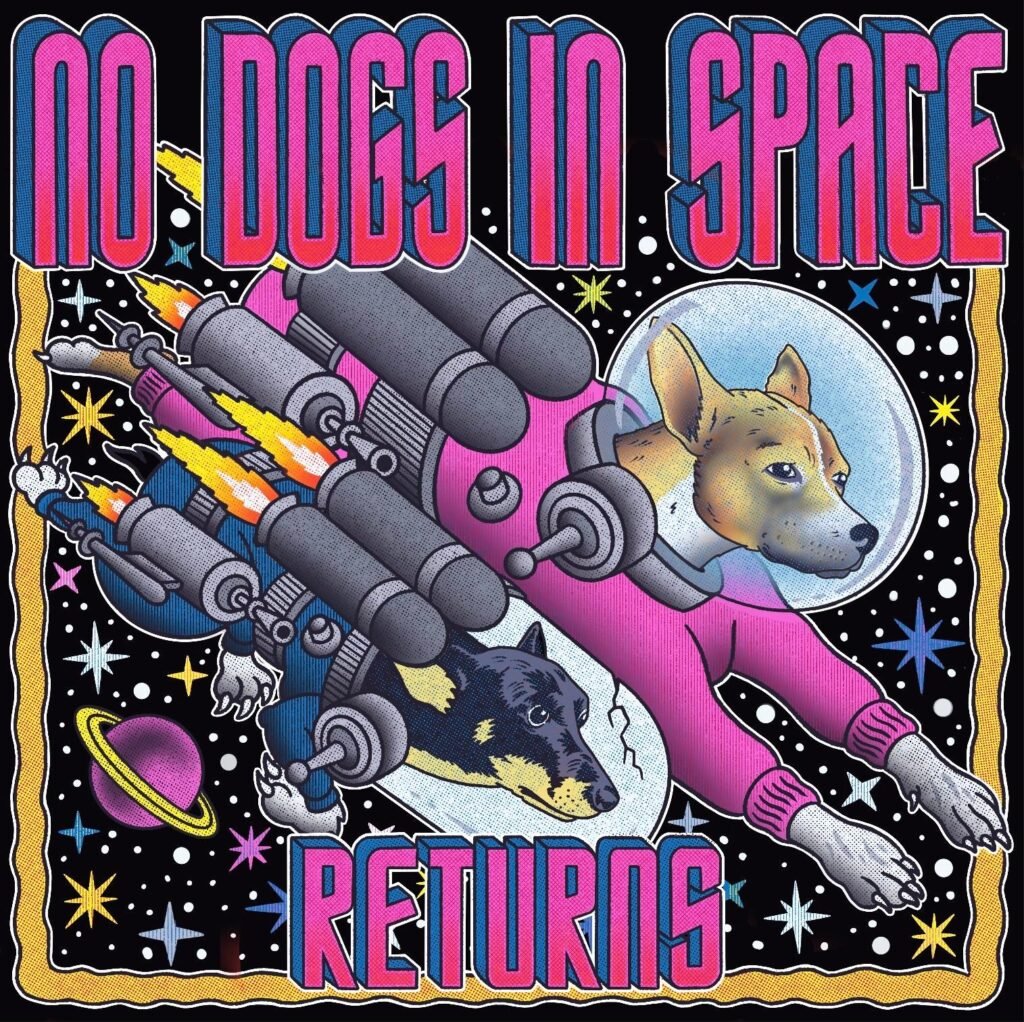
Inside the Revival of the No Dogs in Space Music History Podcast
In an era dominated by bite-sized commentary and algorithmically generated playlists, the return of a dedicated deep-dive music history podcast feels like an act of quiet rebellion. Audiences hungry for substance over soundbites have waited patiently. Now, after a grueling two-year silence, No Dogs in Space has officially returned to the airwaves for its fourth season, dubbed Punk 2.0.
The No Dogs in Space music history podcast is a deep-dive audio docuseries hosted by Marcus Parks and Carolina Hidalgo. Returning after a two-year hiatus with Season 4: Punk 2.0, the show examines subcultural music origins through meticulous archival research, narrative storytelling, and an unyielding focus on foundational rock movements.<\/p>
- Return to Core Strengths: Season four re-centers the podcast on punk rock history following experimental explorations into global art-rock.
- Rigorous Editorial Curation: Over eight months of research into D.C. hardcore were scrapped due to ethical conflicts and narrative bloat, yielding a standalone Link Wray project instead.
- Obsession as Methodology: Hosts Marcus Parks and Carolina Hidalgo credit their recent autism diagnoses with driving their hyper-focused archival technique.
- Multi-Platform Expansion: The show expands into full-length visual episodes on YouTube alongside classic audio RSS feeds.
Co-hosts Carolina Hidalgo and Marcus Parks built a dedicated global following by rejecting superficial retrospectives. They don’t just recap discographies. They dissect subcultures, map sociological landscapes, and trace forgotten artistic lineage. Their grand return launches with a multi-part exploration of the New York Dolls series, bringing the show back to the greasy, glitter-streaked cradle of protopunk.
The Long Silence: Why Deep-Dive Music Journalism Takes Time
Patience is rarely rewarded in modern digital publishing. Audiences expect relentless weekly content streams, yet high-caliber investigative audio requires immense lead time. According to continuous industry tracking by Reuters, digital media consumers are increasingly favoring long-form narrative podcasts over rapid news summaries. Hidalgo and Parks learned this lesson the hard way during their previous deep dive into German experimental rock.
Translating esoteric German texts and tracking down archival bootlegs exhausted the team. Realization struck hard. Behind the dense intellectualism of mid-century experimental movements lay a universal truth: most subcultural revolutions begin with art school kids simply messing around with equipment. To recapture their original momentum, the creators realized they needed to strip away excessive artifice and anchor themselves back in their native domain.
“We realized that what we do best is tell a punk story. Not the punk story, but a punk story. That’s where the most compelling narrative tension lives.” — Marcus Parks
Returning to raw punk rock history wasn’t merely a strategic pivot. It was an intellectual recalibration. But getting Season 4 off the ground proved to be a grueling process filled with editorial speedbumps, ethical dilemmas, and dead ends.
The D.C. Hardcore Ambush: Ethics, Bloat, and Editorial Discipline
Before selecting the New York Dolls as their triumphant launchpad, the duo spent over half a year attempting to map out the legendary Washington D.C. hardcore movement. It seemed like an obvious fit. The D.C. scene remains legendary for its fiercely independent ethos, political consciousness, and sonic intensity. Yet, six months into production, the narrative began to unravel under close scrutiny.
The initial plan called for kicking off the arc with a deep profile of Bad Brains, the all-Black punk trailblazers who redefined speed and precision. However, as Hidalgo dug through primary sources, direct interview transcripts, and historical accounts, unvarnished realities clashed with contemporary editorial ethics. The band’s historical record contained deeply entrenched, fire-and-brimstone homophobia.
Subcultural figures are rarely saints. The hosts were accustomed to handling problematic personalities across rock history. But spending hundreds of script hours platforming views that directly alienated their audience proved demoralizing. Ethics wasn’t the only roadblock; structural scope was equally chaotic.
When Scenery Outgrows the Stage
When the hosts tried to broaden the project into an all-encompassing chronicle of Washington D.C. sound, the story exploded outward. You cannot explain D.C. punk without understanding Go-Go music, the godfather Chuck Brown, or the radical broadcast programming of Georgetown University’s WGTB radio station. Every thread demanded its own documentary series.
- 6+ Months: Time spent drafting and scripting the initial D.C. hardcore outline.
- Narrative Bloat: Secondary influences threatened to overshadow the primary punk core.
- Ethical Conflicts: Severe thematic friction regarding early band ideologies.
- Decisive Action: Scrapping eight months of completed research to protect editorial integrity.
Admitting defeat after eight months of intensive labor requires rare discipline. Many media outlets would have published a half-baked compromise. Hidalgo and Parks killed the project. The effort was not a total loss, however; their deep dive into early roots yielded a standalone, two-part series on rock pioneer Link Wray, set to air later this year.
Subcultural Archeology: Uncovering the Forgotten Threads of Protopunk
What makes a compelling music journalism podcast? It isn’t just reciting chart numbers or recording dates. It is the obsessive detour down historical rabbit holes that mainstream historians ignore completely.
During their research for the New York Dolls narrative, both hosts discovered bizarre, overlooked catalysts that completely reframed early 1970s aesthetics. For Hidalgo, that meant an obsession with Mott the Hoople. Best known for their David Bowie-penned anthem “All the Young Dudes,” the group’s origins were far more grounded. Lead vocalist Ian Hunter was literally digging ditches for a living before an unexpected phone call summoned him to front an underperforming garage group. That blue-collar grit laid vital groundwork for glam’s dirty underbelly.
Jackie Curtis and the Visual Genesis of Punk
Meanwhile, Parks locked onto dynamic underground figure Jackie Curtis, a trailblazing drag queen, playwright, and Andy Warhol superstar. While history routinely credits musicians like Richard Hell with inventing the torn-shirt, safety-pin aesthetic, evidence suggests the visual identity actually originated in Curtis’s theatrical wardrobe.
In one astonishing archival account unearthed during research, Curtis was described climbing out onto an exterior apartment window ledge—moving meticulously like Batman—to slip into a recently deceased neighbor’s apartment and claim her vintage wardrobe before the coroner arrived. These unhinged moments of human desperation and artistic flair define the spirit of early protopunk.
Hyperfixation as a Research Methodology
The secret weapon of No Dogs in Space lies within the hosts’ psychological wiring. Both Parks and Hidalgo recently revealed adult diagnoses of autism, shedding light on their relentless, hyper-focused approach to historical archival work. What mainstream media might dismiss as inefficient obsession is, for them, a fundamental journalism tool.
| Season Theme | Research Phase Duration | Primary Historical Lens | Core Distribution Outlets |
|---|---|---|---|
| Season 1: Punk Origins | 3–4 Months | Early UK & US Hardcore Pioneers | Audio RSS feeds (Apple/Spotify) |
| Season 2: Post-Punk | 5–6 Months | Goth, Industrial, and New Wave Transition | Audio RSS feeds (Apple/Spotify) |
| Season 3: Krautrock | 8+ Months | German Experimental Art-Rock & Avant-Garde | Audio RSS feeds (Apple/Spotify) |
| Season 4: Punk 2.0 | 8 Months (Scrapped) / Ongoing | Protopunk, Glam & Foundational Rock Archeology | Audio RSS + Full Video on YouTube |
To pull context out of chaotic history, one must live in a continuous state of fixation. That level of dedication cannot be faked. It shows up in the scripts, the audio clips, and the seamless contextual leaps that bring decades-old subcultures back to life for modern ears.
Visual Audio: Expanding into the YouTube Era
The return of the show also marks a major technological shift in distribution strategy. While the podcast landscape was traditionally defined strictly by RSS feeds and digital audio workstations, audience consumption habits have fundamentally shifted toward video platforms. Industry data continuously monitored by Bloomberg highlights that video-first podcast consumption on YouTube now accounts for over forty percent of total audience engagement across long-form digital shows.
Season 4 adapts to this modern landscape by broadcasting full visual episodes on YouTube alongside its legacy audio feeds. Adding a visual layer allows the hosts to showcase rare archival photography, vintage album sleeves, and historical concert footage in real-time, elevating the narrative experience without sacrificing intellectual rigor.
The Verdict: Why Meticulous Audio Storytelling Still Matters
In an ecosystem littered with superficial reaction videos and hastily generated content, No Dogs in Space proves that audiences still value passion, intellectual rigor, and editorial honesty. By acknowledging their research missteps and refusing to publish sub-par narratives, Carolina Hidalgo and Marcus Parks have set a high benchmark for independent digital media.
Whether you begin your journey with their legendary archives on Joy Division, The Replacements, and Dead Kennedys, or jump directly into the glitter and grime of the new New York Dolls series, one truth remains clear: true subcultural history demands obsession. Thankfully, this duo has obsession to spare.
<button type="button" onclick="this.parentElement.innerHTML='✓ Thank you, we will refine our analysis!‘” style=”background:#ffffff; border:1px solid #cbd5e1; border-radius:6px; padding:4px 12px; font-size:12px; cursor:pointer; color:#334155;”>👎 No
