
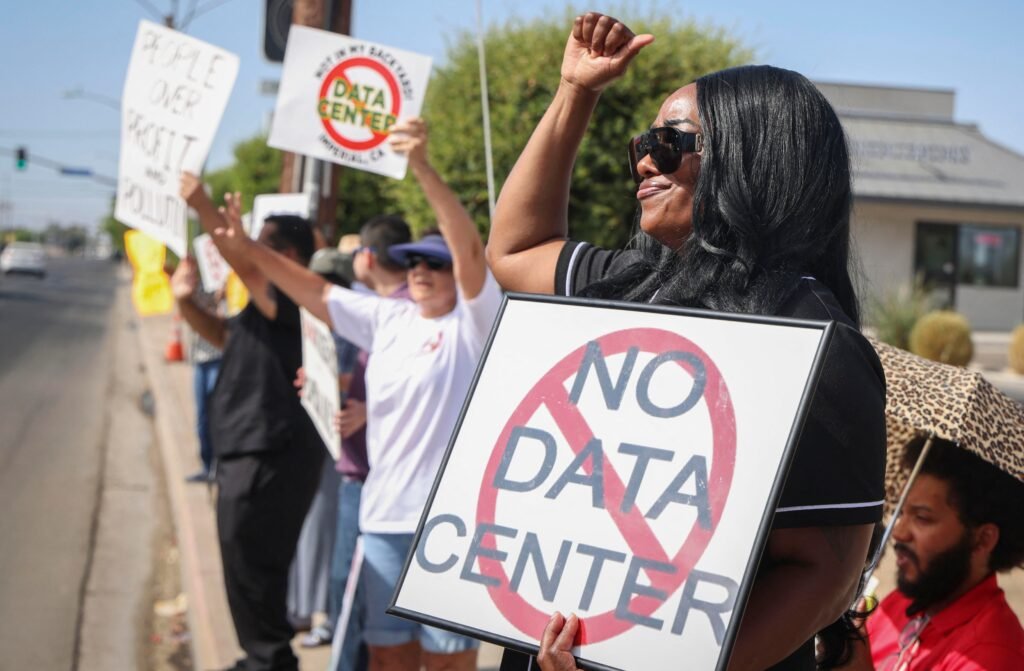
California Enforces Strict AI Data Center Energy Rules
California Governor Gavin Newsom has signed a sweeping, seven-bill legislative package establishing stringent AI data center energy rules designed to shield everyday consumers from escalating utility costs and localized resource depletion. The new statutory framework shifts the financial burden of massive power and water infrastructure upgrades directly onto technology developers. As artificial intelligence models demand exponentially more electricity, Sacramento is signaling that Big Tech’s computational boom will no longer be subsidized by public infrastructure or residential taxpayers.
California's new legislative framework enforces strict AI data center energy rules, requiring technology companies to fund utility grid upgrades, disclose water usage, and meet strict efficiency standards. The laws establish a separate utility rate class to prevent commercial tech expansion from shifting infrastructure costs onto residential utility customers.<\/p>
- Infrastructure Funding Shift: Hyperscale developers must now directly fund local grid and water infrastructure upgrades required by their facilities.
- New Rate Classifications: The CPUC is mandated to create distinct utility pricing structures to isolate high-density computing loads from residential ratepayers.
- Environmental Transparency: Mandatory disclosures covering estimated water volume, efficiency metrics, and drought preparedness are now required for local permitting.
- Streamlined Permitting Requirements: Expedited approval tracks are strictly tied to stringent water conservation, fuel efficiency, and clean power operational targets.
The policy overhaul comes amid mounting national anxiety over electric grid stability. Generative AI clusters consume vastly more power per square foot than traditional cloud storage facilities. Without intervention, state regulators warned, the rapid proliferation of server farms threatened to destabilize local electrical distribution networks and force severe utility rate hikes on working-class communities across the state.
The Escalating Strains of Generative Compute
The math behind modern artificial intelligence is as brutal as it is invisible. Training a single frontier neural network requires tens of thousands of specialized graphics processing units running continuously for months. These hyperscale deployments draw megawatt quantities that dwarf the energy footprint of standard industrial facilities. Silicon Valley’s unyielding pursuit of larger context windows and real-time multimodal reasoning has triggered a gold rush for raw power, straining electric utilities from the Central Valley to the Bay Area.
Until now, utility infrastructure expansion operated on an aggregated cost-sharing model. When a new industrial customer entered a municipal service area requiring massive substation overhauls or line reinforcements, regional utilities routinely absorbed those capital expenses into their broad asset base. Eventually, those costs filtered down into monthly electric bills for residential households. California’s new laws dismantle that legacy structure completely.
“With these laws, we are ensuring that Californians remain in the driver’s seat — and that those profiting from data centers aren’t doing so at our expense,” Newsom stated during the signing announcement.
According to coverage by Reuters, the unprecedented surge in commercial power demand has forced regulatory agencies nationwide to re-evaluate legacy utility structures. California’s legislative intervention establishes a clear legal boundary: tech firms seeking gigawatt-scale operations must pay their own way.
Breaking Down California’s New AI Data Center Energy Rules
The legislative package signed by Governor Newsom targets the lifecycle of data center development across multiple fronts. Rather than issuing a single blanket mandate, Sacramento enacted seven distinct statutes working in tandem to regulate power procurement, environmental reporting, and ratepayer protections.
1. Dedicated Utility Rate Classifications
At the core of the package is a directive requiring the California Public Utilities Commission (CPUC) to establish a dedicated electricity rate class tailored exclusively for high-density computing centers. This mechanism ensures that the long-term capital investments required to serve massive compute loads are segregated from standard commercial and residential rate pools. If an AI provider requires grid expansion, the capital costs are isolated within that high-density billing category.
2. Mandatory Grid and Water Infrastructure Funding
The legislation forces data center developers to enter direct financial binding agreements to cover all necessary off-site infrastructure upgrades. This includes high-voltage transmission lines, local electrical substations, water pipeline extensions, and municipal wastewater treatment augmentations needed to support heavy facilities. Local governments will no longer be forced to issue municipal bonds or deplete reserves to accommodate corporate expansion.
3. Conditional Fast-Track Permitting
Recognizing the fast-moving competitive nature of the technology sector, the package retains an expedited state permitting option for developers—but converts it into an earned privilege. To quality for streamlined municipal approvals, proposed projects must satisfy uncompromising baselines for continuous power efficiency, zero-carbon energy integration, and extreme water conservation measures.
Water Rights and the Evaporative Cooling Dilemma
Power consumption represents only half of the environmental equation. Modern high-density server racks generate immense thermal loads. While direct-to-chip liquid cooling is gaining adoption, many commercial facilities still rely on massive evaporative cooling towers. These systems vaporize millions of gallons of potable water daily to maintain optimal operating temperatures for processing hardware.
In a state repeatedly battered by megadroughts and severe hydrologic swings, unmonitored data center water consumption poses an acute threat to regional water districts. The newly enacted statutes close historical regulatory loop-holes that allowed facility developers to secure industrial water hookups without detailed municipal scrutiny.
- Mandatory Usage Forecasts: Developers must submit audited, long-term water volume projections to local planning boards prior to zoning review.
- Drought Contingency Protocols: Facilities must demonstrate operational resilience under dry-year conditions, including mandatory secondary non-potable or recycled water integration options.
- Air Quality Protections: The legislation mandates strict monitoring of emergency backup diesel generators, preventing operators from bypassing local air quality rules during power curtailment events.
By forcing transparency before ground is broken, local water districts gain the legal authority to reject or modify development proposals that endanger community water security.
Regulatory Comparison: Past Practices vs. New Standards
To understand the profound shift in state oversight, it is helpful to contrast how data center proposals were evaluated previously against the mandatory standards established by this legislative package.
| Regulatory Metric | Previous Regulatory Framework | New Legislative Framework |
|---|---|---|
| Infrastructure Costs | Absorbed into general utility rate base and shared among customers. | 100% funded directly by data center developers and operators. |
| Utility Rate Structure | Standard commercial or large industrial tariff brackets. | Dedicated CPUC high-density compute rate classification. |
| Water Disclosures | Standard municipal commercial water permits with minimal reporting. | Mandatory multi-year water usage disclosures & drought plans. |
| Permit Acceleration | Granted based on economic development promises. | Strictly contingent on meeting clean energy and water metrics. |
| Grid Impact Oversight | Reactive utility adjustments following interconnect requests. | Proactive, localized grid load assessments prior to construction. |
Sacramento vs. Washington: The Politics of Grid Protection
The timing of California’s policy framework highlights a widening political chasm between state action and federal directives. While federal policy maneuvers toward broad deregulation to accelerate domestic computing supremacy, California is fortifying state-level environmental and ratepayer protections.
Recent reporting from Bloomberg underscores that tech companies are actively lobbying federal agencies for direct access to nuclear plants and fossil-fuel power facilities to bypass localized permitting bottlenecks. Governor Newsom explicitly pointed to this federal dynamic, framing California’s legislative response as an essential shield for local communities.
Building sustainable California grid infrastructure requires balancing rapid technological adoption against finite physical resources. Sacrificing environmental protections or shifting financial liability onto residents to win an infrastructure race creates severe long-term economic instability. By establishing firm legal parameters, California is positioning itself as a model for how state governments can manage high-growth tech industries without compromising public welfare.
Hyperscaler Operations and the Threat of Capital Flight
Whenever a state enacts tough regulations on industry, the immediate counterargument from corporate trade groups is capital flight. Representatives for technology coalition groups argue that stringent regional rules will force major developers to build their multi-billion-dollar campuses in neighbor states like Nevada, Arizona, or Oregon, where permitting cycles are faster and environmental oversight is less restrictive.
However, industry analysts suggest that California retains unique operational advantages that insulate it from an immediate exodus:
- Proximity to AI Innovation Hubs: The vast majority of leading AI research labs, engineering talent, and venture capital remain firmly rooted in San Francisco and Silicon Valley.
- Latency Demands: Real-time inference applications require physical infrastructure located close to end-user clusters to minimize data latency times.
- Ultra-High-Density Fiber: California possesses some of the dense long-haul fiber-optic corridors in North America, connecting coastal hubs directly to transpacific subsea cables.
Rather than leaving the state entirely, hyperscalers will likely adjust their architectural deployment strategies. Training facilities—where data processing latency is less critical—may be built in region with abundant cheap energy. Conversely, real-time inference clusters will continue to be sited inside California, operating under the state’s new compliance and cost-recovery mandates.
The Safety Parallel: Emergency Protocols and Kill Switches
California’s regulatory focus extends beyond physical power lines and water pipes. Alongside the seven-bill legislative package, Governor Newsom signed an executive order directing state agencies to accelerate the implementation of emergency safety measures, often colloquially referred to as AI emergency shutoffs or "kill switches."
This dual-track approach highlights a comprehensive philosophy toward tech governance. Sacramento views physical infrastructure limits and operational safety frameworks as two sides of the same coin. As model capability scales, the potential risks—ranging from localized electrical blackouts to rogue autonomous digital agents—require state authorities to possess clear, enforceable intervention mechanisms.
Key Provisions of the Infrastructure and Safety Push:
- Establishing standardized emergency power load-shedding protocols for computing clusters during grid crises.
- Mandating audited safety protocols for advanced AI systems before public deployment.
- Creating formal coordination frameworks between grid operators, tech developers, and emergency services.
Enforcing Clean Energy Mandates in a Power-Hungry Era
California has committed to achieving a 100% clean, zero-carbon electricity grid by 2045. The sudden rise of generative AI introduces a major variable into that transition. If server farms meet their immense power requirements by drawing electricity from natural gas peaking plants during high-demand hours, the state’s decarbonization timeline could stall.
The new legislative package aligns data center growth directly with California’s aggressive clean energy mandates. By conditioning fast-track development approvals on zero-carbon power procurement and energy storage integration, state lawmakers are turning tech capital into a potential catalyst for renewable energy deployment. Developers seeking fast approvals are increasingly incentivized to construct dedicated solar, wind, and battery storage installations alongside their processing sites.
What This Means for Big Tech’s Bottom Line
For hyperscale operators like Microsoft, Google, Meta, and Amazon, the era of frictionless server expansion in California is over. Capital expense budgets for new construction projects in the state will need to increase significantly to account for required grid construction, water recycling hardware, and specialized rate tariffs.
However, this legislative clarity brings an unexpected benefit: predictability. Clear rules reduce legal ambiguity and local zoning delays. Developers who comply with established environmental and utility standards gain a clean, legally sound path to completion without facing endless municipal lawsuits or retroactive regulatory changes.
California’s proactive legislation marks a historic turning point in the governance of artificial intelligence. By refusing to let hyperscale developers pass their true operational costs onto everyday citizens, the state has set a definitive standard for sustainable technology development. As other states grapple with the escalating resource demands of the digital economy, California’s framework provides a concrete blueprint for balancing technological leadership with civic responsibility.
<button type="button" onclick="this.parentElement.innerHTML='✓ Thank you, we will refine our analysis!‘” style=”background:#ffffff; border:1px solid #cbd5e1; border-radius:6px; padding:4px 12px; font-size:12px; cursor:pointer; color:#334155;”>👎 No
