
Tesla Flying Car: Reality or Elon Musk’s Wildest Spectacle?
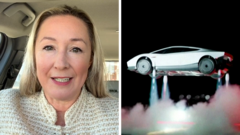
In a late-night spectacle at a SpaceX facility deep in the heart of Texas, the long-promised, perpetually delayed Tesla flying car concept finally made a physical leap off the pages of science fiction. Smoke billowed. Compressors roared. Before a crowd of bewildered spectators, a modified prototype of the next-generation Roadster accelerated up a steep ramp, hovered several feet off the pavement, executed a tight mid-air rotation, and touched down on its high-performance rubber.
The Tesla flying car is a conceptual variant of the next-generation Roadster that utilizes ultra-high-pressure SpaceX cold-air thrusters to briefly hover and maneuver above the ground. Despite dramatic physical demonstrations, commercial production remains blocked by stringent aviation regulations, safety hazards from high-pressure discharge, severe battery weight constraints, and unestablished low-altitude airspace frameworks.<\/p>
- SpaceX Integration: The levitation mechanism relies on composite overwrapped pressure vessels firing compressed air, taking cues from rocket landing thrusters.
- Regulatory Deadlock: Dual oversight by the FAA and NHTSA creates unprecedented legal hurdles for dual-mode ground and air passenger vehicles.
- Economic Distraction: Analysts view the flashy demonstration as a strategic lever to bolster investor sentiment amidst tightening automotive profit margins.
- Physics Bottleneck: Severe energy density limitations dictate that hovering durations will be measured in fleeting seconds rather than viable transit times.
“You’re going to see some crazy stuff tonight,” Chief Executive Officer Elon Musk shouted over the deafening hiss of high-pressure air systems. Sensing immediate skepticism across digital feeds, Musk was quick to insist that a live audience was mandatory to prove the demonstration “is not AI.”
Yet, behind the dramatic lights and rocket-fueled hyperbole lies a complex reality. The spectacle served as a powerful reminder of Musk’s unmatched ability to capture global media attention. But beneath the surface, engineers, legal scholars, and automotive financial analysts are asking the hard question: Did Tesla genuinely redefine transportation, or did it merely stage the world’s most expensive levitation stunt?
SpaceX Rocket Physics Meets Street Asphalt
The engineering philosophy behind this aerial maneuver isn’t based on anti-gravity magic. It relies on cold-air propulsion. By replacing the rear seats with ultra-high-pressure composite overwrapped pressure vessels (COPVs)—the very same pressure tanks deployed in SpaceX rockets—the vehicle channels compressed air through specialized nozzles hidden behind the license plate and under the chassis.
This application of hover vehicle technology generates immense downward and directional thrust. It is brute force physics. Pushing thousands of pounds of high-capacity lithium batteries into the air requires an instant, massive burst of energy. According to preliminary engineering calculations, the air jet system discharges force equivalent to small rocket thrusters, creating a temporary pocket of lift powerful enough to counteract gravity.
“To lift a heavy electric vehicle off the ground using cold-air thrusters demands force that pushes pneumatic technology to its absolute physical limits. It is a stunning display of mechanical force, but converting a few seconds of compressed-air levitation into a usable, safe commuting platform is a fundamentally different challenge.”
— Dr. Aris Thorne, Senior Aerodynamics Researcher
Unlike conventional electric vertical takeoff and landing (eVTOL) craft that rely on distributed electric rotors, Tesla’s system uses pure pneumatic force. It is loud. It is violent. It is brief. The energy required to keep a two-ton electric sports car airborne drains onboard pressure reserves within seconds, requiring high-power internal pumps to recharge the tanks before another jump can occur.
The Economic Engine Behind the Spectacle
Why showcase a hovering car now? To understand the timing, one must look closely at Tesla’s financial backdrop. The global EV sector is experiencing intense competitive pressure. Profit margins across the industry have tightened as traditional automakers scale up production and nimble overseas manufacturers push aggressive price cuts.
Investors closely monitor automotive revenue metrics via authoritative financial tracking on Reuters automotive analysis reports. Against this tense financial environment, dramatic technical reveals act as powerful narrative shifts. They reframe Tesla not merely as an automobile manufacturer fighting for market share, but as an futuristic technology incubator.
Wall Street’s reaction to the stunt was characteristically split. Optimists view the technology as a cross-industry breakthrough that elevates the brand far above its peers. Skeptics, however, warn that high-profile science projects risk distracting capital and engineering talent away from core manufacturing goals, affordable vehicle platforms, and battery supply chain resilience.
How Tesla’s Concept Compares to the Field
To evaluate where this technology sits within the broader mobility landscape, it helps to analyze performance targets against both high-end electric vehicles and dedicated urban air mobility craft.
| Vehicle Concept | Primary Propulsion | Hover / Flight Capability | Targeted Speed / Acceleration | Primary Regulatory Body |
|---|---|---|---|---|
| Tesla Roadster (SpaceX Package) | Cold-Air Pneumatic Thrusters + Electric Motors | Short Bursts (Pneumatic Hover) | 0-60 mph in < 1.0 sec (Claimed) | NHTSA & FAA (Dual Jurisdiction) |
| Standard High-End EV | Dual / Tri Electric Motors | None (Ground Driven) | 0-60 mph in 1.9 – 3.0 sec | NHTSA / EASA |
| Commercial eVTOL (e.g., Joby) | Distributed Electric Tilt-Rotors | Continuous Atmospheric Flight | 150 – 200 mph Cruise | FAA Aviation Certification |
This comparison highlights the fundamental identity crisis of the hovering Roadster. It is neither a pure road car nor a practical aircraft. Instead, it occupies an entirely unclassified middle ground that sits directly in the crosshairs of federal regulators.
The Dual-Agency Nightmare: FAA vs. NHTSA
Even if Tesla solves the extraordinary physics required to sustain flight, the regulatory framework governing transportation presents an almost insurmountable wall. In the United States, motor vehicles are governed by the National Highway Traffic Safety Administration (NHTSA), while aircraft fall under the federal domain of the Federal Aviation Administration (FAA).
Combining these two legal regimes creates unprecedented friction around EV market regulation. Consider the practical reality of operating a pneumatic air thruster system on a public street:
- Pedestrian Hazards: High-pressure pneumatic discharges capable of lifting a car can launch loose gravel, pavement debris, and dust at dangerous velocities, posing severe risks to bystanders and nearby vehicles.
- Acoustic Limits: The sound pressure level generated by supersonic compressed air discharge far exceeds urban noise pollution standards set by municipal codes.
- Airspace Management: Operating a airborne vehicle—even three feet off the asphalt—technically enters regulated low-altitude airspace, triggering complex safety rules regarding flight paths, pilot licensing, and air traffic control communication.
- Structural Safety Standards: Integrating compressed gas vessels capable of holding thousands of pounds per square inch requires rigorous crash-testing to guarantee the tanks will not rupture during a highway collision.
A vehicle designed for highway safety must deform to absorb impact energy. Conversely, high-pressure air tanks must remain rigid to avoid explosive structural failure. Resolving these opposing engineering imperatives within a consumer automobile remains an extraordinary regulatory challenge.
The Physics Wall: Energy Density and Hover Vehicle Technology
To understand why flying cars remain a distant promise, one must examine energy storage density. Lithium-ion battery packs are heavy. While battery development has improved rapidly over the past decade, gasoline and aviation fuels still store significantly more energy per unit of weight.
When a standard electric car accelerates along a road, its tires leverage friction to push against the pavement. The ground bears the weight of the vehicle. However, the moment a vehicle attempts to hover, the propulsion system must directly support every single pound of structural mass against the pulling force of gravity.
Energy consumption rises exponentially during hovering maneuvers. Analysis of clean energy storage systems published by Bloomberg energy intelligence underscores that current battery architectures are optimized for sustained horizontal rolling resistance, not vertical levitation. Until solid-state batteries or alternative power sources deliver dramatic leaps in power-to-weight ratios, pneumatic hover thrusters will remain constrained to brief, high-intensity tricks rather than sustained travel options.
Safety, Insurance, and Street Reality
Beyond legal certification and basic physics, the practical reality of daily ownership introduces massive logistics issues. Who insures a dual-use hovering vehicle? How are liability claims handled if a pneumatic blast damages a neighboring car in a grocery store parking lot?
“Underwriters assess risk based on predictable historical data. A commercial passenger vehicle capable of unpredictable vertical maneuvers breaks every actuarial model we currently use. The insurance premiums alone for such a platform would likely match the cost of the vehicle itself.”
— Financial Risk Analyst
Furthermore, maintenance protocols for ultra-high-pressure gas systems require specialized technicians, rigorous periodic testing, and certified safety inspections. These requirements mirror military aviation standards far more than traditional auto repair shop practices.
Marketing Triumph or Engineering Future?
Despite the steep obstacles, dismissive skepticism would miss a broader point. Tesla has made a history out of pursuing targets that industry experts deemed impossible. The original Roadster challenged the notion that electric cars were inherently slow golf carts. The Supercharger network disproved claims that long-distance electric travel was impractical.
The SpaceX-infused Roadster prototype proves that cross-pollination between aerospace research and automotive design can produce astounding technical spectacles. Pushing engineers to solve extreme mechanical problems often leads to valuable technological offshoots—such as improved thermal management, advanced carbon-composite pressure vessels, and refined power electronics—which eventually trickle down into mass-market vehicles.
However, consumer expectations must be tempered with reality. A vehicle that can hover briefly over a Texas runway inside a controlled test facility is a far cry from a street-legal automobile sitting in a suburban garage.
The Long Horizon of Urban Flight
The vision of soaring over congested urban traffic remains one of humanity’s most persistent technological dreams. Tesla’s Texas demonstration offered a thrilling, noisy glimpse of what high-energy pneumatic thrusters can achieve when pushed to the absolute edge of performance.
Yet, the pathway from a dramatic prototype to certified commercial reality requires far more than engineering ambition. It demands completely overhauled legal frameworks, unprecedented municipal coordination, major battery breakthroughs, and rigorous safety protocols to protect the public. For the foreseeable future, the Tesla flying car will remain an extraordinary engineering showcase—an incredible triumph of modern showmanship and raw pneumatic physics, but one that is destined to keep its wheels firmly on the pavement for a long time to come.
<button type="button" onclick="this.parentElement.innerHTML='✓ Thank you, we will refine our analysis!‘” style=”background:#ffffff; border:1px solid #cbd5e1; border-radius:6px; padding:4px 12px; font-size:12px; cursor:pointer; color:#334155;”>👎 No
