
Protests Across France: Nearly 1,000 Arrested in New Clashes
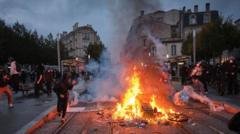
A heavy pall of tear gas drifted past the Haussmann-style facades of Paris on Saturday night as protests across France culminated in violent clashes between radicalized demonstrators and security forces. What began during the daylight hours as a disciplined mobilization of hundreds of thousands of citizens turned into chaotic urban warfare after dark. Across the nation, law enforcement officers detained nearly 1,000 people, struggling to maintain control over a population increasingly inflamed by a worsening cost of living crisis and perceived political abandonment.
Recent protests across France led to nearly 1,000 arrests following widespread demonstrations driven by rising living costs, decaying public services, and government reforms. Despite decrees restricting unapproved marches, heavy clashes erupted between radicalized activists and over 70,000 deployed officers across major cities, including Paris, Marseille, and Bordeaux.<\/p>
- Mass Arrests: French authorities detained nearly 1,000 individuals late Saturday after violent skirmishes fractured otherwise peaceful marches.
- Economic Drivers: Demonstrators are voicing fierce opposition to the ongoing cost of living crisis, stagnant wages, and underfunded state schools.
- Heavy Security Footprint: The interior ministry deployed 70,000 French riot police and elite counter-terrorism units to control urban centers.
- Wider European Unrest: Parallel economic protests triggered tear gas deployments and security lockdowns in Albania, Belgium, and Italy.
By late Saturday, the French Interior Ministry estimated that roughly 410,000 people had marched across various municipalities, while union leaders claimed the true figure neared 800,000. While these numbers fall slightly below the high-water mark of previous weekends, the sheer hostility on the ground signals a dangerous shift in the public mood. The state responded with overwhelming muscle: 70,000 security personnel were positioned across strategic hubs, armed with water cannons, armored assault vehicles, and tactical crowd-control ordnance.
Paris Under Siege: Inside the Clashes and Mass Arrests
The capital bore witness to the most complex tactical standoff. A peaceful procession led by organized labor unions departed from the Porte d’Italie earlier in the day, moving in orderly columns under union banners. However, as the tail of the march approached Porte de Vincennes, the atmosphere transformed. Hundreds of black-clad, masked activists—identified by authorities as radical black-bloc groups—infiltrated the rear of the march, sparking sudden and severe violence.
Skirmishes broke out with astonishing speed. French riot police, reinforced by elite tactical units typically reserved for organized crime and counter-terrorism operations, formed aggressive cordon lines. Groups of young protesters pelted law enforcement with paving stones, pyrotechnics, and glass bottles. In response, officers charged with batons raised, firing barrage after barrage of tear gas canisters that enveloped entire city blocks in thick, suffocating smoke.
“They keep us quiet. They take our money, they tax us heavily, and we are left with zero agency,” said Zelie, a 26-year-old Paris demonstrator. “Today we take to the streets because it has simply been too much for too long.”
On nearby side streets, teams of masked youths smashed the reinforced glass display windows of an auto dealership and ignited fires in commercial trash receptacles. Officers trapped small pockets of demonstrators against shopfronts, executing targeted snatch-and-grab arrests. Interior Minister Laurent Nuñez confirmed that hundreds of fast-track judicial hearings were already underway to process those caught committing acts of vandalism, arson, or assault against public officers.
The Burning Streets of Marseille and Beyond
The unrest was far from isolated to the capital. In the southern port city of Marseille, the situation rapidly dissolved into running street battles. Protesters constructed makeshift barricades from steel construction fencing, wooden pallets, and dumpster bins, setting them ablaze to block major arterial roads. French television cameras captured the dramatic moment a heavy law enforcement vehicle sped directly through a roaring wall of fire to disperse crowds gathered near the historic old port area.
In Bordeaux, a city noted for its high-end commercial districts, dark-clothed agitators tore protective wooden boarding off commercial storefronts to feed street bonfires and assemble defensive walls against charging police units. Further east in Lyon, France’s third-largest city, prefectural authorities declared central shopping zones off-limits ahead of time. When a crowd of roughly 150 high school and university students attempted to assemble inside the restricted perimeter, riot police deployed tear gas almost instantaneously.
“We were just standing together, mostly students,” explained one young demonstrator in Lyon. “The tear gas canisters landed right at our feet within minutes. You literally could not see five feet in front of you.”
The human toll of the weekend was severe. Aside from the hundreds of arrests, Nuñez acknowledged that two individuals suffered catastrophic injuries during the riots—one in the south-western city of Toulouse and another in Clermont-Ferrand. These incidents follow last week’s horrific injury where a demonstrator lost a hand to a explosive crowd-control grenade, underlining the dangerous escalation of force on both sides of the barricades.
Protests Across France by the Numbers
To understand the sheer scale of the disruption gripping the country, analyzing the comparative data between recent weekend demonstrations reveals an unprecedented strain on municipal infrastructure and public finances. According to figures compiled from government statements and the France Chambers of Commerce and Industry (CCI), the economic fallout has crossed into catastrophic territory.
| Metric / Data Point | Previous Weekend Peak | Current Mobilization | Primary Regional Impact |
|---|---|---|---|
| Demonstrator Turnout (Govt / Union) | 550,000 / 1,200,000 | 410,000 / 800,000 | Paris, Marseille, Lyon, Bordeaux |
| Law Enforcement Deployment | 85,000 Officers | 70,000 Officers | Nationwide (Focus on Urban Cores) |
| Total Arrests Made | 2,500+ Detained | 950+ Detained (Rising) | Paris (300+), Marseille, Bordeaux |
| Commercial Impact (Damaged Sites) | Over 2,000 Businesses | Estimated 400+ Businesses | High-End Retail & Dealerships |
| Estimated Financial Damage | €250 Million+ | €60 Million+ (Preliminary) | National Retail & Public Transport |
While the overall turnout dipped slightly compared to the peak disruption seen seven days prior, the persistence of extreme violence highlights a hardened core of opposition that tactical policing alone has failed to neutralize.
Economic Despair and Political Reckoning
At its core, this wave of broad political rage stems from severe structural pressure on ordinary working households. Inflation has eaten away at purchasing power, while energy costs remain stubbornly high. Simultaneously, public infrastructure—particularly in primary and secondary schools located within working-class suburbs—is fraying. Parents and educators alike cite overcrowded classrooms, deteriorating facilities, and severe staff shortages as daily reminders of state neglect.
This systemic breakdown has fueled deep animosity toward the political establishment. According to coverage from Reuters, business leaders across southern France report that consumer confidence has collapsed to multi-year lows, threatening small businesses that are already struggling to service debt accumulated during previous economic crises.
Faced with escalating chaos, President Emmanuel Macron adopted a uncompromising stance earlier in the week. By presidential decree, the Élysée Palace announced that only demonstrations organized by officially recognized trade unions would be permitted to assemble, effectively criminalizing wildcat student marches and grassroots neighborhood blockades. Opposition figures from both the far-left and hard-right have condemned the decree as a authoritarian overreach designed to silence legitimate public grievances.
“Looting is unacceptable, but it doesn’t happen in a vacuum,” stated an 18-year-old masked demonstrator in Paris. “It happens because of absolute poverty and the violence of the state. The protests won’t stop until our fundamental demands are answered.”
With presidential elections fast approaching in six months, Macron government unrest has become the primary battleground for political rivals. Leading political contenders are seizing on the disorder, blaming the administration’s aloof governance style for tearing the country’s social fabric apart. Meanwhile, public opinion remains sharply divided over who bears ultimate responsibility for the scorched streets of Paris and Marseille.
Escalation Across Borders: European Civil Unrest
The turmoil unfolding in France is not an isolated phenomenon; rather, it represents the sharpest edge of broader European civil unrest. On the same day French cities burned, parallel protests flared across multiple European capitals, driven by identical economic anxiety and anger over declining public services.
- Tirana, Albania: Riot police deployed heavy tear gas salvos to break up thousands of anti-government demonstrators attempting to storm municipal buildings over corruption and rising living costs.
- Brussels, Belgium: Violent skirmishes erupted near European Union headquarters as labor activists clashed with security cordons during a rally focused on wage stagnation.
- Milan, Italy: Fearing a violent repeat of previous riots where storefronts were torched, Italian authorities executed a massive preemptive military deployment, putting hundreds of armed soldiers alongside police to lock down the city center.
Analysts at Bloomberg observe that European governments are running out of fiscal leeway to calm public anger with subsidies or tax relief. With central bank interest rates remaining elevated to combat stubborn inflation, state budgets are squeezed, leaving leaders with few tools beyond security crackdowns to manage public dissent.
The Long Road Ahead for the Élysée
As daylight broke over France on Sunday morning, street sweepers and municipal crews moved in to clear shattered glass, burnt rubber, and overturned barricades. The immediate threat of city-wide arson was contained, but the underlying social crisis remains completely unresolved. The government’s strategy of using heavy police deployment alongside fast-track judicial sentencing has managed to prevent full-scale riots on the level seen last week, yet it has clearly failed to quell the national impulse toward rebellion.
For Emmanuel Macron, the political stakes could not be higher. With six months remaining before voters head to the polls, the administration finds itself boxed into a corner. Yielding to street pressure risks rendering the government politically impotent, while relying permanently on 70,000 armed police officers to enforce public order threatens to erode the democratic legitimacy of the republic itself. As unions threaten further strike action in the coming weeks, France remains balanced on a razor’s edge.
<button type="button" onclick="this.parentElement.innerHTML='✓ Thank you, we will refine our analysis!‘” style=”background:#ffffff; border:1px solid #cbd5e1; border-radius:6px; padding:4px 12px; font-size:12px; cursor:pointer; color:#334155;”>👎 No
