
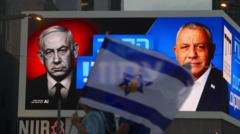
Israel’s Pivotal Election Tests Deeply Divided Nation
After three distinct years of grinding regional conflict, the moment has arrived. Israel’s pivotal election hangs heavily over a society that feels less like a unified nation and more like a collection of armed camps preparing for a final reckoning. This is a battle the country always knew was coming. Tuesday’s general vote arrives with the distinct, heavy energy of a pressure cooker nearing its limit.
Israel's pivotal election is a watershed general vote pitting a deeply entrenched governing coalition led by Benjamin Netanyahu against a surging centrist opposition bloc spearheaded by former military chief Gadi Eisenkot, taking place amid severe national security and democratic strains following the October 7 attacks.<\/p>
- Extremely Tight Polls: Recent surveys indicate the governing coalition and main opposition bloc are neck-and-neck as Israel's pivotal election arrives.
- Demographic Shifts: Half a million first-time voters and tens of thousands of returning diaspora citizens highlight the high stakes of the ballot.
- Security vs. Democracy: The national conversation remains bitterly polarized between Prime Minister Benjamin Netanyahu's hardline defense stance and the opposition's focus on institutional repair.
Polls published ahead of the blackout period put the incumbent governing coalition and the primary opposition bloc dead even. The margins are razor-thin. But the raw numbers tell only part of the story. More than half a million first-time voters are registered to cast their ballots, alongside an estimated 70,000 Israeli citizens reportedly flying in from across the globe solely to participate in what many perceive as an existential turning point.
Tel Aviv Streets and the Battle for the National Soul
On a humid Saturday night, a sea of opposition demonstrators flooded central Tel Aviv. They came bearing flags, megaphones, and a singular demand: immediate government change. The atmosphere was charged with a volatile mix of grief, anxiety, and a stubborn, defiant hope.
“We’re optimistic,” 21-year-old Omri told me amidst the chanting crowds. “I want peace, I want security, and I want to end corruption and get the religious fanatics out.”
This campaign has rewritten the rules of political engagement. It has been supercharged by novel tactics, including hyper-targeted AI-generated video campaigns designed to cut through the digital noise, and by the emergence of an entirely unexpected political persona.
Gadi Eisenkot is not cut from the traditional cloth of flashy, aggressive, media-savvy Israeli politicians. As global news agencies have frequently noted, his ascent marks a sharp stylistic break from the country’s longest-serving prime minister, Benjamin Netanyahu.
The Rise of the ‘Non-Politician’
Relatively new to institutional politics and proudly bearing a working-class Moroccan background, Eisenkot is a former military chief of staff. He is renowned for a temperament that borders on the monastic: calm, measured, and entirely allergic to melodramatic political theater. Supporters and analysts alike have taken to calling him a “non-politician.”
Yet, he and his centrist Yashar party have consistently traded blows with Netanyahu’s Likud party at the top of the polls. Because Israeli politics is the notoriously complex art of coalition-building rather than a simple winner-take-all contest, Eisenkot’s rising stock has turned this race into a high-stakes referendum on the state’s identity.
“These elections are about many issues—security, economy, education… but primarily, they are about the identity of the State of Israel, and what kind of Israel we want to see. A Jewish state, a democratic state, a liberal, tolerant, egalitarian state.” — Gadi Eisenkot
To opposition ears, this rhetoric strikes a deeply resonant chord. Critics of Benjamin Netanyahu argue that his administration represents a systemic threat to Israeli democracy. They point directly to his legislative efforts to neuter judicial oversight and his persistent refusal to establish an independent state commission of inquiry into the catastrophic security failures of October 7, 2023.
Eisenkot has capitalized on this vulnerability, promising a full, transparent state inquiry—a proposal that independent surveys suggest is backed by more than 70% of Jewish Israelis. Furthermore, he has vowed to enforce court rulings mandating the military draft for ultra-Orthodox Jews, striking a chord with secular and moderate right-leaning voters alike.
The Fortress Mentality: Netanyahu’s Defensive Shield
Not to be outmaneuvered, Benjamin Netanyahu has anchored his survival strategy to a singular, time-tested theme: national survival. His campaign broadcasts run under the unyielding slogan of “No Surrender.”
The prime minister has aggressively painted his opponents as weak on defense, stoking fears among right-wing constituencies that a center-left government might be forced into dangerous compromises or rely on Arab party kingmakers. Three years after Hamas-led militants breached the Gaza border fence in an assault that shattered the national psyche, Netanyahu is once again asking the electorate to trust him as the ultimate guardian of the nation.
Down in the limestone labyrinth of Jerusalem’s Mahane Yehuda market, devotion to the prime minister runs deep. In a cramped basement café, Shlomi Bashar sips his coffee and shakes his head at the mention of the opposition.
“If the army had woken him in time, it wouldn’t have happened,” Shlomi concedes, acknowledging the shadow of October 7. “He does bear a certain responsibility. But after that day, he changed the entire Middle East. We need him to be re-elected so that he can finish this work.”
Polarized Peripheries and the Shift to the Radical Right
While Netanyahu’s traditional base shows signs of fraying at the edges, the shockwaves of recent history have driven many traumatized voters not toward the center, but toward the aggressive fringes of the political spectrum.
In Sderot, right on the edge of the Gaza envelope, Lt Col (Res) Eyal Hajbi lights daily memorial candles in his office for friends lost in the attacks. Standing on a ridgeline overlooking the pulverized ruins of northern Gaza, his calculus is stark and uncompromising.
“As far as I’m concerned, after October 7, we should wipe them all out,” he states flatly. “My family has become more extreme than it ever was before. If once we deliberated over it, today we don’t think twice; we vote.”
Hajbi represents a growing demographic that has abandoned Likud for hardline nationalist factions like Itamar Ben Gvir’s Jewish Power or Bezalel Smotrich’s Religious Zionism. Data indicates that far-right parties are capturing a disproportionate share of first-time voters, particularly among ideologically charged youth who view traditional diplomatic approaches as obsolete.
$$text{Voter Realignment Score} = frac{text{Security Anxiety} times text{Institutional Trust Deficit}}{text{Polarization Index}}$$
| Political Block | Core Campaign Focus | Primary Demographic Appeal |
|---|---|---|
| Likud & Allies | Uncompromising security, regional dominance, ‘No Surrender’ | Traditional right, security hawks, border communities |
| Yashar & Centrists | Democratic integrity, institutional inquiry, non-dramatic governance | Urban moderates, disillusioned centrists, secular professionals |
| Far-Right Factions | Maximum territorial control, forceful deterrence, nationalist expansion | First-time voters, religious youth, evacuated border residents |
The Kibbutzim and the Search for Humanity
Conversely, a few miles down the road in the devastated agricultural communities like Nir Oz—once considered the idealistic heartland of the Israeli left—survivors are processing the trauma through a different lens. Here, residents are slowly returning, rebuilding amidst the scars of history.
Gal Pauker runs a modest Friday wine pop-up under canvas sheets near the border, honoring his grandfather who was killed on that dark Saturday. His mother, Galia, has discarded her historical centrist voting habits to back Eisenkot.
“We need a change—we can’t live with this government anymore,” Galia insists. “And I’m not talking about security, I’m talking first about humanity.”
Ultimately, Tuesday’s ballot may very well crash into a familiar, frustrating wall of parliamentary deadlock. With neither the governing coalition nor the fragmented opposition guaranteed a working majority without awkward alliances, the political machinery of the state faces a profound stress test.
As election day dawns, Israelis are forced to confront an uncomfortable truth: the greatest threats to their future may not only be massed across their borders, but deeply entrenched within the ballot boxes of their own divided democracy.
<button type="button" onclick="this.parentElement.innerHTML='✓ Thank you, we will refine our analysis!‘” style=”background:#ffffff; border:1px solid #cbd5e1; border-radius:6px; padding:4px 12px; font-size:12px; cursor:pointer; color:#334155;”>👎 No
