
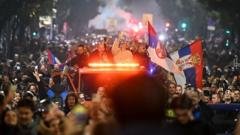
Vučić Concedes Election as Student Movement Claims Historic Win
BELGRADE — The unbelievable happened late Sunday night in the capital city. After more than a decade of firm control over Serbia’s government apparatus, President Aleksandar Vučić concedes election defeat, yielding to a youth-led movement that transformed systemic grief into a political force.
In a historic shift for Balkan politics, Serbian leader Aleksandar Vučić conceded election defeat following snap parliamentary elections triggered by years of anti-corruption protests. The student-led movement, running on the Student List ticket, achieved an unexpected victory propelled by record domestic turnout and massive diaspora participation across Europe and North America.<\/p>
- Decade of Dominance Ends: Aleksandar Vučić officially admitted defeat after his Serbian Progressive Party (SNS) fell to an organic opposition movement.
- Grassroots Surge: The Student List, fielding academics, doctors, and artists instead of career politicians, swept parliament with promises to dismantle systemic corruption.
- Tragedy Sparked Action: Two years of nationwide protests following the fatal 2024 Novi Sad train station collapse culminated in this election night shock.
- Global Diaspora Impact: Long queues stretched across European and American cities as voters mobilized to deliver a 64.9%+ overall turnout.
“We still do not have final results… it is clear that we have lost these elections,” a visibly subdued Vučić announced at the Serbian Progressive Party (SNS) headquarters in central Belgrade. For a leader who skillfully navigated ties between Western powers, China, and Moscow, the defeat marks an extraordinary political shift in Southeast Europe.
The Night Belgrade Shook: Street Celebrations Replace Tensions
In the moments following the admission, tears gave way to wild celebrations. Thousands poured into Belgrade’s Republic Square. Horns echoed through urban avenues. Fireworks illuminated the midnight sky over the Danube as university students embraced on street corners.
“This will be a free state,” declared Ilija Srdanović, a lead candidate for the Student List, speaking during late-night street rallies. “We set out to free our country from tyranny, and tonight, ordinary citizens made that a reality.”
Similar scenes unfolded in Novi Sad, the northern city that became the focal point of civic outrage two years ago. For those who spent months marching in freezing winter rain and scorching summer heat, the political shift felt surreal.
“It is a genuine miracle,” remarked one student protester amidst the blaring car horns in Belgrade. “We were told young people didn’t care about politics. Tonight, we rewrote our nation’s destiny.”
Tragedy as a Catalyst: The Legacy of Novi Sad
To understand how an entrenched political machine unravelled, one must look back to 2024. The tragic collapse of a newly renovated concrete canopy at the Novi Sad railway station killed 16 people, igniting nationwide anger. For millions of Serbians, the catastrophe was not merely an accident; it was viewed as the fatal result of state corruption, hasty infrastructure deals, and institutional negligence.
What began as quiet vigils quickly expanded into massive demonstrations. University students organized strikes, blocked key transport corridors, and systematically challenged official narratives. Rather than dissipating over time, the grief evolved into a organized voter registration drive.
International observers from organizations like Reuters noted that the movement’s strength lay in its resistance to traditional political structures. Instead of relying on established opposition leaders, the movement brought forward candidates from everyday professional backgrounds.
Anatomy of an Unconventional Political Movement
The Student List presented a unique challenge to the incumbent party. Devoid of a single political chief, the coalition selected candidates across civic sectors: university professors, public hospital doctors, stage actors, and national athletes.
Core Manifesto Commitments:
- Purging Corrupt Officials: Removing state actors who authorized heavy-handed crackdowns against peaceful demonstrators.
- Depoliticizing State Enterprises: Banning party loyalists from managing critical public utilities and state infrastructure projects.
- Restoring Media Freedom: Guaranteeing editorial independence for the national public broadcaster RTS.
- Institutional Accountability: Establishing independent anti-corruption tribunals with prosecution authority.
By the Numbers: How the Snap Election Unfolded
By 18:00 local time on Sunday, election authorities recorded a turnout rate exceeding 64.9%, breaking previous modern records. Voting booths across major cities saw long lines stretching around city blocks. The high turnouts extended well beyond domestic borders, as long lines formed outside Serbian embassies in Ljubljana, Munich, Paris, and Chicago.
| Election Dimension | Serbian Progressive Party (SNS) | The Student List Coalition |
|---|---|---|
| Primary Support Base | Older demographics, public sector employees, rural areas | Youth voters, urban centers, academic communities, overseas diaspora |
| Core Message | Economic continuity, pension increases, infrastructure spending | Anti-corruption, institutional reform, rule of law, press freedom |
| Key Platform Driver | Pledges on state pensions and healthcare funding | Justice for the Novi Sad catastrophe, depoliticizing public offices |
| Candidate Composition | Career politicians, long-time party operatives | Doctors, professors, artists, athletes, student organizers |
Geopolitical Fallout and the Path Ahead
The political change introduces new dynamics into Balkan diplomacy. Vučić had built an international reputation by seeking European Union membership while simultaneously maintaining economic ties with Moscow and securing infrastructure investments from Beijing. His sudden concession leaves diplomats across Europe scrambling to assess the direction of Serbia’s prospective coalition governance.
While the incoming Student List lawmakers lack administrative experience, their immediate goal centers on internal democratic reform rather than sudden external alignments. How this diverse coalition transitions from street-level activism to legislative policymaking remains the big question for Serbia’s democratic experiment.
For now, as the sun rises over Belgrade, the focus remains on the immediate reality: a political shift driven not by traditional party bargaining, but by a generation that insisted on being heard.
<button type="button" onclick="this.parentElement.innerHTML='✓ Thank you, we will refine our analysis!‘” style=”background:#ffffff; border:1px solid #cbd5e1; border-radius:6px; padding:4px 12px; font-size:12px; cursor:pointer; color:#334155;”>👎 No
