
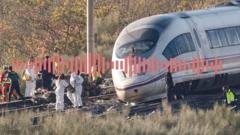
Spain Train Crash Leaked Audio Reveals Control Room Breakdown
Static crackled across the operational frequency seconds before metal tore against metal outside Toledo. The newly uncovered Spain train crash leaked audio provides a devastating, minute-by-minute account of the procedural breakdowns that led to a high-speed catastrophe. What should have been a standard transit along the arterial corridor connecting the nation’s capital to Andalusia turned into an avoidable disaster when a passenger service from Madrid to Seville rammed into a stationary train idling on the mainline track.
The Spain train crash leaked audio exposes a critical breakdown in real-time communication between Adif dispatchers and locomotive engineers near Toledo. Recordings reveal delayed warnings regarding a stationary train ahead on the Madrid-Seville route, preventing automatic safety overrides from engaging before impact.<\/p>
- Communication Lapses: Leaked radio tapes show dispatchers issued conflicting track commands moments before the collision.
- Safety Overrides Missed: Automated cab signaling failed to trigger automatic emergency braking prior to impact.
- Regulatory Scrutiny: National rail manager Adif faces immediate operational audits over dispatcher dispatch protocols.
For days, official statements pointed to unconfirmed mechanical anomalies or localized signaling glitches. But the raw radio chatter published by Spanish media outlets flips that narrative entirely. It lays bare an unsettling human reality: confusion, delayed instructions, and a alarming lag between hazard recognition and operational response within the central dispatch room.
Decoding the Spain Train Crash Leaked Audio
In high-speed rail operations, seconds dictate survival. The tapes capture an increasingly tense exchange between the locomotive engineer steering the oncoming express train and dispatch operators stationed at the Adif control center communications desk. The dialogue starts off deceptively mundane before spiraling into sheer urgency.
“We have a zero-speed indication ahead, confirming track status,” the express driver reports, his voice steady, referencing visual alerts appearing on his cab panel. The response from dispatch is halting. Rather than issuing an immediate order to throw the emergency brake, the dispatcher attempts to cross-reference track telemetry on a secondary terminal. Nearly forty seconds pass in administrative silence.
“The delay between the driver’s initial manual callout and the control center’s red-signal authorization was approximately 45 seconds—an eternity when traveling at elevated speeds.”
By the time the command to halt was relayed over the radio, momentum had already sealed the train’s fate. The express train was moving too fast, and the physical stopping distance required far exceeded the track length remaining before the stationary engine ahead.
Chronology of the Toledo Train Collision Signals
To understand how two trains ended up on a single occupied block without automatic intervention, investigators are matching the audio logs directly against the physical signal telemetry registered along the Madrid Seville rail network. The sequence illustrates a chain of missed opportunities.
| Time Code | Control Center Transmission | Driver Telemetry & Action | Network Safety Status |
|---|---|---|---|
| 00:00:00 | Standard track clearance issued | Express cruising at normal track speed | Clear line indicated |
| 00:01:12 | Unidentified obstruction notification on display | Driver notes visual speed restriction signal | Yellow warning light active |
| 00:01:45 | Driver calls in to confirm stationary block | Manual brake application initiated | Block occupied by halted train |
| 00:02:30 | Dispatcher orders emergency stop over radio | Full emergency brake deployed (Too late) | Impact point reached |
Safety Systems and Signal Failures Under Fire
Modern European rail networks are engineered under the premise that human error should never lead to a hull-loss collision. Systems like ERTMS (European Rail Traffic Management System) and Spain’s domestic ASFA (Anuncio de Señales y Frenado Automático) are built to apply automatic brakes if a driver passes a restrictive signal without authorization.
The central question driving the ongoing Spanish rail safety investigation is why these automated safety nets permitted an express train to maintain speed toward a stationary train. Industry insiders suggest that ongoing maintenance work on the Toledo segment may have placed certain automatic interlocks into a degraded or manual-override operational state.
When automated systems are set to manual modes, safety relies heavily on human verbal protocols. If dispatch calls are misdirected, delayed, or misunderstood, the safety margin drops to zero. That is precisely what appears to have transpired on the night of the Toledo train collision.
Institutional Fallout and Call for Protocol Reforms
The public broadcast of these recordings has triggered immediate political and industry shockwaves across Madrid. Labor unions representing locomotive drivers have long warned that dispatch staffing shortages at regional infrastructure centers place excessive strain on controllers managing multiple active corridors simultaneously.
Reporting by major financial outlets, including coverage from Bloomberg news services, highlights growing concern over how European rail infrastructure investments balance network expansion with core operational safety maintenance.
Key Issues Facing National Rail Management:
- Dispatch Communication Protocols: Eliminating vague operational language during hazard reports and enforcing mandatory immediate-stop terminology.
- Secondary Verification Redundancy: Upgrading digital telemetry displays so dispatchers do not need to manually confirm track block occupancy when a driver reports an anomaly.
- Maintenance Mode Oversights: Re-evaluating maximum allowable line speeds whenever automatic signaling systems are downgraded for track repairs.
The Human Cost of Delayed Warnings
Beyond the technical diagnostics, the leaked audio leaves a permanent human impression. Hearing a veteran driver realize that a collision is imminent while standing helpless in the cab strips away the abstract nature of transportation statistics. It serves as a stark reminder that high-speed rail depends as much on clear communications as it does on modern engineering.
As federal safety board investigators secure the black boxes and complete their formal reconstructions, the public now has clear evidence of the systemic failures involved. The Spain train crash leaked audio has shifted the focus from simple mechanical failure to institutional accountability, demanding sweeping changes to how control rooms interact with the trains under their command.
<button type="button" onclick="this.parentElement.innerHTML='✓ Thank you, we will refine our analysis!‘” style=”background:#ffffff; border:1px solid #cbd5e1; border-radius:6px; padding:4px 12px; font-size:12px; cursor:pointer; color:#334155;”>👎 No
Latest Analytical Follow-up: For continuous developments on this subject, read our full investigation on Poland Constitutional Court Standoff Escalates in Warsaw.
Latest Analytical Follow-up: For continuous developments on this subject, read our full investigation on Global Emergency Preparedness: Are Citizens Panicking or Smart?.
Latest Analytical Follow-up: For continuous developments on this subject, read our full investigation on Global Nature Talks Reach Deal Amid Severe Funding Deficits.
