
Poland Constitutional Court Standoff Escalates in Warsaw
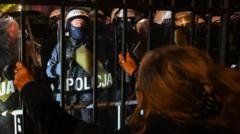
The high-stakes Poland constitutional court standoff reached a dramatic flashpoint on the streets of Warsaw as armed riot police established a tight perimeter around the country’s highest judicial body. What began as a legal feud over executive mandates has mutated into an open physical and institutional confrontation between Prime Minister Donald Tusk’s coalition government and the entrenched conservative judges appointed under the previous Law and Justice (PiS) administration.
The Poland constitutional court standoff is an escalating political and legal confrontation in Warsaw where Prime Minister Donald Tusk’s government deployed riot police around the tribunal. The government moved to strip senior judges of immunity over disputed appointments, sparking accusations of a constitutional coup from conservative opponents.<\/p>
- Riot Police Deployed: Armed officers surrounded Warsaw's Constitutional Tribunal amidst a sharp escalation between Prime Minister Donald Tusk and court leadership.
- Presidential U-Turn: President Karol Nawrocki aborted an official trip to Senegal mid-air to return to Warsaw and physically enter the tribunal premises.
- Immunity Stripping: Justice Minister Waldemar Żurek moved to revoke criminal immunity for Tribunal President Bogdan Święczkowski and Vice-President Bartłomiej Sochański.
- Legal Backlash: Prominent legal scholars warned that using police forces and executive pressure to clear the court risks setting a dangerous, anti-rule of law precedent.
Outside the Constitutional Tribunal on Szucha Avenue, heavy police cordons stood face-to-face with angry demonstrators. Inside, senior judges declared that the executive branch was orchestrating an unconstitutional takeover. The scene represents the most volatile moment yet in Tusk’s effort to unravel eight years of judicial restructuring executed by PiS.
Sirens over Szucha Avenue: Inside the Warsaw Showdown
The immediate catalyst for the Warsaw riot police court deployment came when Justice Minister Waldemar Żurek announced formal requests to strip Tribunal President Bogdan Święczkowski and Vice-President Bartłomiej Sochański of their criminal immunity. Żurek accused both senior figures of unlawfully preventing legitimately elected judges from adjudicating cases on the bench.
Within hours of the announcement, uniformed units took up positions around the court premises. Officers barred unauthorized entry while ensuring that government-backed interim leadership could access administrative offices. Supporters of PiS gathered near the barricades, chanting slogans against the government and accusing Tusk of totalitarian methods.
“Restoring the rule of law is our duty. After years of Law and Justice’s lawlessness, this is a difficult, sometimes painful process that requires decisive action. There is no other way.”
— Donald Tusk, Prime Minister of Poland
The tribunal’s current leadership responded with scorching rhetoric. In an official communique released online, the court insisted that Święczkowski and Sochański remain the sole legal leaders of the bench. “All persons participating in these actions are committing the crime of a coup d’etat,” the statement read, signaling that the court would not comply with executive directives.
A Mid-Air U-Turn: Nawrocki’s Presidential Counter-Move
The political gravity of the clash became clear when President Karol Nawrocki, an ally of the PiS alignment, abruptly aborted an official international diplomatic mission. Nawrocki was en route to Dakar for the Summer Youth Olympic Games when news of the police deployment broke. He ordered his aircraft to turn around mid-flight and return straight to Warsaw.
Upon landing, Nawrocki bypassed standard protocols and went directly to the Constitutional Tribunal. According to his chief of staff, the president entered the tribunal building to directly challenge the executive action and offer physical protection to the existing court leadership.
Nawrocki has consistently blocked Tusk’s legislative attempts to reform the judiciary by exercising his presidential veto power. Furthermore, the president has repeatedly refused to swear in five Constitutional Tribunal judges chosen by the parliamentary majority since March, citing procedural defects in their appointment process. In response to this gridlock, the Tusk government placed Anna Korwin-Piotrowska, one of the disputed appointees, in temporary charge of tribunal operations—a move the court’s leadership considers entirely illegal.
The Broader Clash Over the Polish Rule of Law Crisis
This explosive showdown did not happen in a vacuum. It is the culmination of a decade-long debate over the Polish rule of law crisis. When PiS took power in 2015, it reorganized the tribunal by appointing several judges to seats that the outgoing parliament had already filled. European supranational courts subsequently stepped in.
Both the Court of Justice of the European Union (CJEU) and the European Court of Human Rights (ECHR) ruled that the tribunal’s PiS majority included improperly elected judges, effectively stripping the court of its status as an independent legal body under international standards. For coverage on how international bodies assess European legal compliance, consult Reuters European policy analysis.
Relying on these international judgments, Tusk’s administration stopped publishing the tribunal’s decisions in the official legal gazette, rendering its rulings functionally void in the eyes of state agencies. Yet, executive attempts to bypass the tribunal altogether have run into serious constitutional resistance.
Comparing Institutional Positions in the Poland Constitutional Court Standoff
| Political / Legal Faction | Primary Figures | Core Action / Strategy | Stated Constitutional Justification |
|---|---|---|---|
| Executive Coalition | Donald Tusk, Waldemar Żurek | Stripping immunity, police deployment, withholding publication of rulings | Executing CJEU/ECHR mandates to restore true judicial independence |
| Tribunal Leadership & PiS | Bogdan Święczkowski, Karol Nawrocki | Refusing entry to new judges, presidential vetoes, declaring executive actions a coup | Defending the constitutional order against arbitrary executive overreach |
| Independent Legal Scholars | Prof. Marcin Matczak | Public criticism of executive shortcuts and political nominations | Protecting long-term rule of law norms against dangerous procedural precedents |
Legal Restoration or Executive Overreach? The Matczak Critique
While Tusk’s base has long demanded swift action to clear PiS appointees, his aggressive methods are drawing sharp warnings from prominent constitutional lawyers who previously criticized PiS.
Legal scholar Professor Marcin Matczak—a outspoken critic of PiS-era reforms who has publicly condemned Święczkowski’s leadership—argued that the government’s current maneuver is legally unsupportable. Matczak noted that suspending top justices via executive pressure lacks solid statutory backing.
“Today’s action at the Constitutional Court, in my opinion, buries this body and the issue of the rule of law for two decades. Images of armed police and legal interpretations according to which the minister of justice can remove the president of the Constitutional Court by decree will have a powerful, anti-rule of law backlash for years to come.”
— Prof. Marcin Matczak, Legal Scholar
Critics also highlight contradictions in Tusk’s approach to the bench. In September, Tusk’s party nominated Maciej Berek, a practicing politician and sitting cabinet minister, to a judicial opening on the court. Analysts argue that replacing one political faction’s nominees with another’s harms the credibility of the broader Donald Tusk judicial reform program.
Political Pressures and the Road Ahead
With parliamentary elections approaching next year, Tusk faces intense domestic pressure. Base voters feel the government has moved too slowly to dismantle the legacy of the PiS administration. By taking decisive physical control of Szucha Avenue, Tusk signals strength to his electorate, showing he will not let presidential vetoes block his agenda.
Yet, the sight of tactical police controlling entry to a nation’s supreme constitutional body carries heavy symbolic risks. International watchdog organizations and market analysts are monitoring the situation closely. Detailed assessments of regional market stability amid political friction can be found at Bloomberg financial reporting.
As long as President Nawrocki refuses to swear in parliament’s appointees, and as long as the executive branch refuses to recognize the tribunal’s existing leadership, Poland remains stuck in a dangerous state of dual legality. Two competing authorities now claim to represent the true constitution: one backed by parliamentary votes and police power, the other by presidential vetoes and established judicial seals. Until one side yields, the stability of Poland’s legal architecture hangs in the balance.
<button type="button" onclick="this.parentElement.innerHTML='✓ Thank you, we will refine our analysis!‘” style=”background:#ffffff; border:1px solid #cbd5e1; border-radius:6px; padding:4px 12px; font-size:12px; cursor:pointer; color:#334155;”>👎 No
