
Attempted Murder Investigation in France After Police Firebomb
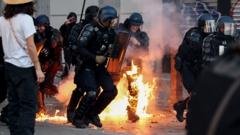
PARIS — The smell of acrid chemical smoke still hung over the Boulevard Voltaire when the judicial machinery of the French state swung into motion. What began as a massive, youth-led march against crippling inflation and decaying public infrastructure dissolved into violence on Saturday afternoon, leaving a veteran law enforcement officer severely burned and prompting an immediate attempted murder investigation in France. The trigger was a chillingly effective strike caught on video: an incendiary device, hurled from deep within a black bloc formation, striking a police officer and enveloping his lower body in a sudden, high-intensity fireball.
French prosecutors opened an attempted murder investigation in France following a targeted firebomb attack on a Gendarmerie officer during street protests in Paris. Authorities confirmed the use of an advanced incendiary device, marking a sharp escalation in violent clashes between law enforcement and anti-government demonstrators opposing rising living costs.<\/p>
- Targeted Violence: French prosecutors formally opened an attempted murder case after a Gendarmerie officer suffered severe fire injuries from a modified incendiary weapon.
- Tactical Shift: Security officials warn that extremist elements are deploying military-grade or chemically enhanced Molotov cocktails against riot lines.
- Widespread Unrest: Over 770 arrests occurred nationwide as hundreds of thousands joined youth-led rallies over inflation, housing, and public service funding.
- Counter-Accusations: Activist groups, including the Gilets Jaunes, highlight police use of controversial stun grenades that have maimed civilian protesters.
Images of the officer desperately trying to smother the flames on his leg rapidly ignited public shock and political outrage across the nation. For a government already struggling to contain widespread domestic friction, the weaponization of advanced incendiaries marks an alarming operational shift. Investigators are no longer dealing solely with angry citizens throwing cobblestones; they are actively hunting violent elements deploying improvised weapons intended to kill.
A Devastating Attack on the Front Lines of Paris
The targeted officer, a member of the National Gendarmerie urgently recalled from scheduled leave to reinforce Parisian riot units, recounted the harrowing encounter from a hospital bed. Speaking to French daily Le Figaro, he described a rapidly deteriorating tactical situation where his squad suddenly found themselves isolated and surrounded by ‘several hundred hostile, well-equipped adversaries’ who had infiltrated the broader demonstration.
Unlike the traditional, crude gasoline-and-rag Molotov cocktails historically encountered during French street battles, this device behaved with unsettling efficiency. Law enforcement forensics teams are analyzing residue from the scene, but initial accounts indicate a tailored liquid mixture designed to burn at significantly higher temperatures and adhere stubbornly to ballistic fabrics.
“We faced hostile individuals who are not protesters,” the injured officer told French media, noting burns to his ankle and hand alongside injuries sustained by fourteen of his colleagues. “These adversaries are there with the single intent to harm those who represent the state. The device had a far greater burning capacity than any standard Molotov cocktail I have ever seen in my career.”
Interior Minister Laurent Nuñez spoke candidly during a press briefing late Saturday evening, discarding diplomatic ambiguity regarding the legal classification of the act. Throwing a high-capacity incendiary weapon directly into a dense law enforcement line, Nuñez asserted, constitutes nothing short of an explicit murder attempt. Intelligence agencies and anti-terror investigators have joined regional police to identify the perpetrator, utilizing high-definition security footage, drone footage, and cell tower telemetry from the boulevard corridor.
Despite the high-profile nature of the attack, judicial authorities confirmed that while more than 770 people were taken into custody across the nation on Saturday, no individual has yet been detained in direct connection with the firebombing of the officer.
Street Reality vs. Official Numbers: A Metrics Breakdown
The intensity of Saturday’s events reflects a broader national crisis that has seen millions take to the streets over the past six weeks. While public security forces have mobilized tens of thousands of officers nationwide, the friction between tactical policing methods and aggressive protester factions continues to generate heavy casualties on both sides of the barricades.
To understand the scale of recent mobilizations and the mounting toll on both law enforcement and the civilian population, consider the operational metrics from the last four major weekend demonstrations across France:
| Protest Date | Estimated National Demonstrators | Police & Gendarme Deployment | Reported Officer Injuries | Confirmed Arrests |
|---|---|---|---|---|
| October 14 | 450,000 | 11,000 | 32 | 410 |
| October 21 | 620,000 | 14,500 | 58 | 980 |
| October 28 | 580,000 | 13,000 | 41 | 620 |
| November 4 (Latest) | 510,000 | 12,500 | 15 (1 severe burn) | 774 |
While total arrest numbers over the weekend were roughly half of the preceding week’s peak, top security officials note that the hard-core fringe embedded within the marches has become markedly more confrontational, organized, and tactically sophisticated.
The Dual Narrative: Claims of Police Brutality and Stun Grenade Controversies
The escalation of violence in Paris does not exist in a vacuum. Human rights groups and grass-roots activist organizations—including remnants of the Gilets Jaunes demonstrations movement—have forcefully denounced what they characterize as disproportionate, indiscriminate force by French riot units. For weeks, public health officials have reported treating protesters for severe lacerations, blunt force trauma, and chemical eye burns caused by tear gas canisters fired at close range.
The debate reached a fever pitch in early October when a 15-year-old student lost his hand during a high school blockade clash in suburban Paris, an injury caused by an explosive crowd-control device. Under intense public scrutiny, the Interior Ministry temporarily suspended the usage of the GLI-F4 tear-gas grenade—a weapon containing a high-explosive TNT charge long criticized by international watchdog bodies.
However, investigative reports published by Reuters and major French outlets like Le Monde reveal that field officers simply transitioned to the GM2L grenade, a replacement device that omits TNT but still relies on high-pressure pyrotechnic blast charges capable of inflicting severe maiming injuries. Activists insist that state violence creates a cycle of retaliation, fueling the radicalization of younger demonstrators who now view conflict with law enforcement as an inevitable act of self-defense.
Inside the Tinderbox: Youth Economic Rage Hits the Boiling Point
Strip away the tactical chaos from the Parisian avenues, and the core driver of this crisis remains intensely economic. The current wave of civil unrest began in late September as a decentralized, youth-driven coalition demanding immediate government intervention to offset surging fuel, food, and energy costs. What started as university teach-ins and localized school strikes rapidly expanded into a broader societal coalition representing working-class families, trade unions, and underemployed university graduates.
In secondary school districts across Marseille, Lyon, and Lille, administrators report severe budget shortfalls that have left classrooms unheated and educational support services gutted. Students entering an increasingly strained job market face astronomical rent spikes in major urban centers and stagnant baseline wages. The sentiment among the young demographic is no longer just frustration; it is an existential anger regarding their economic future in Western Europe.
Economic analysts at Bloomberg point out that consumer price pressures across the Eurozone have disproportionately penalized young households, who spend a far larger percentage of their net disposable income on essential commodities, energy bills, and basic housing. When public service quality degrades concurrently with rising living expenses, social contracts snap.
A Continental Phenomenon: Unrest Spreads Beyond French Borders
France is not an isolated battleground. Over the past weekend, major economic demonstrations erupted in Germany and Italy, signaling a wider regional contagion of youth-led political defiance. While local demands vary in specifics, the underlying theme across Rome, Milan, Berlin, and Paris remains strikingly consistent: public rage over the eroding standard of living and state neglect of civic infrastructure.
Germany: Urban Housing Crises Trigger Mass Rallies
In Berlin and Leipzig, tens of thousands of young activists took to the streets under the banner of housing justice, protesting skyrocketing rents and demanding state-enforced price caps on residential properties. Skirmishes with police broke out near Berlin’s Alexanderplatz, resulting in dozens of detentions as protesters attempted to occupy vacant commercial buildings to highlight residential shortages.
Italy: Student Unions Confront Austerity Measures
Meanwhile, across Italy, coordinated strikes by student unions shut down major transport hubs in Turin and Rome. Italian demonstrators focused their ire on proposed budget cuts to higher education and public transportation subsidies, framing the state’s fiscal policies as a direct assault on the nation’s youth. Banners held in front of the Ministry of Finance in Rome echoed the slogans painted on the walls of Paris: “Our Future Is Not for Sale.”
The Forensic and Judicial Road Ahead
Back in Paris, the immediate priority for the Ministry of the Justice is bringing structural charges in the wake of the firebomb attack. Opening a formal attempted murder investigation in France grants specialized magistrates sweeping investigative powers, allowing for long-term wiretaps, pre-trial detentions, and nationwide surveillance sweeps targeting radical anti-state networks.
Forensic teams at the Laboratoire Central de la Préfecture de Police are presently breaking down the chemical composition of the liquid recovered from the officer’s uniform. Early indications suggest the addition of synthetic thickening agents—a modification designed to mimic military napalm by clinging to target surfaces while burning. If investigators prove that such compounds were systematically manufactured prior to the protest, prosecutors will likely add charges of premeditated conspiracy to commit murder against state authorities.
For the French government, the crisis presents an excruciating dilemma. Double down on hardline tactical policing, and risk further alienating a deeply stressed citizenry while triggering retaliatory urban violence; or pull back security lines, and risk ceding control of the capital’s streets to increasingly aggressive, well-organized extremist cells.
As another weekend of planned national demonstrations approaches, one reality is undeniably clear: the political, social, and physical temperature on the streets of France has reached a dangerous flashpoint, and neither side appears ready to step back from the edge.
<button type="button" onclick="this.parentElement.innerHTML='✓ Thank you, we will refine our analysis!‘” style=”background:#ffffff; border:1px solid #cbd5e1; border-radius:6px; padding:4px 12px; font-size:12px; cursor:pointer; color:#334155;”>👎 No
