
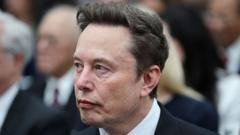
How Elon Musk Political Spending Backfired in the Midterms
When record-breaking Elon Musk political spending topped $450 million during the latest US midterm election cycle, the tech billionaire sought to build an insurmountable political fortress. He failed. Instead, the staggering half-billion-dollar gamble yielded a stunning Democratic blue wave that shattered Republican strongholds, reconfigured Capitol Hill, and cast a long shadow over Musk’s commercial empire.
Elon Musk political spending reached an unprecedented $450 million during the recent US midterm elections to back Republican candidates. Despite this historic monetary blitz, Democrats achieved sweeping victories across critical battlegrounds, shattering Musk's political playbook and exposing his corporate empire—including SpaceX and Tesla—to severe federal scrutiny and new regulatory risks.<\/p>
- Unprecedented Outlay: Elon Musk poured nearly $450 million into the midterm cycle, making him the largest individual campaign donor in American history.
- Texas Shockwave: Democrat James Talarico defeated Republican Ken Paxton in Texas despite Musk funneling over $45 million into the race.
- Regulatory Vulnerability: Key SpaceX government contracts worth roughly $10 billion face potential congressional investigations following Democratic wins.
- Data Center Resistance: Dozens of newly passed state ballot measures and gubernatorial victories will curtail rapid AI data center expansion.
For months, Musk operated as the Republican Party’s ultimate financial benefactor. Money poured out of his coffers into crucial swing states—Arizona, Michigan, Wisconsin, Minnesota, and Texas. Yet, when the ballots were tallied, the return on investment was nearly zero. The massive cash infusion could not stop voters from delivering a decisive rebuke to Trump-aligned candidates nationwide.
“There is something deeply wrong with a political system that allows one trillionaire to buy his own personal US Senator,” declared Democrat James Talarico after defeating Republican Ken Paxton in Texas.
By Wednesday morning, the political narrative had shifted completely. Musk’s audacious attempt to engineer electoral outcomes has left his core enterprises—SpaceX, Tesla, and xAI—dangerously exposed to a hostile legislative environment, impending congressional subpoenas, and aggressive state-level crackdowns on technology infrastructure.
The Anatomy of a $450 Million Cash Blitz
Campaign finance records reveal an unprecedented flow of capital. No individual donor in American history has ever matched the sheer scale of Musk’s midterm spending. The $450 million outlay flooded airwaves, funded ground operations, and saturated digital feeds across the country.
Musk didn’t merely write checks; he weaponized his personal media footprint. Utilizing his 241 million followers on X, he broadcasted daily political appeals, warned against Democratic immigration policies, and explicitly urged his audience to vote a straight Republican ticket. The strategy was clear: combine personal star power with infinite capital to rewrite the political landscape.
Yet, voters rejected the package. In contest after contest, Musk-funded candidates underperformed compared to historical benchmarks. The grand experiment in political hyper-capitalism faltered at the ballot box.
The Midterm Balance Sheet: High Spending, Low Returns
To understand the depth of the failure, one must look at where the capital actually went. Below is a breakdown of key states targeted by Musk’s political operation alongside the political outcomes.
| Target State | Estimated Musk Spending | Key Target Candidate / Cause | Electoral Outcome |
|---|---|---|---|
| Texas | $45,000,000+ | Ken Paxton (US Senate) | Democratic Victory (James Talarico) |
| Arizona | $38,000,000 | GOP Senate & House Slate | Democratic Victory |
| Michigan | $29,000,000 | GOP Congressional Blitz | Democratic Sweep |
| Wisconsin | $24,000,000 | State & Federal GOP Candidates | Democratic Victory |
| Georgia | $31,000,000 | Pro-Tech GOP Gubernatorial Campaign | Democratic Victory |
As the table demonstrates, high-dollar spending yielded minimal electoral leverage. Financial dominance did not translate into grassroots turnout.
The Texas Disaster: Talarico Defeats Paxton
Nowhere was Musk’s political defeat more pronounced than in his adopted home state of Texas. After moving the corporate headquarters of both Tesla and SpaceX to Texas from California, Musk treated the Lone Star State as his personal political proving ground.
He zeroed in on the high-stakes US Senate race, sinking at least $45 million into supporting hardline Republican Ken Paxton. Musk publicly attacked Paxton’s opponent, rising Democratic star James Talarico, posting to X that “there is something deeply wrong with Talarico.”
Talarico seized on the billionaire’s attacks, turning Musk’s interference into a central campaign issue. By framing the election as a choice between local working families and an out-of-state tech mogul trying to buy a Senate seat, Talarico tapped into a deep vein of populist frustration.
The result sent shockwaves through the political establishment. Talarico secured a comfortable victory, flipping a seat that Republicans considered untouchable. It was a humiliating outcome for Musk, proving that even a $45 million targeted campaign could backfire spectacularly when voters feel antagonized by billionaire influence.
Corporate Aftershocks: SpaceX Contracts Under the Microscope
The political hangover for Musk extends far beyond damaged pride. The shift in congressional power creates immediate structural threats to his core business operations, most notably SpaceX.
Since Donald Trump took office for his second term, SpaceX has secured an estimated $10 billion in new government defense and aerospace contracts. Federal agency reliance on SpaceX’s Falcon rockets and Starlink satellite constellation grew exponentially. However, Democratic lawmakers are already signaling that the era of unquestioned federal patronage is over.
Several incoming committee chairs have signaled intentions to launch aggressive investigations into how government defense contracts were awarded. Questions around national security, potential conflicts of interest, and executive overreach are expected to dominate upcoming hearings.
Responding to queries about potential congressional oversight targeting tech executives, Democratic Senator Ed Markey issued a direct warning on X: “They are going to need to plant new forests for all of the subpoenas we’ll be printing.”
Wall Street registered the risk immediately. On Wednesday morning following the election, while general technology stocks enjoyed a modest rally, Musk’s publicly traded flagship, Tesla, dropped 4.9%. SpaceX private valuations also took a hit in secondary market trading, sliding 3.4% as investors calculated the cost of lost political capital.
The Data Center Bottleneck and State-Level Resistance
Beyond Washington oversight, Musk faces a burgeoning crisis at the state level that threatens his ambitions in artificial intelligence. Running platforms like X, training Grok, and building xAI require enormous computational infrastructure—specifically, sprawling data centers that devour massive amounts of electricity and water.
Across the nation, local communities are pushing back. In the midterm elections, voters approved dozens of state and municipal measures designed to restrict or heavily tax new data center developments.
Key Issues Driving State-Level Anti-Data Center Legislation:
- Grid Reliability Concerns: Massive energy consumption placing strain on public utilities and pushing up residential electricity bills.
- Resource Depletion: Millions of gallons of water required daily for cooling server farms in drought-prone regions.
- Tax Incentive Backlash: Growing public outrage over billion-dollar tax breaks granted to ultra-wealthy tech firms.
- Zoning Restrictions: Local municipal bans on industrial-scale compute facilities near residential neighborhoods.
In Georgia, where SpaceX and xAI maintain large-scale infrastructure operations, the newly elected Democratic governor ran explicitly on a platform to eliminate corporate tax exemptions for tech giants and curb unchecked data center construction.
Recognizing the mounting wall of opposition on Earth, Musk posted a brief comment on X suggesting that his floating concept of orbital, space-based data centers was “looking pretty appealing right now.” While space data centers remain far from technical reality, the comment betrayed an underlying anxiety about ground-level regulatory gridlock.
Changing Market Realities and Strategic Pivots
The broader tech sector is now preparing for a fundamentally altered regulatory environment. While Silicon Valley has historically navigated split governments, the explicit hostility between the new Democratic congressional majority and Musk creates a uniquely volatile dynamic.
Financial analysts suggest that the political failure will force institutional investors to re-evaluate the risk profiles of Musk-led companies. According to an analysis published by Bloomberg, the market is pricing in prolonged regulatory friction.
James Flintoft, head of investment solutions at AJ Bell, emphasized the shift in market sentiment following the elections:
“The failure of high-profile tech spending to secure political outcomes ushers in a distinct period of uncertainty for investors. They must now assess whether tech companies, particularly those tightly bound to individual political figures, are set to face heightened regulatory hostility, delayed contract approvals, and structural antitrust scrutiny.”
The standard playbooks for corporate lobbying have been rendered ineffective. With Democrats taking control of legislative agendas, policy initiatives surrounding AI safety, labor standards at Tesla manufacturing plants, and federal launch permits for SpaceX will face rigorous public debate rather than fast-tracked approvals.
The Digital Scrubbing: Silencing the Megaphone
Perhaps the most revealing indicator of Musk’s defeat was his behavior on his own social media platform in the 24 hours following the polls closing.
During the peak of the campaign, Musk posted about politics constantly—sometimes hundreds of times a day. He amplified conspiratorial narratives regarding voting machines, warned of dark Democratic plots to ruin the nation, and pinned a lengthy manifesto detailing his political concerns to the top of his personal feed.
By Wednesday morning, the digital landscape on Musk’s profile had changed dramatically:
- Post Deletions: A widely circulated post instructing his 241 million followers to “Vote red today!” quietly vanished.
- Unpinned Manifestos: His pinned essay warning about the dangers of Democratic victories was removed without comment.
- Content Pivot: Political commentary was replaced entirely by promotional posts highlighting the capabilities of GrokBot, xAI’s artificial intelligence assistant.
- Humor as Shield: His sole acknowledgement of the massive political loss was a flippant joke on X stating that his “election-interfering space lasers didn’t work.”
This rapid digital retreat underscores a stark reality. The aggressive attempt to leverage social media ownership and deep pockets into national political control reached its absolute limit.
A Warning Shot for Silicon Valley
The fallout from the midterm elections serves as a cautionary tale for the broader technology industry. Tech executives who believed that pure capital could reshape public opinion overnight have been disabused of the notion.
Reid Hoffman, LinkedIn co-founder and prominent Democratic donor, reflected on the election results, framing them as a decisive victory for democratic processes over oligarchical control. Hoffman noted that the results “blew the doors off our expectations,” adding that voters clearly communicated a refusal to allow high-tech billionaires to dictate national policy.
As Washington prepares for a contentious new legislative session, Elon Musk finds himself in an unfamiliar position: stripped of political momentum, facing an army of congressional investigators, and forced to defend his corporate empire from the very policy headwinds his $450 million gamble failed to prevent.
<button type="button" onclick="this.parentElement.innerHTML='✓ Thank you, we will refine our analysis!‘” style=”background:#ffffff; border:1px solid #cbd5e1; border-radius:6px; padding:4px 12px; font-size:12px; cursor:pointer; color:#334155;”>👎 No
