
Iran-Backed Operatives Charged in RAF Fairford Attack Plot
In the quiet, rolling countryside of the Cotswolds, military routine rarely collides so starkly with global espionage. Yet in the early hours of late September, a suspicious convoy near the perimeter of RAF Fairford unravelled what federal prosecutors now describe as an international conspiracy. The unsealed US Department of Justice indictment details a coordinated effort by Iranian state-backed proxies to execute the RAF Fairford attack plot, an operation designed to strike at the heart of Anglo-American power projection in Western Europe.
The RAF Fairford attack plot was an Iranian-orchestrated terror operation targeting a strategic UK airbase housing US military assets in September 2026. According to a unsealed US Department of Justice indictment, Iran-backed operatives arranged surveillance, hired local handlers, and dispatched fuel-laden vans disguised as commercial vehicles to breach the base perimeter before being intercepted.<\/p>
- US DOJ Charges: Three operatives linked to the IRGC and Kataib Hezbollah face an eight-count federal indictment for orchestrating European terror plots.
- Fairford Perimeter Intercept: Attackers deployed three disguised commercial vans loaded with fuel barrels and accelerants toward RAF Fairford before local law enforcement intervened.
- Prison Communications: One key suspect allegedly managed intelligence operations and directed UK logistics while incarcerated in a New York detention facility.
- Strategic Fallout: The incident prompted the US military to temporarily evacuate all long-range heavy bombers from the Gloucestershire facility.
The charges, unsealed in a New York federal court, paint an alarming picture of proxy warfare. Three men—Iranian national Mohsen Mohajeri, Iraqi national Mohammad Ali al-Hassani, and dual Iranian-Iraqi citizen Mohammad Baqer Saad Dawood al-Saadi—stand accused of orchestrating a campaign of violence spanning the United Kingdom and continental Europe. Their goal? Sabotage, terror, and the strategic disruption of Western military assets.
Midnight in Gloucestershire: The Fairford Intercept
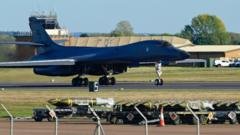
It began with three delivery vans creeping along rural roads toward RAF Fairford. The airbase, a linchpin for United States Air Force heavy bomber operations, had recently been launching B-1 and B-52 sorties across the Middle East. The facility was an obvious flashpoint. Tehran had already warned that any installation used for operations against Iranian interests was a legitimate military target.
The plan was carefully staged. According to court filings, suspect Mohammad Ali al-Hassani began laying the groundwork weeks prior. In August, al-Hassani allegedly transferred funds to handlers inside the UK to conduct pre-operational surveillance along Fairford’s perimeter fence. By September, logistics had escalated rapidly.
- Vehicle Procurement: Operatives acquired three commercial vans, fitting them with fake decals to mimic local fuel delivery and swimming pool maintenance companies.
- Combustible Cargo: Inside the vehicles, conspirators loaded steel barrels filled with petrol, along with chemical accelerants including bulk orders of potassium chloride.
- Shrapnel Preparation: Metal objects were purchased to act as improvised explosive fragmentation.
The operational phase stalled on September 26 when two of the disguised vans encountered an unexpected security roadblock set up near the base perimeter. Unable to pass, the drivers maneuvered into surrounding lanes. At roughly 2:00 AM on September 27, a local farmer returning home spotted the idling, misbranded vans and dialed emergency services. Armed counter-terrorism officers swarmed the scene shortly after.
“This eight-count indictment shows the determination of Iran to commit terrorist attacks in Europe and the US,” stated FBI Director Kash Patel during the official DOJ announcement.
While no completed detonators were recovered inside the vans, the sheer volume of fuel and chemical accelerants pointed to an intended catastrophic incendiary event. The reaction was swift: the US military evacuated its strategic bomber fleet from the base, citing heightened operational risks.
The Shadow Network: IRGC, Kataib Hezbollah, and HAYI
Investigative details revealed by the DOJ show that the Fairford operation was not an isolated cell acting on impulse. Instead, it represented one prong of a campaign conducted under the flag of Harakat Ashab al-Yamin al-Islamiya (HAYI), or the Islamic Movement of the People of the Right Hand.
Western intelligence agencies regard HAYI as a convenient legal and psychological front—a “smokescreen brand” created to absorb credit for attacks while allowing state actors in Tehran to maintain plausible deniability. Under this name, the network claimed responsibility for 18 distinct acts of terrorism across Europe during the spring and summer, seven of which occurred on British soil.
Connecting the Operational Threads
The indictment links the trio directly to Iran’s Islamic Revolutionary Guard Corps (IRGC) and Kataib Hezbollah, an Iraqi paramilitary group backed by Iran. The reach of this cell extended well beyond military infrastructure:
- London Stabbing Attack: In April, two Jewish men, including a dual US-British citizen, were ambushed and stabbed in Golders Green, North London—an attack later tied to the HAYI operational network.
- Arson and Explosives: Multiple low-level arson campaigns targeting commercial and transit targets across Western Europe were funded through the same Iranian-directed channels.
- Coded Communications: Prosecutors allege that one defendant directed UK-based assets while sitting inside a Metropolitan Detention Center cell in New York, using compromised prison comms systems to relay coded target instructions.
Comparative Breakdown of Europe-Wide Operations
To understand the scope of the threat detailed in the federal indictment, it is necessary to examine how the network divided its logistics between urban hit-squads and strategic military sabotage.
| Operational Focus | Target Type | Primary Tactics | Network Connection |
|---|---|---|---|
| RAF Fairford Plot | Military Infrastructure | Fuel-filled decoy vans, chemical accelerants, shrapnel | Directed via al-Hassani using local UK couriers |
| Golders Green Attack | Civilian / Hate Crime | Near-fatal knife ambush on Jewish citizens | Claimed under the HAYI front organization |
| Continental European Attacks | Commercial / Logistics | Arson, small improvised incendiaries | Funded via IRGC-linked hawala payment systems |
Tehran’s Denial and the Geopolitical Fallout
Official responses from Iran were predictably sharp. The Iranian Embassy in London released a statement categorically rejecting the DOJ’s claims, labelling the indictment as “malicious speculation” aimed at inflaming regional tensions. Tehran maintains that its armed forces operate strictly within international law and have no connection to the arrests made in the UK or the United States.
However, security analysts point out that the tactics match a established pattern of Iranian proxy activity in Europe. For years, Western counter-terrorism officials have warned about Tehran outsourcing surveillance and kinetic operations to criminal networks and radicalized locals to lower the political cost of failure.
Strategic Vulnerabilities Exposed
The incident has forced a drastic reassessment of operational security surrounding joint Anglo-American bases. RAF Fairford occupies a critical place in NATO’s heavy aviation architecture. Unlike standard fighter bases, Fairford’s long runways are specifically engineered to support heavy bombers like the B-52H Stratofortress and the B-1B Lancer.
The ease with which proxy operatives conducted physical surveillance and positioned heavy incendiary materials near perimeter fencing highlights a vulnerabilities in rural base security. While police roadblocks successfully turned the vans away, the fact that three fuel-laden vehicles reached the outer boundary undisturbed has raised urgent questions in both Whitehall and Washington.
Legal Proceedings and What Lies Ahead
Currently, seven individuals remain in UK custody in connection with the Gloucestershire incident, with two British nationals already facing formal court charges related to terrorism logistics. Meanwhile, the three primary conspirators named in the US indictment face extradition requests, severe federal terror charges, and potential life sentences in American facilities.
The fallout from the RAF Fairford attack plot continues to reverberate through diplomatic channels. As intelligence agencies dismantle the remnant infrastructure of HAYI, Western defense analysts argue that the perimeter security models for allied bases must evolve. Shadow warfare is no longer confined to distant conflict zones—it has arrived at the gates of Europe’s most vital military installations.
<button type="button" onclick="this.parentElement.innerHTML='✓ Thank you, we will refine our analysis!‘” style=”background:#ffffff; border:1px solid #cbd5e1; border-radius:6px; padding:4px 12px; font-size:12px; cursor:pointer; color:#334155;”>👎 No
