
How a Telecom Upgrade Triggered a Historic FAA Ground Stop
On a Friday afternoon packed with thousands of weekend travelers, the backbone of American air travel simply snapped. Radar screens remained lit, but the vital voice links connecting controllers to cockpits went completely silent across vast swaths of the continent. The resulting FAA ground stop paralyzed national airspace for over four hours, causing the most severe nationwide shutdown of civil aviation since the immediate aftermath of September 11, 2001.
The recent nationwide FAA ground stop was caused by a hardware malfunction during a routine infrastructure upgrade managed by contractor L3Harris. As technicians migrated legacy copper communications to fiber-optic cables, a newly installed router flooded 17 of 22 regional air control centers with rapid connection attempts, severing vital pilot-controller communications.<\/p>
- The Spark: A newly installed router flooded air traffic control systems with 1,000 automated connection requests every four seconds during a routine fiber-optic cable migration.
- Paperwork Bottleneck: FAA technicians lost 45 minutes attempting to identify the rogue router because facility maintenance records were kept manually on paper logs.
- Massive Disruption: Over 8,500 flights were delayed and nearly 8,000 were canceled nationwide, marking the most severe air space halt since September 11, 2001.
- Systemic Vulnerability: Transportation officials estimate a complete modernizing of legacy airspace communication networks will require upwards of $50 billion.
The root cause was not a sophisticated cyberattack or an act of terror. Instead, it was a routine maintenance procedure gone catastrophic. A government contractor, working at a remote installation, attempted to swap out decades-old telecommunications equipment. What was supposed to be a seamless shift from legacy copper wiring to high-speed fiber optics rapidly devolved into an operational nightmare that grounded over 3,500 planes in mid-flight and stranded hundreds of thousands of passengers across the globe.
The Digital Cascade: How a Router Flooded the Skies
The trouble began deep within the nation’s air traffic architecture. Federal Aviation Administration (FAA) contractor L3Harris air traffic control team members were actively executing a planned infrastructure migration. The objective was straightforward: replace legacy copper lines—a technology so antiquated that commercial telecom providers have largely discontinued supporting it—with modern fiber-optic cable.
As part of this copper to fiber migration, field technicians installed a new hardware router intended to direct data flow across the aviation network. The moment the unit was powered on, it malfunctioned spectacularly. Rather than quietly routing data, the device began flooding surrounding air traffic networks with an avalanche of automated connection attempts—sending roughly 1,000 requests every four to five seconds.
This digital flood surged through the system’s veins. Within minutes, 17 of the nation’s 22 Air Route Traffic Control Centers (ARTCCs) experienced widespread instability across both ground communications and critical controller-to-pilot voice channels. Controllers lost reliable audio contact with aircraft traveling through high-altitude corridors.
“It was the network equivalent of a massive internal denial-of-service attack. A single misconfigured junction box effectively rendered two-thirds of our national airspace communication grid unstable in a matter of seconds.”
With critical safety margins compromised, FAA leadership made the emergency decision to halt all domestic departures. The agency’s order went out at 15:54 EST, freezing aircraft on taxiways from JFK to LAX, while controllers scrambled to safely land the thousands of aircraft already airborne.
Paper Logs and 45 Minutes of Blindness
While controllers fought to keep planes separated using backup frequencies, engineers faced a baffling technical detective story. The primary challenge was not fixing the malfunctioning router; it was finding out which piece of hardware was actually failing and where it was located.
In an era of cloud computing and real-time remote diagnostics, the agency’s diagnostic capabilities were hindered by legacy practices. Facility maintenance work across the network was logged manually on paper balance sheets and physical logbooks. Technicians attempting to isolate the rogue signal had to manually leaf through paper files across disparate centers to determine which contractor was working on which physical circuit.
It took engineers 45 minutes just to pinpoint the rogue router at a remote facility. Those 45 minutes of manual document searching represented a catastrophic operational blindspot, keeping the entire country’s aviation system locked in a high-stakes freeze.
Transport Secretary Sean Duffy acknowledged the breakdown during a weekend news briefing, admitting that the manual logging protocol severely hampered the emergency response. The revelation has ignited sharp criticism from technical auditors who point out that multi-billion-dollar airspace operations should not rely on physical binder sheets to locate active network interventions.
A House About to Be Condemned: Aging US Aviation Infrastructure
The systemic vulnerability exposed by the grounding has reignited an urgent debate regarding US aviation infrastructure. Industry analysts and former regulators have long warned that the nation’s air traffic control network relies on dangerously outdated technology held together by patchwork upgrades.
Prominent aviation analyst Miles O’Brien offered a blunt assessment following the incident, characterizing the network as an overburdened legacy structure operating far beyond its designed lifecycle.
“I think most of us look at this and recognize a system in the United States that we have allowed to decay over decades. It is far worse than a fixer-upper—it is a house that is right on the verge of being condemned.”
The financial scale required to rectify these structural flaws is immense. Transportation Secretary Duffy estimated that bringing the nation’s air traffic system up to modern redundancy standards will require a comprehensive overhaul costing upwards of $50 billion. Decades of piecemeal funding, congressional budget disputes, and procurement delays have left the FAA managing a complex patchwork of legacy copper, early-generation digital systems, and modern fiber lines.
Comparing Historic US Airspace Shutdowns
To understand the magnitude of the incident, consider how this failure compares to previous major disruptions in American civil aviation history:
| Event | Primary Cause | Duration | Flight Cancellations | Flight Delays |
|---|---|---|---|---|
| September 11, 2001 | National Security Emergency (Terror Attacks) | 3 Days | ~45,000 | N/A (Total Freeze) |
| 2023 NOTAM Outage | Corrupted Database File (Legacy Software) | 1 hr 52 min | ~1,300 | ~9,500 |
| 2024 Telecom Upgrade | Router Hardware Malfunction / Network Flood | 4 hrs 21 min | ~8,000 | ~8,500+ |
As the table demonstrates, while the total duration of the recent outage was significantly shorter than the days-long freeze following 9/11, its rapid cascade caused far more immediate damage than the 2023 NOTAM database failure. A full reporting breakdown of the fallout was documented by global news outlets like Reuters and Bloomberg as airlines struggled to recover.
The Decision to Work in the Daytime
Beyond technical hardware flaws, major questions are being raised regarding basic operational risk management. Former government officials have openly challenged the decision to allow critical network infrastructure updates during peak Friday operational hours.
Juliette Kayyem, former US Assistant Secretary of Homeland Security, questioned why an upgrade of this sensitivity was executed on one of the highest-volume travel days of the week.
“You simply do not execute high-risk hardware cutovers on a Friday afternoon when air traffic controllers are managing peak airspace density,” Kayyem noted. “You isolate upgrades to off-peak hours, you implement strict regional staging, and you ensure robust failover systems are actively online before touching live lines.”
In response, federal officials confirmed that emergency protocols will be re-evaluated immediately. Future major system migrations will likely be restricted to low-volume overnight maintenance windows, with strict bans on daytime cutovers for critical voice and telemetry circuits.
Global Gridlock: The International Domino Effect
Because the FAA controls the world’s busiest airspace corridors, the domestic grounding quickly triggered massive international air travel disruptions. The European Organisation for the Safety of Air Navigation (Eurocontrol), which coordinates air traffic across 42 member nations including the UK, EU states, Turkey, and Israel, was forced to suspend all US-bound departures.
Across the Atlantic, London Heathrow saw dozens of transatlantic departures delayed or scrubbed entirely. In Canada, national carrier Air Canada canceled hundreds of cross-border flights, while international hubs as far away as Sydney, Australia, grounded US-bound flights at their gates.
When the ground stop was finally lifted at 20:15 EST on Friday night, the operational damage was already done. Planes were severely out of position, flight crews had exceeded their legally mandated duty hours, and gate space at major hubs was completely exhausted.
Financial Fallout: Flight Delays and Cancellations
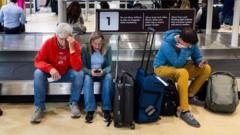
The lifting of the FAA order did not bring an immediate end to traveler misery. Saturday morning inherited the cumulative mess of Friday’s logjam, resulting in widespread flight delays and cancellations that stretched through the weekend.
By Saturday afternoon, FlightAware data logged more than 5,900 additional canceled flights and over 7,000 delayed flights within the US. Major carriers faced massive operational recovery challenges:
- Delta Air Lines & United Airlines: Both major carriers were forced to cancel roughly 20% of their total Saturday schedules to reposition aircraft and reset crew schedules.
- American Airlines: Canceled over 520 mainline flights, working through severe crew-scheduling bottlenecks at key hubs in Dallas and Charlotte.
- JetBlue: Suffered the hardest hit proportionally, scrubbing roughly 40% of its Saturday operations due to heavy exposure along the congested East Coast corridor.
The total economic impact on the airline industry is expected to run into hundreds of millions of dollars in lost revenue, rebooking fees, and crew overtime costs.
Passenger Protections, Legal Realities, and Compensation Limits
For millions of stranded travelers, navigating the aftermath has proven confusing and frustrating. Because the operational stoppage was triggered by an air traffic control network failure—a government-managed safety environment—airlines are legally categorized as non-liable for the underlying cause.
Under US federal regulations, when flight cancellations stem from extraordinary third-party events like air traffic control outages or severe weather, airlines are not legally required to provide cash compensation for lost hotel bookings, missed events, or ground transportation.
What Passengers Are Entitled To Under US Law
Despite the lack of non-performance penalties, travelers maintain clear rights under the updated FAA Reauthorization Act of 2024:
- Mandatory Full Refunds: If a flight is canceled or significantly delayed (defined as three hours for domestic flights and six hours for international journeys), passengers who choose not to accept alternative travel arrangements are legally entitled to a 100% refund of their unused ticket value.
- Strict Refund Timelines: Refunds must be processed back to the original credit card within seven business days, or within 20 days for cash and check purchases. Airlines cannot force consumers to accept travel vouchers in lieu of cash refunds if the passenger demands monetary reimbursement.
- No Duty of Care Mandate: US federal law does not compel domestic carriers to provide free meal vouchers or hotel accommodations during air traffic control outages, though several major carriers choose to offer limited hotel assistance to stranded travelers on a voluntary basis.
Enhanced Rights for Transatlantic Travelers
Passengers traveling into or out of Europe and the UK enjoy significantly stronger consumer protections under UK261 and EU261 regulations. If a traveler was booked on a UK/EU carrier or departing from an airport within those jurisdictions (such as Heathrow or Paris CDG):
- Duty of Care Protections: Airlines are legally mandated to provide stranded passengers with reasonable meal and refreshment vouchers regardless of what caused the flight disruption.
- Overnight Accommodation: If an outage forces an overnight delay, carriers must provide hotel accommodations and cover ground transportation to and from the lodging facility.
- Out-of-Pocket Reimbursements: If an airline fails to arrange care, travelers who keep reasonable receipts for basic food and lodging can submit those expenses for full reimbursement upon returning home.
The Road Ahead: Rebuilding American Air Traffic Infrastructure
As flight schedules slowly return to normal across major US hubs, political pressure is mounting in Washington. Members of both the House Transportation Committee and the Senate Commerce Committee have announced plans to hold formal hearings regarding the L3Harris upgrade failure.
Investigators are focusing on two distinct avenues: whether the router failure was caused by a fundamental hardware design flaw or human error during installation, and why back-end failover systems failed to isolate the flooded data traffic before it affected regional control centers.
L3Harris issued a formal statement confirming full cooperation with federal investigators, expressing regret over the widespread travel disruptions and emphasizing their ongoing commitment to supporting the FAA’s modernization mission. However, industry experts caution that true resilience cannot be achieved overnight.
Migrating thousands of legacy copper circuits to high-speed fiber across a sprawling, 24/7 airspace network is an intensely complex engineering challenge. Until the FAA receives sustained capital investment to modernize both its digital infrastructure and its manual paper-based diagnostic workflows, the world’s most complex aviation system remains dangerously vulnerable to a single point of failure.
<button type="button" onclick="this.parentElement.innerHTML='✓ Thank you, we will refine our analysis!‘” style=”background:#ffffff; border:1px solid #cbd5e1; border-radius:6px; padding:4px 12px; font-size:12px; cursor:pointer; color:#334155;”>👎 No
Latest Analytical Follow-up: For continuous developments on this subject, read our full investigation on Russia After Putin: Inside the Oligarchs’ Secret Plans.
Latest Analytical Follow-up: For continuous developments on this subject, read our full investigation on Why Bangladesh Clothing Factories Shut Amid Mass Wage Strikes.
