
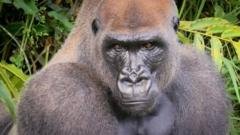
Solitary Gorilla Rehabilitation: Inside Jojo’s Quest
In the dense shadows of Gabon’s Bakoumba region, an adult silverback named Jojo gazes through the enclosure wire. His life is a stark case study in solitary gorilla rehabilitation, a complex discipline where wildlife biology, deep psychological trauma, and international bureaucracy collide. He was smaller than a football when poachers ripped him from the canopy, slaughtering his family before selling him into the illegal pet trade. For over a decade, he knew only the rusted iron borders of a tiny cage at a private zoo.
Solitary gorilla rehabilitation refers to the specialized veterinary, psychological, and behavioral interventions required to socialise and heal gorillas subjected to long-term isolation. Due to severe early-life trauma and complex international translocation regulations, pairing traumatized adult apes with compatible companions requires thermal stress monitoring, scent-based introductions, and custom sanctuary-led integration protocols.<\/p>
- Extreme Trauma Manifestation: Early-life poaching and complete isolation induce chronic physiological stress in great apes, measurable through facial thermal imaging.
- Regulatory Bottlenecks: Current international translocation laws favor zoo breeding programs over wild sanctuary reintroductions, delaying companion matching.
- Evolutionary vs. Forced Isolation: While wild adult male gorillas naturally experience solitary phases, forced early confinement prevents critical social development.
It was not until 2015 that Jojo felt grass beneath his palms for the very first time. Now living under the care of the Lekedi Foundation Gabon, the 20-something gorilla has space and safety, but he remains completely alone. He has not touched another gorilla since the day his mother was killed. Conservationists and psychologists are now fighting to answer an agonizing question: can an ape who never learned to be a gorilla finally find a companion?
Navigating Solitary Gorilla Rehabilitation in Modern Sanctuaries
Rehabilitating an adult great ape is fundamentally different from caring for a young orphan. Gorillas are deeply social creatures whose developmental milestones mimic human childhood. In the wild, Western lowland gorillas spend their first 14 to 19 years embedded in complex family troops governed by silverbacks, adult females, and playful juveniles. They learn the subtle grammar of grunts, chest-beats, and postural cues through decades of immersion.
Jojo was deprived of every bit of that education. Taken when he was less than a year old, his early years were spent on public display, surrounded by loud human onlookers. Today, his caregivers at Lekedi note that Jojo displays an heartbreaking reliance on human attention.
“He definitely feels lonely — you can see it in his eyes. He craves human interaction to an extraordinary degree, even gathering leaves for us to hold just so we trade them for a treat to interact with him.” — Maxe Anaclet Makaba, Head Keeper at Lekedi Foundation
When female staff members he recognizes walk away from his enclosure, Jojo emits low vocalizations — the distinct call wild silverbacks use to rally their harems. The tragedy, according to sanctuary director Éric Willaume, is that Jojo is directing his natural reproductive and social instincts toward species that cannot fulfill them.
The Invisible Scars of Great Ape Psychological Trauma
The trade in wild primates remains a devastating shadow economy across Central Africa. According to reports compiled by the Pan African Sanctuary Alliance, more than 6,000 African primates were bought, sold, or trafficked illegally between 2000 and 2023 for exotic pets, bushmeat, and entertainment. For every infant gorilla that reaches a sanctuary or private zoo, multiple adults are slain defending their offspring.
This violent separation leaves permanent psychological wounds. Industry experts studying great ape psychological trauma note that young apes frequently suffer from severe depression upon capture.
“If they’re old enough to understand what happened to them, to understand their family was killed, they just lose the will to live. You see it in their eyes — the light goes out.” — Tony King, Conservationist at the Aspinall Foundation
To quantify the physiological impact of this trauma, researchers have turned to cutting-edge technology. Prof Gillian Forrester from the University of Sussex has been documenting Jojo’s physiological state using primate stress response thermal imaging. By measuring subtle fluctuations in skin temperature across Jojo’s face, Forrester’s team can track autonomic nervous system activation in real time.
The Science of the “Nasal Dip”
When a primate experiences acute stress or fear, blood flow rapidly shifts to the eyes and ears to sharpen sensory awareness for immediate fight-or-flight responses. Consequently, blood recedes from the nasal region, causing a sudden temperature drop known as a “nasal dip.”
In healthy individuals, normal temperature resumes once the threat passes. For Jojo, thermal readings reveal a persistently cold nose — evidence of a broken, chronically active stress response. His body remains stuck in a perpetual state of high alert, decades after leaving his iron cage.
Comparing Sanctuary Integration Approaches
Integrating traumatized primates requires drastically different strategies depending on age, background, and sanctuary resources. Below is an overview of standard conservation methodologies applied across African primate rescue facilities:
| Rehabilitation Strategy | Target Age Group | Primary Objective | Behavioral & Regulatory Hurdles |
|---|---|---|---|
| Gorilla-Led Peer Grouping | Infants & Juveniles (< 5 years) | Rapid socialization; learning wild foraging & troop dynamics | High risk of infant depression; requires 24/7 surrogate care |
| Sanctuary Pair Bond Placement | Sub-adults & Adults (6–15 years) | Providing lifelong companionship; stress reduction | Risk of physical aggression; compatibility matching struggles |
| Solitary Adult Managed Integration | Mature Adults (> 15 years) | Targeted stress mitigation; potential wild release preparation | Severe legal hurdles; chronic stress; risk of fatal territorial fights |
Organizations like the Gorilla Rehabilitation and Conservation Education (GRACE) Center in the Democratic Republic of Congo prioritize early intervention. When young gorillas are confiscated from illegal trade, they are immediately placed into peer surrogate groups where older orphan females act as foster mothers. This enables “gorilla-led” recovery. Jojo, however, never had access to a surrogate family.
Bureaucracy Beyond Borders: The Companion Search
Finding a suitable partner for Jojo is far more complex than placing two animals in an adjacent enclosure. Because Jojo is a mature adult silverback with immense physical strength, an incompatible pairing could result in fatal injuries. The ideal companion would be a calm, socialized female or a compatible sub-adult male, possibly sourced from an accredited global zoo or another regional rescue sanctuary.
Yet, bringing a zoo-bred ape to Gabon for captive gorilla reintroduction or sanctuary pairing runs into dense international regulatory walls. Global wildlife shipping frameworks, overseen by bodies monitoring endangered species trade like CITES, are explicitly structured around managed captive breeding programs. They were never designed to move animals across international borders simply for psychological welfare or sanctuary companionship.
Why International Discussions Stall
- Genomic Management: International zoo associations prioritize breeding animals with known genetic lines to maintain healthy captive reserves. Sanctuary rescues often lack complete genetic pedigree data.
- Disease Transmission Controls: Moving apes between continents requires rigorous quarantine protocols to protect native wild populations from novel human or domestic pathogens.
- Liability and Risk: Zoos are hesitant to send captive-reared animals to African sanctuaries where full wild reintroduction cannot be guaranteed.
As a result, informal discussions between researchers and international zoological institutions regarding Jojo have repeatedly fizzled out. The administrative pathways to transfer an ape across borders for non-breeding, trauma-healing purposes simply do not exist.
Solitude in the Wild vs. Institutional Confinement
Is keeping Jojo alone strictly unnatural? Primatologists offer a nuanced view. Dr Robin Morrison, an expert in mountain gorilla social dynamics at the University of Zurich, points out that solitude is not entirely foreign to adult male gorillas.
In wild populations, roughly one-third of adult silverbacks live solitaric lives for long stretches. Upon reaching sexual maturity, young males often leave their birth groups, wandering the forest alone while attempting to recruit females to start their own troops. Some fail for years.
Understanding Evolutionary Loneliness
From an evolutionary perspective, the ache of isolation serves a purpose. Loneliness acts as a biological signal — an internal drive pushing a solitary male to locate unattached females or challenge established silverbacks. In nature, solitary males still interact with their environment, forage alongside dynamic forest ecosystems, and maintain visual or auditory contact with neighboring groups.
Jojo’s situation is fundamentally different. His solitude was not a natural choice made during sexual maturity, but a forced, sensory-deprived confinement imposed during critical infant brain development. While a wild male’s isolation is active and purposeful, Jojo’s is static and inescapable.
The Fragile Path Toward Integration
Despite the immense obstacles, staff at the Lekedi Foundation remain committed to improving Jojo’s welfare. Conservationists are cautiously designing non-invasive social exposure methods. Before any physical meeting is ever attempted, keepers plan to exchange scented items — such as blankets or leafy bedding — between Jojo and potential companions to gauge his emotional reaction.
Some experts, however, urge extreme caution. Given Jojo’s age and deeply ingrained reliance on human caregivers, introducing another powerful gorilla might trigger overwhelming anxiety rather than relief. If his stress response is already hyperactive, the sudden presence of a competitor could cause irreparable harm.
What Success Looks Like for Jojo
- Stabilizing Autonomic Stress: Achieving consistent, normal thermal readings across his facial profile without persistent nasal cooling dips.
- Desensitization to Conspecific Scent & Sound: Displaying calm curiosity rather than territorial distress when hearing or smelling neighboring apes.
- Successful Adjacent Housing: Sharing a secure boundary wall with another ape, allowing visual and vocal contact without physical risk.
- Full Physical Integration: Sharing physical space, resting quietly side-by-side, and engaging in mutual grooming.
Whether Jojo ultimately finds a gorilla companion or spends his remaining years supported solely by his dedicated human keepers, his journey has permanently altered how primatologists view ape mental health. His story proves that conservation can no longer focus exclusively on preserving species numbers; it must also account for the psychological restoration of individual lives damaged by human greed.
<button type="button" onclick="this.parentElement.innerHTML='✓ Thank you, we will refine our analysis!‘” style=”background:#ffffff; border:1px solid #cbd5e1; border-radius:6px; padding:4px 12px; font-size:12px; cursor:pointer; color:#334155;”>👎 No
Latest Analytical Follow-up: For continuous developments on this subject, read our full investigation on Ebola Outbreak DR Congo Survival: A Doctor’s Story.
Latest Analytical Follow-up: For continuous developments on this subject, read our full investigation on How a Telecom Upgrade Triggered a Historic FAA Ground Stop.
