
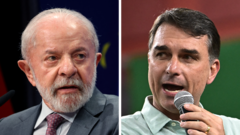
Brazil Election Results: Flávio Bolsonaro Leads Lula in Shock First Round
The air in Brasília on Sunday night was thick with the kind of tension that only a political earthquake can produce. When the final electronic voting machines reported their tallies, the official Brazil election results sent shockwaves through the continent. Right-wing challenger Flávio Bolsonaro had not just survived the first round; he had won it. Securing 47% of the vote against the incumbent left-wing President Luiz Inácio Lula da Silva’s 45%, the 45-year-old senator pulled off a stunning upset that defied months of polling.
The first round of the Brazil election results saw right-wing challenger Flávio Bolsonaro secure 47% of the vote, defeating incumbent left-wing President Luiz Inácio Lula da Silva, who garnered 45%. Because neither candidate secured an absolute majority, they will face off in a highly polarized run-off election scheduled for October 25.<\/p>
- Right-Wing Surge: Flávio Bolsonaro outperformed polling expectations, securing 47% of the vote to Lula's 45%, positioning him as the frontrunner for the second round.
- Legislative Dominance: Bolsonaro's Liberal Party (PL) captured the most seats in Congress and the Senate, ensuring a conservative-dominated legislative branch regardless of the presidential outcome.
- Geopolitical Realignment: A Bolsonaro victory would accelerate the right-wing shift in Latin America, aligning Brazil closely with the US administration and its regional security initiatives.
This sets up a brutal, winner-take-all Flávio Bolsonaro run-off on October 25. For Lula, the 80-year-old titan of the Brazilian left, the result was a cold shower. He had spent the campaign warning voters that the choice was between democracy and “barbarism,” openly admitting his expectation of an outright first-round victory. Instead, he finds himself fighting for his political life in “extra time,” facing a younger, energized conservative movement that has successfully consolidated its grip on the legislative and gubernatorial branches.
The Hard Math of the First Round
The math is brutal for the incumbent. Historically, the candidate who leads the first round of a Brazilian presidential election almost always goes on to win the presidency. With minor right-wing candidates now eliminated, their voters are highly likely to migrate to Bolsonaro, making the second round his to lose. The Liberal Party (PL) also enjoyed a historic night elsewhere on the ballot, electing the largest bloc of governors, senators, and federal deputies, ensuring that even if Lula manages a miraculous comeback, he will face an intensely hostile Congress.
To understand how the electorate has fractured, it is helpful to look at the stark policy and demographic divides that define this race. The table below outlines the competing visions for Brazil’s future:
| Metric / Policy Area | Flávio Bolsonaro (PL) | Luiz Inácio Lula da Silva (PT) |
|---|---|---|
| First-Round Vote Share | 47% | 45% |
| Core Voter Base | Wealthier South, Evangelical Christians, Agribusiness | Poorer Northeast, Low-income voters, Catholics, Women |
| Security Strategy | El Salvador-style mega-prisons, gang terror designation | Financial tracking of cartels, prison reform, police training |
| Economic Vision | Spending cuts, debt ceiling, critical mineral deregulation | Social welfare expansion (Bolsa Família), state-led investment |
| Geopolitical Alignment | Pro-US, “Shield of the Americas” coalition, Trump ally | Global South neutrality, multipolar diplomacy, BRICS focus |
This deep division underscores the intense Brazilian political polarization that has characterized the country since the tumultuous 2022 election. That contest, which Lula won by less than two percentage points, ended with the infamous January 8, 2023 riots, where supporters of former President Jair Bolsonaro ransacked government buildings in Brasília. The scars of that day remain open, and they are actively shaping the current campaign.
The Dynasty in the Shadow of the Penitentiary
Flávio Bolsonaro is no ordinary challenger. He is the political heir to Jair Bolsonaro, the former president currently serving a 27-year prison sentence for his role in masterminding the failed 2023 coup. The family’s brand of populist conservatism, once thought crippled by the elder Bolsonaro’s legal woes, has proven remarkably resilient. In fact, Sunday’s vote was a family triumph: while Flávio took the lead in the presidential race, his stepmother, Michelle Bolsonaro, secured a seat in the Senate.
The family’s message is clear, unapologetic, and highly disruptive. Flávio has already pledged to grant a full amnesty to his father and the hundreds of supporters imprisoned for the Brasília riots. It is a promise that has electrified the right and horrified the left, framing the upcoming vote not just as a choice between economic models, but as a referendum on the rule of law itself. “I am very happy with the real possibility that, three weeks from now, Brazil will give a definitive answer by choosing a modern government,” Flávio told reporters, signaling his confidence in securing the presidency.
“The Bolsonaro brand has transcended the father,” notes a senior political analyst based in São Paulo. “By running Flávio, they have presented a more polished, media-savvy version of the same populist message, allowing them to retain the hardline base while appealing to moderate conservatives who were turned off by Jair’s rhetorical excesses.”
The Vorcaro Tapes: Money, Movies, and Influence Peddling
Then there is the money. There is always the money in Brazilian politics. The campaign was rocked in its final weeks by a sprawling corruption scandal involving Daniel Vorcaro, a jailed billionaire banker behind one of the largest financial frauds in modern Brazilian history. The fallout spared neither side, but it hit the campaigns in vastly different ways.
For Flávio, the vulnerability came in the form of leaked audio recordings in which he could be heard asking Vorcaro for 134 million reais ($25.9 million) to finance a cinematic biopic about his father. Flávio admitted to the conversation but dismissed it as standard fundraising, arguing that there was nothing illegal about seeking private backing for a cultural project.
Lula, meanwhile, faced collateral damage. Police investigations suggested that Vorcaro had attempted to leverage contacts to reach Supreme Court Justice Alexandre de Moraes—the very judge who presided over Jair Bolsonaro’s coup trial and is widely perceived as a key ally of the Lula administration. Though Moraes vehemently denied any wrongdoing, the mere association fed into the right-wing narrative of a corrupt, weaponized judiciary protecting the leftist establishment. It was a narrative that resonated deeply with voters tired of systemic corruption, blunting Lula’s attempts to paint the Bolsonaros as the sole source of political rot in the country.
Iron Fists and Welfare Checks: The Policy Chasm
The policy divide between the two men represents two entirely different visions for Brazil’s future. Lula’s campaign leaned heavily on his historic legacy of poverty reduction. He pointed to the success of the Bolsa Família welfare program, which pays low-income families to keep their children in school and vaccinated. He also highlighted his environmental record, noting that deforestation in the Amazon had plummeted under his watch compared to the rampant destruction permitted during the elder Bolsonaro’s presidency.
But for many voters, particularly in the wealthier south and among the rapidly growing evangelical demographic, these arguments fell flat. Street crime, highly visible phone thefts, and the persistent grip of powerful drug factions like the PCC and CV remain daily anxieties. Flávio’s counter-offer is uncompromising: designate domestic gangs as terrorist organizations, build massive, El Salvador-style maximum-security prisons, and restore the liberalized gun ownership laws introduced during his father’s presidency.
On the economic front, Flávio has promised a strict public debt ceiling, sweeping spending cuts, and a deregulation of the critical minerals sector to attract foreign investment. Lula, conversely, has defended state-led development, including controversial oil exploration projects near the mouth of the Amazon River, while attempting to balance environmental protections. The economic anxiety is real; Brazil is grappling with high levels of personal debt and slowing growth, making Flávio’s promises of fiscal discipline and market liberalization highly attractive to the business community.
The Washington Connection and the “Shield of the Americas”
This election is not happening in a vacuum. A victory for the younger Bolsonaro would solidify a massive Latin America right-wing shift, aligning the region’s largest economy directly with the Trump administration in Washington. Donald Trump was quick to congratulate Flávio, calling it a “very, very big victory” from the White House and predicting a close but decisive run-off.
The geopolitical stakes are immense. Under Lula, Brazil has championed global south neutrality, often clashing with Washington over sanctions and trade. Flávio, by contrast, has signaled an eager willingness to join the US-led “Shield of the Americas” coalition, a security initiative aimed at dismantling transnational drug cartels. Earlier this year, Flávio successfully lobbied the US to designate Brazil’s two largest gangs as terrorist organizations, a move that Lula criticized as foreign interference but which played incredibly well with security-conscious voters at home.
Lula has made “sovereignty” a key pillar of his campaign, occasionally accusing the US of trying to influence the election—a charge the US State Department has repeatedly denied. The president of Brazil’s supreme electoral court stated on Sunday that no evidence of international interference was found, but the rhetorical battle lines are drawn. A Bolsonaro victory would fundamentally alter the balance of power in the Western Hemisphere, creating a powerful conservative axis stretching from Washington to Brasília.
The Extra-Time Strategy
For Lula, the path forward is narrow, steep, and littered with obstacles. The 80-year-old leader must now do what he has done throughout his long career: negotiate, build coalitions, and mobilize the masses. “The game is about to start,” Lula told supporters on Sunday night, defiant despite the setback. “We are in extra time. In extra time, we will win over the Brazilian people.”
To do so, he will need to convince moderate voters that a Flávio Bolsonaro presidency represents a return to the instability of his father’s term, while offering concrete solutions to the economic and security anxieties that drove voters into the challenger’s camp. It is a monumental task. The electorate is deeply entrenched, and the momentum is firmly with the challenger.
As the campaign enters its final, frantic three weeks, the eyes of the world will be on Brazil. The outcome will not only decide the fate of the Amazon and the economic trajectory of Latin America’s powerhouse; it will determine whether the global tide of conservative populism has found its newest, and perhaps most powerful, champion. For more detailed analysis on the regional impact of this vote, readers can consult coverage on Reuters and Bloomberg.
<button type="button" onclick="this.parentElement.innerHTML='✓ Thank you, we will refine our analysis!‘” style=”background:#ffffff; border:1px solid #cbd5e1; border-radius:6px; padding:4px 12px; font-size:12px; cursor:pointer; color:#334155;”>👎 No
