
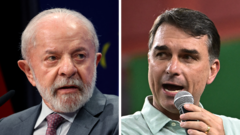
Brazil Election: Lula and Flávio Bolsonaro Face Off
The polls are closed. Brasília is waiting. Democracy is holding its breath.
The Brazil election Lula vs Flavio Bolsonaro features incumbent left-wing President Luiz Inácio Lula da Silva taking on Senator Flávio Bolsonaro, son of disgraced former president Jair Bolsonaro. With both frontrunners polling around 40%, the race hinges on economic policy, Amazon conservation, and fallout from a massive financial fraud scandal.<\/p>
- A Deadlock at the Top: Incumbent Luiz Inácio Lula da Silva and Senator Flávio Bolsonaro are tied near 40% in opinion polls, making an October run-off almost inevitable.
- Shadow of Jair Bolsonaro: Convicted of plotting a coup and serving a 27-year sentence, former president Jair Bolsonaro remains a potent force through AI avatars and his son's campaign.
- The Vorcaro Scandal Shift: Corruption charges surrounding jailed banker Daniel Vorcaro have disrupted both campaigns, entangling Flávio in an illicit film-funding probe and implicating allies of Lula's camp.
- Geopolitical Friction: Lula's rejection of Washington's regional influence contrasts sharply with Flávio Bolsonaro's open courting of the Trump administration.
As electronic ballot tallies tick upward across Latin America’s largest nation, the Brazil election Lula vs Flavio Bolsonaro showdown has reached its agonizing climax. Nearly 160 million citizens were called to the booths on Sunday to choose between two diametrically opposed visions for the country. On one side stands incumbent President Luiz Inácio Lula da Silva, the 80-year-old titan of the Latin American left. On the other stands Senator Flávio Bolsonaro, the 45-year-old heir to a right-wing dynasty that refuses to fade into history.
This is not merely an election. It is an ideological rematch by proxy. Four years after Lula narrowly defeated former President Jair Bolsonaro in a bitter contest that ended in an insurrection, the political battleground remains intensely polarized. With both frontrunners hovering around 40% in final poll aggregations, the prospect of an outright victory in the first round appears slim, pointing toward a tense runoff on October 25.
The Ghost in the Machine: Jair Bolsonaro’s Enduring Shadow
Jair Bolsonaro isn’t on the ballot. He can’t be. The 71-year-old former army captain is serving a 27-year sentence under house arrest for his role in plotting a violent coup following his 2022 defeat. Supreme Court orders strictly forbid him from posting on social media or addressing the public. Yet, his presence overhangs this entire campaign cycle like a permanent thunderstorm.
When Flávio Bolsonaro launched his presidential bid, he made sure his father was in the room—virtually. Campaign organizers screened a slick video featuring a high-definition, AI-generated avatar of Jair Bolsonaro issuing a ringing endorsement of his eldest son. The deepfake immediately triggered legal challenges from the Electoral Court, with the elder Bolsonaro’s lawyers issuing delicate denials regarding official authorization. But the political message had already hit its target: Flávio is the undisputed carrier of the Bolsonarista torch.
“They can silence a man, lock him in his house, and ban his voice, but they cannot delete the movement he created,” an insider from the Liberal Party (PL) stated during a rally in São Paulo. “Flávio isn’t just running as a senator; he’s running as his father’s vindication.”
The younger Bolsonaro has leaned heavily into this heritage while attempting to project a calmer, more tactical demeanor than his famously incendiary father. A lawyer by training who has served in the Senate since 2019, Flávio has concentrated his message on economic deregulation, hardline criminal justice initiatives, and aggressive courting of Brazil’s powerful evangelical Christian bloc and agribusiness magnates.
Two Visions for Latin America’s Superpower
The policy divide between the two candidates could not be starker. Lula’s third presidential term has been defined by a return to state-led social welfare programs, international diplomacy, and environmental protection initiatives. Under his administration, satellite tracking confirms that Amazon deforestation dropped to a ten-year low in mid-2026—a key selling point for global allies concerned with climate stability, as detailed in reports by Reuters on South American environmental trends.
However, Lula’s domestic record has drawn fire from both sides. Environmental purists criticize his approval of offshore oil exploration near the mouth of the Amazon River. Lula counters that oil revenues are non-negotiable for funding Brazil’s transition toward clean energy infrastructure, insisting that state energy firm Petrobras must secure sovereign wealth to finance future green technology.
Flávio Bolsonaro offers a radically different economic blueprint. He promises to eliminate environmental regulations that he claims choke agricultural productivity. When pressed during a television interview regarding past comments dismissing climate change, Flávio offered a mild concession, acknowledging that while “extreme events” occur, they remain largely “cyclical.” His focus remains firmly on deregulation: “getting the state off the farmer’s back.”
On national security, Flávio advocates for dramatically expanded private gun ownership and harsher penal codes. He successfully lobbied Washington to designate top Brazilian drug syndicates—the Comando Vermelho (CV) and Primeiro Comando da Capital (PCC)—as Foreign Terrorist Organizations, a unilateral move strongly resisted by Lula’s foreign ministry on sovereign jurisdictional grounds.
Candidate Comparison: Key Indicators
To understand how these two leaders contrast across core policy areas, consider the breakdown below:
| Metric / Issue | Luiz Inácio Lula da Silva (PT) | Flávio Bolsonaro (PL) |
|---|---|---|
| Age / Status | 80 (Turning 81) / Incumbent President | 45 / Sitting Federal Senator |
| Core Poll Standing | ~41% (Lead frontrunner) | ~39% (Challenger) |
| Primary Economic Strategy | State investment, social cash-transfers (Bolsa Família) | Free-market deregulation, tax cuts for agriculture |
| Environmental Policy | Target zero deforestation; fossil-fuel transition fund | Reduce farming restrictions; views climate events as cyclical |
| Public Security Approach | State intelligence, social crime intervention | Laxer gun ownership laws, mandatory minimum sentences |
| Foreign Policy Alignment | Multilateral non-alignment; strong Latin American sovereignty | Pro-US conservative alignment; close tie to Trump administration |
The Vorcaro Scandal: Corruption Re-Emerges at the Final Hour
For months, public opinion polls signaled that urban violence and violent crime were the top anxieties for voters. Then came the Daniel Vorcaro affair.
In late August, an explosive investigation into jailed financier Daniel Vorcaro—alleged mastermind behind one of the largest private banking frauds in Brazilian history—upended the entire campaign. Vorcaro’s sprawling web of political connections reached across the aisle, but the fallout hit both leading camps with precision efficiency.
First, police recordings surfaced showing Flávio Bolsonaro soliciting 134 million reais ($25.9 million) from Vorcaro to finance a big-budget biographical film celebrating his father’s political career. Federal prosecutors immediately opened an investigation into the younger Bolsonaro for criminal money laundering and illicit political financing. Flávio admitted discussing the project but fiercely denied any corrupt intent, writing off the probe as a political hit job orchestrated by government agencies.
Yet, just as the right-wing campaign reeled from the allegations, leaking police files struck the government’s allies. Intelligence reports leaked to the press exposed dozens of phone logs and encrypted messages between Vorcaro and a mobile line connected directly to Supreme Court Justice Alexandre de Moraes. Moraes was the presiding magistrate who jailed Jair Bolsonaro and set strict terms for his house arrest.
According to investigative transcripts, Vorcaro reached out directly to Moraes’ team seeking intervention to dodge an imminent arrest warrant. While Justice Moraes forcefully denied any wrongdoing or improper contact, the scandal allowed Flávio Bolsonaro to pivot from defense to offense.
“Voting for Lula isn’t just voting for the PT—it’s voting for Alexandre de Moraes,” Flávio declared to thousands of cheering supporters at an election eve rally in Rio de Janeiro. “The system is protecting itself.”
Lula moved quickly to insulate his campaign, declaring publicly that “no citizen, judge or politician, stands above the rule of law.” But the damage was done. The scandal revitalized anti-establishment sentiment among undecided voters right before election day.
Geopolitical Frictions: Washington and the “Donroe Doctrine”
The international implications of the Brazil election Lula vs Flavio Bolsonaro run deep, particularly regarding relations with the United States. Tensions between Brasília and Washington have simmered for months, exacerbated by ideological clashes between President Lula and the conservative Trump administration.
Lula’s foreign ministry recently took the unprecedented step of revoking entry visas for two high-ranking U.S. government officials, citing intelligence reports of clandestine foreign interference in the electoral process. Addressing the United Nations General Assembly, Lula delivered a blunt message aimed at Washington’s assertive foreign policy stance, which critics have labeled a modern revival of the Monroe Doctrine.
“Brazil does not fit into anyone’s backyard,” Lula warned, emphasizing national self-determination. “We will not tolerate foreign and local enemies of democracy seeking to dictate the outcome of our elections.”
Conversely, Flávio Bolsonaro has actively courted Washington political figures. During an unannounced visit to the White House earlier this year, Flávio met with American conservative strategists, pledging to sign Brazil up for the “Shield of the Americas” anti-crime alliance if elected. His campaign has openly signaled that a Bolsonaro victory would mean immediate geopolitical alignment with Washington’s security apparatus.
The Mathematical Reality: Why a Runoff Loomed
Brazil’s electoral rules are straightforward: a candidate must secure more than 50% of all valid votes (excluding blank and spoiled ballots) in the first round to win outright. If no candidate crosses that threshold, the top two contenders advance to a head-to-head runoff.
According to Bloomberg analysis of political metrics in South America, reaching an outright victory in a polarized nation of 160 million is an immense logistical challenge. With eleven minor candidates soaking up a combined 10% to 12% of the electorate, and an estimated 9% of voters remaining undecided or planning to spoil their ballots until the final hours, the numbers pointed toward an October 25 showdown.
Voting is legally compulsory for literate citizens between 18 and 70 years old. Those who fail to show up face federal fines and administrative freezes on public services. This mandatory turnout rule brings tens of millions of politically disengaged citizens into the voting booths, creating late shifts that traditional polling struggles to capture.
What Happens Next?
The Superior Electoral Court (TSE) relies on a fully digital voting system capable of tabulating tens of millions of votes within hours of poll closures. By midnight in Brasília, the nation will know whether Lula has secured a final mandate or if Flávio Bolsonaro has forced a grueling three-week runoff battle.
Regardless of the immediate tally, one thing is certain: the deep ideological divide that has defined Brazilian politics for a decade is far from resolved. As the electronic tallies update line by line, the entire continent watches to see whether Brazil chooses the continuity of Lula’s elder statesmanship or the defiant resurrection of the Bolsonaro legacy.
<button type="button" onclick="this.parentElement.innerHTML='✓ Thank you, we will refine our analysis!‘” style=”background:#ffffff; border:1px solid #cbd5e1; border-radius:6px; padding:4px 12px; font-size:12px; cursor:pointer; color:#334155;”>👎 No
Latest Analytical Follow-up: For continuous developments on this subject, read our full investigation on Red Sea Waterway Security Restored After Major Yemen Offensive.
Latest Analytical Follow-up: For continuous developments on this subject, read our full investigation on Brazil Election Results: Flávio Bolsonaro Leads Lula in Shock First Round.
Latest Analytical Follow-up: For continuous developments on this subject, read our full investigation on Trump Confirms Threat Behind RAF Fairford Bomber Withdrawal.
