
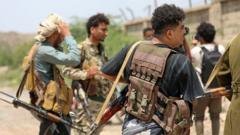
Red Sea Waterway Security Restored After Major Yemen Offensive
The guns of Mokha are silent, for now. In a swift and violent shift of the front lines, Yemeni pro-government forces, heavily supported by Saudi Arabian airpower, claim to have restored Red Sea waterway security after seizing the strategic port city of Mokha and securing the Bab al-Mandab Strait. This dramatic offensive marks the beginning of a sweeping military campaign aimed at breaking the Houthi movement’s grip on the country’s western coast.
Red Sea waterway security has become the focal point of a massive military escalation in Yemen, where pro-government forces backed by Saudi airstrikes have retaken the strategic port city of Mokha and the Bab al-Mandab Strait. This offensive aims to neutralize Houthi maritime blockades and secure critical global energy corridors.<\/p>
- Strategic Seizure: Yemeni pro-government forces have captured the port city of Mokha and secured the Bab al-Mandab Strait, a vital chokepoint for global oil transit.
- Operation Yemen Dawn: The internationally recognized government has launched an all-out offensive to reclaim all Houthi-held territories, ending a fragile four-year informal ceasefire.
- Economic Retaliation: Houthi forces responded with ballistic missile and drone strikes targeting Saudi Aramco facilities in Riyadh and Khurais, causing visible damage verified by satellite imagery.
- Humanitarian Toll: The escalation has displaced nearly 200,000 people and resulted in over 950 deaths since early August, with civilian infrastructure in Sanaa caught in the crossfire.
For months, the waters off Yemen have been a volatile theater of war. The Bab al-Mandab Strait, a narrow neck of water through which millions of barrels of oil pass daily, has been the site of intense geopolitical maneuvering. The latest push by the Yemeni military, utilizing a coalition of battle-hardened ground units, represents the most significant challenge to Houthi territorial gains in years. But while the government celebrates a tactical victory, the broader region braces for a dangerous cycle of retaliation.
Red Sea Waterway Security and the Global Energy Choke Point
To understand the gravity of the situation, one must look at the global energy map. The Bloomberg commodity index recently reflected a sharp uptick in crude prices, a direct consequence of the Bab al-Mandab Strait conflict. When Houthi forces seized Mokha and Perim Island last month, they effectively held a knife to the throat of global trade.
“The Red Sea is no longer just a regional shipping lane; it is the primary artery keeping the Saudi oil economy afloat while the Strait of Hormuz remains highly restricted,” notes a senior maritime security analyst. “If the government cannot guarantee safety here, global supply chains face severe disruption.”
The Yemeni military’s announcement that it has “secured” the waterway is an attempt to reassure international shipping firms. However, reassurance is hard to come by when the skies are filled with drones and ballistic missiles. The Houthis have proven remarkably resilient, using asymmetric warfare to counter the conventional military superiority of the Saudi-backed coalition. While pro-government forces now hold the coastline, the high ground remains contested, leaving shipping lanes within range of mobile missile launchers.
Inside Operation Yemen Dawn
The offensive, officially dubbed Operation Yemen Dawn, was announced on Sunday by Rashad al-Alimi, the head of Yemen’s internationally recognized Presidential Leadership Council. Al-Alimi’s address was uncompromising. He declared that all diplomatic avenues had been exhausted, framing the offensive as a war of liberation against what he termed the “Houthi terrorist militia.”
The ground assault was executed by a coalition of highly motivated factions:
- The National Shield: A newly formed, Saudi-funded force trained specifically for rapid intervention.
- The Giants Brigades: Salafist-led fighters known for their discipline and effectiveness in coastal warfare.
- The Tihama Resistance: Local fighters intimately familiar with the rugged terrain of the Red Sea coast.
These forces moved rapidly. By Monday afternoon, they had captured Dhubab airport before pushing north to overwhelm Houthi defenses inside Mokha. The speed of the advance caught many observers by surprise, but it was made possible only by a relentless, “round-the-clock” aerial bombardment by Saudi fighter jets. According to coalition spokesmen, these strikes targeted and destroyed over 320 high-value Houthi assets, including air defense systems, command centers, and ammunition depots.
The Aramco Strikes and the Cost of Retaliation
The Houthi response was not long in coming, and it did not target the coast. Instead, the group struck deep into the Saudi heartland. Houthi military spokesmen claimed responsibility for a series of coordinated Saudi Aramco drone strikes and ballistic missile attacks targeting oil facilities in Riyadh and the Khurais area.
While Saudi authorities initially downplayed the impact, independent verification tells a different story. Satellite imagery analyzed by media outlets, including Reuters, revealed thick, dark plumes of smoke rising from the Aramco Riyadh Refinery and the Khurais Central Processing Facility. These strikes demonstrate the Houthis’ ability to project power far beyond their borders, hitting the Kingdom where it hurts most: its energy infrastructure.
The Houthi-run Humanitarian Operations Co-ordination Centre took the escalation a step further, issuing a stark warning to civilian airlines. They declared Saudi airspace—excluding the skies over the holy cities of Mecca and Medina—a “theatre of operations,” warning that civilian flights were no longer safe. This move threatens to isolate the Kingdom aerially and raises the stakes for international airlines operating in the Middle East.
A Humanitarian Catastrophe in the Shadows
Behind the strategic movements of armies and the fluctuations of oil prices lies a staggering human cost. The Yemen civil war escalation has reignited a humanitarian crisis that the United Nations had been desperately trying to contain. Since the informal ceasefire began to unravel in July, the fighting has claimed the lives of nearly a thousand people, with thousands more wounded.
In Sanaa, the Houthi-controlled capital, Saudi airstrikes aimed at military targets have reportedly struck residential areas. Local media reported the deaths of a schoolgirl and a woman during Monday’s raids. Houthi spokesman Mohammed Abdul Salam condemned the strikes, accusing Saudi Arabia of committing massacres and warning of severe consequences. Meanwhile, the UN reports that another 197,000 Yemenis have been forced to flee their homes, joining the millions already displaced by a decade of conflict.
Conflict Dynamics: Before and After Operation Yemen Dawn
The following table outlines the dramatic shift in the conflict’s parameters following the launch of the government’s latest offensive:
| Metric / Area | Status Prior to August Offensive | Current Status (Post-Operation Dawn) |
|---|---|---|
| Mokha & Bab al-Mandab | Under Houthi control; maritime embargo active. | Secured by pro-government forces; shipping lanes contested. |
| Saudi Airspace | Generally safe; sporadic drone activity. | Declared an active “theatre of operations” by Houthis. |
| Oil Price Volatility | Moderate; driven by global economic factors. | High; spiked due to Aramco strikes and Red Sea instability. |
| Displaced Populations | Relatively stable under informal ceasefire. | An additional 197,000 people displaced since August. |
The Proxy War and the Strait of Hormuz Connection
The current fighting cannot be viewed in isolation. It is deeply intertwined with the broader geopolitical struggle between Riyadh and Tehran. When the United States and Israel’s conflict with Iran effectively closed the Strait of Hormuz, the Red Sea became Saudi Arabia’s economic lifeline. The Houthis, widely believed to receive intelligence, training, and advanced weaponry from Iran, understood this vulnerability perfectly.
By launching a “maritime embargo” in July, the Houthis were not just retaliating for the Saudi blockade of their own ports; they were executing a strategic maneuver designed to squeeze the Saudi economy. The rapid loss of Mokha and Dhubab last month was a red line for Riyadh. It forced the Kingdom to abandon the informal ceasefire and back a high-risk, all-out offensive to reclaim the coast.
However, holding territory is vastly different from capturing it. The Giants Brigades and National Shield forces may now control the ports, but they are operating in a highly hostile environment. The Houthis have already demonstrated their tactical flexibility by cutting a key mountain road near the southwestern city of Taiz, effectively surrounding government forces and civilian residents in the area. This siege tactic could allow the Houthis to divert government resources away from the coast, setting the stage for a grueling war of attrition.
Tactical Realities: Can the Coalition Hold the Coast?
Military analysts remain skeptical about the long-term stability of the government’s gains. The Tihama coastline is notoriously difficult to defend against guerrilla incursions. The Houthis have spent years embedding themselves within the local population and constructing elaborate underground networks.
If pro-government forces are stretched too thin trying to secure both the coast and the interior highlands, they risk being cut off and destroyed piecemeal. Furthermore, the reliance on Saudi air support is a double-edged sword. While it provides decisive firepower on the battlefield, the resulting civilian casualties fuel local resentment, making it easier for the Houthis to recruit new fighters.
The road forward is fraught with peril. Operation Yemen Dawn has succeeded in its immediate objective of restoring a semblance of control over the Bab al-Mandab Strait. Yet, as long as the skies over Saudi Arabia remain a battleground and the highlands of Yemen remain under Houthi control, the promise of true maritime security remains an elusive mirage. The conflict has entered a new, more dangerous phase, and the global economy will inevitably feel the tremors.
<button type="button" onclick="this.parentElement.innerHTML='✓ Thank you, we will refine our analysis!‘” style=”background:#ffffff; border:1px solid #cbd5e1; border-radius:6px; padding:4px 12px; font-size:12px; cursor:pointer; color:#334155;”>👎 No
