
How Indian AI Start-ups Fix Broken Roads and Land Records
When Sanjay Mandava boarded a flight from Chicago to Chennai in 2020 to settle a family property conflict, he expected routine paperwork. Instead, he stepped straight into a bureaucratic labyrinth. Over several grueling months, Mandava bounced between regional land registration offices, municipal archives, and revenue departments. He was trying to produce a string of ancient paper records just to establish clear legal title to his family’s ground.
Indian AI start-ups are leveraging downstream artificial intelligence, computer vision, and geospatial data to resolve deeply rooted domestic challenges. Rather than training broad foundational models, these ventures focus on pragmatic civic applications—ranging from automating complex, fragmented land record verification and mapping urban road damage to optimizing public healthcare triage in municipal hospitals.<\/p>
- Targeted Problem-Solving: Unlike Western giants focused on foundational frontier LLMs, Indian ventures concentrate heavily on downstream AI applications tailored to hyper-local structural bottlenecks.
- Surging Capital, Hardware Constraints: Funding for national AI start-ups jumped 265% year-on-year, crossing $1 billion in nine months, despite severe access limitations to high-performance GPU hardware.
- Legal & Infrastructure Focus: Deep-tech tools are actively tackling systemic legal drag—such as presumptive property titling involving 1.8 billion records—and municipal urban upkeep like road pothole remediation.
- Monetization & Scalability Friction: Founders face an asymmetry between Western-tier compute costs and lower domestic paying capacity, forcing companies to move beyond public pilots into sustainable commercial models.
A basic sale deed was nowhere near sufficient. Authorities demanded building approval certificates, historical tax receipts, and legacy survey maps dating back decades. The ordeal revealed a stark reality about real estate across the country. A new wave of Indian AI start-ups is now emerging specifically to dismantle these structural bottlenecks.
The Presumptive Titling Trap and the Geospatial Solution
The core issue lies in the nation’s legal framework for real estate. Unlike Western jurisdictions where state guarantees back property titles, India relies on presumptive titling. Ownership is inferred rather than certified by the state. Buyers carry the legal burden of tracing an unbroken line of ownership through disconnected records. When you consider that roughly 80% of household wealth in India is tied up in real estate, the financial stakes are massive. Land disputes routinely choke court dockets, accounting for the vast majority of civil litigation nationwide.
Frustrated by his personal ordeal, Mandava founded Landeed. The platform functions as a deep-tech aggregator designed to solve a friction point unique to the subcontinent. By tapping into geospatial mapping, municipal databases, and revenue records across 24 states, the company has constructed a massive clearinghouse of real estate intelligence. It holds an unprecedented repository of 1.8 billion records, linking physical parcels directly to official survey numbers and tax identities.
“In the US or UK, when you purchase a property, the government verifies ownership. In India by contrast, we follow presumptive titling—the buyer is responsible for establishing ownership,” Mandava explains.
Reading these fragmented, unstructured documents manually used to take real estate lawyers and independent brokers several days. Landeed deployed an artificial intelligence layer capable of optical character recognition and natural language processing across multiple regional languages. It parses complex titles, highlights missing documentation, and flags ownership inconsistencies in under three minutes. Millions of retail buyers and enterprise real estate firms now use the service to conduct due diligence before capital changes hands.
Dashcams, Algorithms, and Municipal Potholes
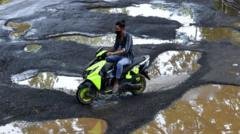
While legal tech works to digitize property boundaries, another group of founders is focusing on physical civic infrastructure. Urban transit across major Indian hubs has long suffered from chronic road damage, exacerbated by intense monsoon seasons and heavy traffic density. Traditional road maintenance relies on manual inspections or passive citizen complaints—an inefficient, slow model.
Enter Gaurav Sen, a Bengaluru-based developer and prominent online educator. Sen built an intelligent computer vision application that turns routine road transit into a automated civic audit. By mounting standard dash-cams onto moving vehicles, his system feeds high-definition street video into an AI vision pipeline paired with satellite-based navigation.
The system automatically detects asphalt degradation, measures pothole dimensions, maps exact coordinates, and identifies the specific municipal office responsible for that ward. The data is then routed directly to public works departments.
Sen’s initiative isn’t an isolated experiment. Across the nation, at least six deep-tech ventures are deploying computer vision systems to map road damage. Municipal authorities can easily install these edge-AI applications on public transit buses or garbage trucks, transforming municipal fleets into real-time road quality monitoring networks.
Scalpels and Code: Clinical Support in Mumbai
Downstream technology applications are proving equally transformative inside public health facilities. In Mumbai, data analytics firm Fractal Analytics deployed its specialized tool, “Vaidya,” across hospitals operated by the local civic authority, Municipal Corporation of Greater Mumbai.
Public healthcare facilities in megacities handle astounding patient volumes every day. Doctors often have mere minutes per consultation. Vaidya acts as a digital triage assistant. The system processes patient history, simplifies complex diagnostic lab reports into clear summaries across local languages for citizens, and generates pre-consultation briefings for attending physicians.
For public health managers, the aggregated, anonymized insights offer a live telemetry dashboard of community health. The software spots localized spikes in infectious diseases or shifts in metabolic markers long before traditional epidemiological reporting catches up.
Comparative Snapshot: Frontier vs Downstream AI Deployment
To understand how this landscape differs from global technology hubs, it helps to look at operational priorities. While Silicon Valley pours billions into frontier foundation models, local ventures emphasize field deployment under severe resource constraints.
| Metric / Focus Area | Western Paradigm (Frontier AI) | Indian Ecosystem (Downstream Civic AI) |
|---|---|---|
| Primary Objective | General intelligence, large multimodal models | Applied problem-solving, local datasets |
| Core Technologies | Trillion-parameter LLMs, massive compute clusters | Computer vision, OCR, geospatial integration |
| Primary End Users | Global enterprise, broad consumers | Regional citizens, municipal bodies, retail buyers |
| Major Constraints | Safety alignment, high inference overhead | GPU hardware scarcity, low customer price sensitivity |
| Data Dynamics | Broad web-scale text and media curation | Fragmented, multi-lingual, physical archival records |
The Downstream Paradox: Capital Surges vs Compute Scarcity
The market has noticed this shift toward practical, high-impact applications. According to market data from Inc42, venture funding targeting national AI applications surged 265% year-on-year. Founders secured over $1 billion in the first nine months of the year—a notable achievement given the broader venture capital slowdown.
Yet, building high-performance applications in emerging markets presents a distinct operational dilemma. The underlying hardware costs of deep learning do not adjust based on regional purchasing power.
“The cost of building in India is sometimes much higher than what Indian customers are willing to pay,” says Srikanth Velamakanni, co-founder of Fractal Analytics. “The computing power needed to run an AI model is the same whether it is built in India or the US—but American customers have a far bigger paying capacity.”
The situation is made harder by hardware access. Advanced graphics processing units (GPUs) remain difficult to acquire locally. While the central government’s AI Mission pledged to make 38,000 GPUs available to local ventures, actual operational demand far outstrips public supply allocations. Indian entrepreneurs are forced to design around structural compute scarcity—optimizing small models to run efficiently on limited hardware budget envelopes.
Moving Beyond Pilots to Defensible Moats
The long-term success of Indian AI start-ups depends on their ability to turn initial pilot projects into recurring, sustainable enterprise contracts. Working with government entities often means navigating complex procurement cycles, changing administrative priorities, and limited municipal budgets.
There is also the threat of displacement by global technology giants. Major platforms can easily add basic civic reporting or document processing features into their existing product suites. Local founders must build defensible technical moats through proprietary hyper-local datasets and deep integration with municipal workflows.
Sen candidly acknowledges these competitive risks. “Someone like a Google will probably laugh if I tell them of my pilot,” he admits. “To make it sustainable and hard to replicate, it will have to be much more sophisticated.”
Despite capital limitations, regulatory hurdles, and compute constraints, these founders remain committed to their mission. They are demonstrating that deep technology does not always require multi-billion-dollar datacenter clusters to create meaningful economic value. By addressing practical domestic problems like title verification and road repairs, these start-ups are creating a distinct, application-first playbook for emerging markets worldwide.
<button type="button" onclick="this.parentElement.innerHTML='✓ Thank you, we will refine our analysis!‘” style=”background:#ffffff; border:1px solid #cbd5e1; border-radius:6px; padding:4px 12px; font-size:12px; cursor:pointer; color:#334155;”>👎 No
Latest Analytical Follow-up: For continuous developments on this subject, read our full investigation on California Sues OpenAI Over Hugging Face Attack.
