
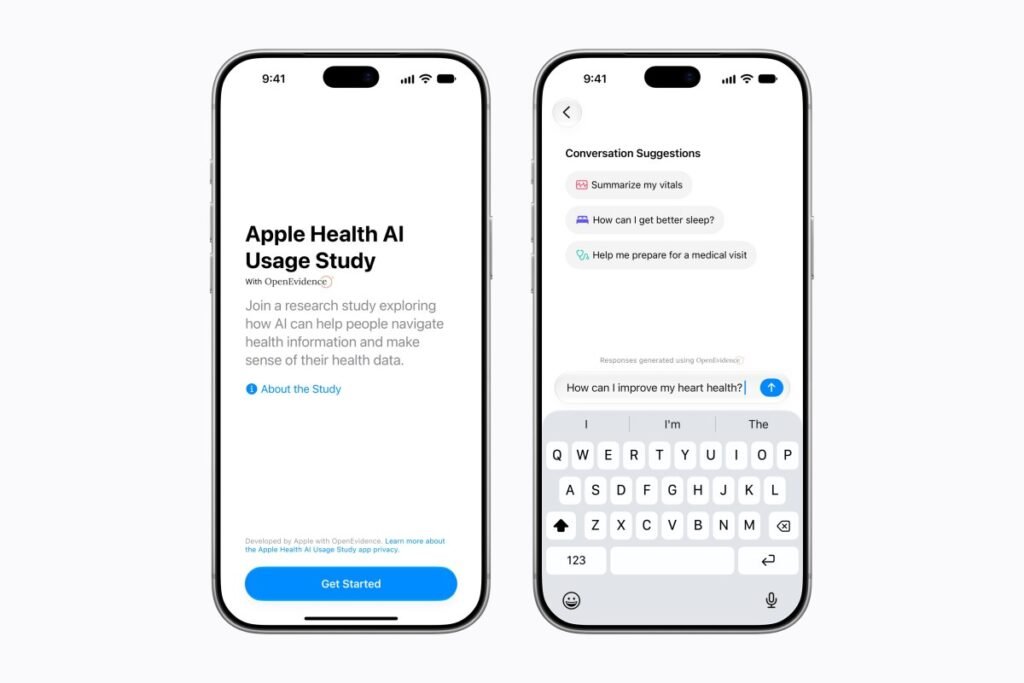
Apple Health AI Study: Reimagining Medical Intelligence
Silicon Valley has spent the last two years racing to transform general-purpose large language models into virtual physicians. Consumer demand is staggering: market reports indicate that users enter more than 300 million medical queries into generic AI interfaces every week. Yet, as competitors rush conversational tools directly to consumers, the tech giant in Cupertino is adopting a noticeably different cadence. The newly launched Apple health AI study marks a deliberate shift away from unvetted consumer chatbots, prioritizing empirical research and clinical validation over rapid commercial deployment.
The Apple health AI study is a 12-month research initiative involving up to 200,000 U.S. participants to evaluate how clinically grounded AI answers impact user health management. Partnering with OpenEvidence, the study leverages peer-reviewed literature and HealthKit metrics while enforcing strict data anonymization and 24-hour retention limits.<\/p>
- Research-First Approach: Unlike competitors deploying broad chatbots, Apple is running a rigorous 12-month study with up to 200,000 participants before integrating generative health tools into Siri or Health.
- Peer-Reviewed Grounding: The initiative leverages an OpenEvidence Apple partnership to source answers directly from journals like NEJM, JAMA, and Nature.
- HealthKit Integration: Participants can optionally sync physiological metrics—resting heart rate, sleep patterns, lab records—to receive personalized, contextual responses.
- Zero Model Training: All user data is anonymized, sent to secure cloud infrastructure, and completely purged by OpenEvidence within 24 hours without being used for AI training.
Instead of turning Siri into an instant diagnostician, Apple is executing a 12-month research program designed to observe how everyday consumers interact with, comprehend, and evaluate medical information generated by artificial intelligence. By pairing peer-reviewed academic literature with real-time biometric metrics, the initiative seeks to establish whether high-trust, source-backed language models can alter patient behavior without sacrificing data privacy.
Inside the Apple Health AI Study Infrastructure
The scope of the initiative is substantial. Apple is opening enrollment to as many as 200,000 participants across the United States. To join, users must be at least 21 years old, operate an iPhone 15 or later updated to iOS 26, and have Apple Intelligence active on their device. Participants gain access to a dedicated iOS research application where they can pose complex health questions—ranging from interpreting a lab value to understanding chronic symptom patterns.
Where general-purpose chatbots rely on broad internet crawls that occasionally produce plausible-sounding hallucinations, Apple’s test environment relies on clinically grounded AI. The system pulls core data from established medical institutions and peer-reviewed journals, including The New England Journal of Medicine, the Journal of the American Medical Association (JAMA), and Nature. The objective is to translate highly dense academic research into clear, accessible prose without losing scientific accuracy.
“At Apple, we believe responsible innovation starts with scientific rigor and clinical grounding. Health is deeply personal, and conducting a dedicated research study is the most thoughtful way to understand how people engage with, comprehend, and evaluate health AI in everyday life,” said Dr. Sumbul Desai, Vice President of Health and Fitness at Apple.
Participants are expected to actively critique the system. Users rate individual responses, provide granular qualitative feedback, and complete monthly surveys detailing whether the information clarified their health concerns or influenced their clinical decisions.
Bridging Peer-Reviewed Literature and HealthKit Metrics
Static medical answers often fail because they lack personal context. A blood pressure reading that is normal for an athlete might signal hypertension in a sedentary patient. Apple addresses this by incorporating optional HealthKit data integration directly into the research interface.
Users can grant the application temporary access to continuous physiological signals collected by their devices. These metrics include:
- Resting Heart Rate & Variability: Providing baseline cardiovascular metrics over multi-week windows.
- Sleep Architecture: Tracking sleep stage distribution, disturbances, and duration trends.
- Daily Activity Patterns: Measuring exertion, steps, and active caloric burn against baseline normatives.
- Exported Lab Results: Parsing digitized blood panels, lipid profiles, and metabolic markers.
By pairing biometric background with precise queries, the application produces tailored responses. For instance, if a user inquires about unexpected fatigue, the model cross-references peer-reviewed literature on sleep fragmentation and iron deficiency against the participant’s actual sleep logs and recent blood work. Rather than offering a definitive diagnosis, the platform serves as an analytical bridge between raw telemetry and clinical dialogue.
Preparing Patients for Real-World Care
A primary goal of the study is assessing how AI tools impact downstream medical utilization. Rather than keeping users trapped inside a digital loop, the app explicitly attempts to improve doctor-patient interactions. It generates structured summaries and suggested questions that participants can bring to their next appointment. When queries flag potentially urgent symptoms, the software redirects users toward professional clinical care, providing directory guidance for local healthcare providers.
Privacy Architecture: Anonymization and 24-Hour Data Purges
Handling personal medical data alongside generative software presents significant compliance and privacy hurdles. Central to Apple’s deployment is its strategic OpenEvidence Apple partnership. OpenEvidence, a specialized firm focused on clinical AI tools for medical professionals, provides the underlying domain-specific retrieval mechanisms.
To maintain consumer trust, Apple has constructed strict architectural boundaries around AI medical advice privacy:
- Local Anonymization: Before any query or HealthKit metric leaves the participant’s iPhone, personal identifiers—such as names, IP addresses, and exact locations—are stripped entirely.
- Encrypted Transport: Anonymized payloads route to secure third-party cloud environments using end-to-end encryption protocols.
- Zero Training Retention: Data processed during the study is explicitly excluded from being used to train foundation models for Apple, OpenEvidence, or any external entity.
- Mandatory Ephemeral Purges: OpenEvidence operates under a strict protocol that permanently deletes all query logs and generated answers within 24 hours of transmission.
This zero-retention methodology stands in stark contrast to mainstream consumer AI platforms, which frequently retain user conversations for reinforcement learning and model fine-tuning unless users manually opt out.
Comparing Consumer Health AI Frameworks
The tech industry’s major players are split on how to bring artificial intelligence into the medical sphere. The table below outlines how Apple’s research-first methodology compares to broader market strategies reported across the tech sector, according to analysis covered by Bloomberg and industry research.
| Provider / System | Primary Data Source | Clinical Validation Method | Data Retention & Privacy | Primary Target Audience |
|---|---|---|---|---|
| Apple Research Study App | NEJM, JAMA, Nature, OpenEvidence | 12-month, 200,000-user clinical study | Anonymized; 24-hour purge; zero model training | Enrolled U.S. consumer research participants |
| OpenAI (ChatGPT) | Broad web index & fine-tuned medical datasets | Internal benchmarks & medical expert evaluations | Retained for model training (unless opted out) | General consumer base (300M+ weekly health queries) |
| Anthropic (Claude) | Curated web indices & safety fine-tuning | Red-teaming & constitutional AI alignment | Standard enterprise/consumer privacy terms | Developers, enterprise partners, end consumers |
| Google (Med-PaLM / Gemini) | Medical text sets & institutional partner data | Peer-reviewed clinical benchmark testing | Enterprise-grade HIPAA compliant cloud tiers | Healthcare systems, clinicians, enterprise search |
A Scientific Counter-Weight to AI Hype
Apple’s cautious posture reflects broader tension within the digital health sector. While general consumer platforms have embraced rapid public deployment, medical professionals routinely warn about hallucinated treatments, misread lab values, and overconfident diagnoses. Industry analysis from Reuters highlights growing regulatory interest in how large language models handle consumer safety when offering informal medical guidance.
Apple is intentionally avoiding the quick release of unvalidated medical features into Siri or its primary Health application. By isolating the technology within a dedicated research app, the company creates a regulatory sandbox. It can study user comprehension, measure accuracy, and evaluate risks without exposing its broader ecosystem to clinical liabilities.
Will this study lead to a permanent, AI-powered health assistant built into every iPhone? Apple remains silent on future product roadmaps. However, the scale of the cohort suggests broader ambitions. Gathering structured feedback from 200,000 participants over a full year gives Apple a massive, empirically vetted dataset on how humans interact with medical AI.
As algorithms become a common front door for medical inquiries, Apple is placing its bet on methodological rigor. If the 12-month study proves that peer-reviewed, privacy-centric AI leads to better health decisions and safer outcomes, Cupertino will hold the gold standard for consumer health technology.
<button type="button" onclick="this.parentElement.innerHTML='✓ Thank you, we will refine our analysis!‘” style=”background:#ffffff; border:1px solid #cbd5e1; border-radius:6px; padding:4px 12px; font-size:12px; cursor:pointer; color:#334155;”>👎 No
Latest Analytical Follow-up: For continuous developments on this subject, read our full investigation on How Indian AI Start-ups Fix Broken Roads and Land Records.
