
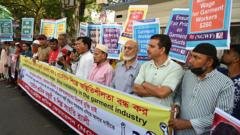
Why Bangladesh Clothing Factories Shut Amid Mass Wage Strikes
The highways surrounding Dhaka fell silent under an uncomfortable standoff this weekend. As Bangladesh clothing factories shut down across key manufacturing satellite cities, the tremors vibrated far beyond the industrial belts of Savar, Ashulia, and Gazipur. What began as localized factory floor walkouts over stagnant pay has quickly escalated into a full-scale labor impasse, halting production lines that feed the world’s biggest high-street retail brands.
Dozens of Bangladesh clothing factories shut down following widespread labor strikes across major industrial hubs including Gazipur, Savar, and Ashulia. Garment workers are demanding a minimum monthly wage increase from 12,500 taka to 30,000 taka to cope with severe inflation, forcing factory owners to invoke 'No Work No Pay' labor provisions.<\/p>
- Mass Closures: Nearly 150 ready-made garment manufacturing units across Gazipur, Savar, and Ashulia suspended operations amid escalating labor strikes.
- Wage Gap: Workers demand a monthly minimum wage of 30,000 taka ($273), contrasting sharply with the existing 12,500 taka ($113) floor established during prior negotiations.
- Legal Hardball: Factory owners, backed by the BGMEA, have triggered 'No Work No Pay' legal clauses, shuttering doors indefinitely until security guarantees are established.
- Global Ripple Effects: As the world's second-largest apparel exporter generating $40 billion annually, Bangladesh's disruption threatens inventory pipelines for Western titans like H&M, Zara, and Primark.
Nearly 150 apparel manufacturing facilities suspended work over forty-eight hours. Outside the gates, thousands of workers filled the arteries connecting industrial districts to the capital, blocking major transit routes like the Dhaka-Tangail highway. For international buyers already navigating fragile global logistics, the sudden stoppage in the world’s second-largest garment exporting nation represents an immediate supply chain threat.
Stagnant Wages Meet Skyrocketing Inflation
The catalyst for the unrest is deceptively simple: economic survival. Bangladesh’s garment sector operates under a minimum wage framework that currently sits at 12,500 taka per month (roughly £76 or $95 USD). In the current macroeconomic climate, dominated by double-digit domestic food inflation and depreciating currency value, labor representatives argue that this floor is no longer livable.
Striking factory hands are demanding a revised monthly minimum of 30,000 taka (£182 or $230 USD)—more than double their current baseline. For line workers operating sewing machinery six days a week, the math of daily survival simply no longer adds up.
“They are asking for a wage they can survive on. How can any person of conscience stand against such a basic human demand? Workers have carried the costs for years while factory owners and global retailers profit from their exploitation.”
— Joly Talukder, Vice President of the Garment Workers Trade Union Centre
The gap between urban living costs and industrial pay scales has widened significantly over the past two years. Basic food staples, rent in high-density industrial suburbs, and utility costs have eaten away at household reserves. For many families, working overtime hours is no longer enough to plug the deficit.
The $40 Billion Engine of Global Fast Fashion
To understand the high stakes of the current labor standoff, one must examine the absolute scale of Bangladesh’s ready-made garment (RMG) sector. The industry generates nearly $40 billion in export revenue every year, accounting for approximately 10 percent of the country’s entire Gross Domestic Product (GDP). More critically, apparel exports represent over 80 percent of the nation’s total foreign exchange earnings.
The sector relies on a massive, highly concentrated labor pool of roughly four million workers, the vast majority of whom are women. These factories manufacture garments for global retail behemoths including H&M, Primark, and Zara owner Inditex, offering turnarounds and price points that few competing nations can match.
| Metric / Economic Indicator | Current Sector Baseline | Worker Demand / Revision Target | Macroeconomic Context |
|---|---|---|---|
| Monthly Minimum Wage | 12,500 Taka (~$113 USD) | 30,000 Taka (~$273 USD) | Stagnant since previous wage board adjustments despite severe inflation. |
| Annual Apparel Exports | ~$40 Billion USD | Targeting Growth | Makes up ~80% of total national export revenue. |
| National GDP Contribution | ~10% of total GDP | N/A | Crucial source of hard foreign currency reserves. |
| Active Sector Workforce | ~4 Million Workers | N/A | Predominantly female demographic spanning rural-to-urban migrants. |
This immense economic footprint creates a double-edged sword. While the sector has lifted millions out of extreme poverty and transformed Bangladesh’s economic trajectory, it has done so by offering international brands some of the lowest sourcing costs on earth. When those operational costs face upward pressure, the systemic balance of the entire sector wavers.
Section 13(1) and the Legal Siege of Factory Owners
The reaction from factory owners to the mass walkouts has been swift and legally assertive. Industrial police commanders confirmed that dozens of operations were suspended over the weekend as security conditions deteriorated near key production clusters.
Speaking on behalf of plant proprietors, Police Superintendent Mohammad Amjad Hossain noted that law enforcement officers moved to shut down facilities after wildcat strikes spread. Thirteen plants were halted on Saturday evening, followed by sixteen additional closures during Sunday morning’s highway blockades near Gazipur.
Rather than absorbing continuous disruptions, major industry associations—including the Bangladesh Garment Manufacturers and Exporters Association (BGMEA) and the Bangladesh Knitwear Manufacturers and Exporters Association (BKMEA)—have pushed back hard against the labor movement.
Factory owners are increasingly resorting to Section 13(1) of the Bangladesh Labour Act, commonly known as the “No Work, No Pay” provision. Under this law, management holds the legal authority to close facilities indefinitely and withhold worker wages during period of unannounced operational disruptions.
“BGMEA and BKMEA have questioned the justification of continuing to participate in wage board negotiations without any assurance that the factories will be protected. Garment factories that have been unable to continue production due to the ongoing unrest will remain indefinitely closed from tomorrow under Bangladesh’s labour law.”
— Mahmud Hasan Khan, President of the BGMEA
By enforcing Section 13(1), factory owners are issuing a stark ultimatum: return to production lines under existing security protocols or forfeit daily compensation entirely. This hardline stance highlights the narrow profit margins many domestic suppliers operate on when fulfilling fixed-rate purchase orders for Western buyers.
The Supply Chain Fallout for Western Retailers
For international supply chain directors, the timing of these closures could hardly be worse. Spring and summer collections are currently slated for cutting, assembly, and maritime dispatch. Any prolonged delay in factory output risks leaving store shelves empty across Western capitals in coming quarters.
Over the past decade, international brands have faced mounting scrutiny over their purchasing practices. While global retailers routinely publish ethical sourcing guidelines and corporate social responsibility (CSR) commitments, critics argue that purchasing contracts rarely reflect the cost of fair labor standards.
According to investigative reports from global trade analysts at Reuters, international brands have maintained aggressive downward pressure on wholesale unit prices, leaving Bangladeshi factory owners with very little margin flexibility to absorb higher wage bills without raising export prices.
This creates a complex structural dynamic:
- Western Brands: Demand rigid delivery schedules, low procurement prices, and strict compliance with workplace safety standards.
- Factory Owners: Face fixed overhead costs, low margins, and fluctuating raw material prices, making them resistant to sudden wage floor increases.
- Garment Workers: Bear the ultimate economic squeeze, struggling to pay for housing and food as real purchase value drops.
The December Deadline: Can the Wage Board Deliver?
There is a potential pathway out of the crisis, though it remains fraught with friction. On November 1, the Bangladeshi government formally convened a national minimum wage board to evaluate pay structures across the textile sector. Chaired by a senior district judge, the tri-partite board includes representatives from labor unions, manufacturing associations, and state ministries.
The board’s declared objective is to complete its review and finalize pay recommendations before the end of November. Under the planned timeline, any revised minimum wage structure would take legal effect on December 1.
However, trust between the negotiating parties remains thin. Labor organizers worry that the government-backed board will offer a compromise figure far below the requested 30,000 taka threshold, leaving workers vulnerable to continued inflation. Conversely, manufacturers warn that an aggressive mandatory wage increase without corresponding price adjustments from global buyers could force smaller, under-capitalized factories into permanent bankruptcy.
As wildcat strikes continue to flare across Ashulia and Gazipur, the immediate future of the sector depends on whether negotiating teams can bridge this widening financial divide. For now, production lines remain cold, freight containers sit waiting, and millions of workers stand outside locked gates demanding a living wage.
<button type="button" onclick="this.parentElement.innerHTML='✓ Thank you, we will refine our analysis!‘” style=”background:#ffffff; border:1px solid #cbd5e1; border-radius:6px; padding:4px 12px; font-size:12px; cursor:pointer; color:#334155;”>👎 No
Latest Analytical Follow-up: For continuous developments on this subject, read our full investigation on EU Migrant Deportation Centre to Open in Rwanda by 2027.
Latest Analytical Follow-up: For continuous developments on this subject, read our full investigation on Houthi Advance Global Economy Risks Escalate in Red Sea.
