
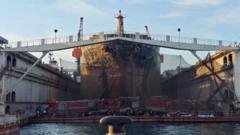
Qingdao Cargo Ship Fire: Casualties and Maritime Safety
A catastrophic fire erupted on a foreign-flagged cargo ship docked at the eastern Chinese port city of Qingdao, resulting in significant casualties and triggering an immediate, high-level emergency response from the country’s top leadership. The incident, which occurred during routine shipyard maintenance, highlights the persistent safety vulnerabilities in global maritime repair hubs and has placed a renewed spotlight on industrial safety protocols. As rescue operations continue under intense political and public scrutiny, the disaster is poised to reshape regulatory oversight for international vessels undergoing refits in Chinese waters.
The Qingdao cargo ship fire occurred on a foreign-flagged vessel undergoing maintenance at a shipyard in Qingdao, China, at 11:15 local time. The incident resulted in significant casualties, drawing immediate emergency response directives from President Xi Jinping and Premier Li Qiang to rescue trapped personnel and prevent secondary environmental disasters.
- Severe Industrial Incident: A major fire on a foreign-flagged cargo ship undergoing maintenance in Qingdao has resulted in significant casualties and trapped workers.
- High-Level State Intervention: President Xi Jinping and Premier Li Qiang have issued urgent directives, elevating the incident to a national priority and demanding a swift, comprehensive investigation.
- Secondary Disaster Risks: Emergency protocols are heavily focused on preventing cascading hazards, including chemical spills, structural collapse, and marine pollution in the Yellow Sea.
- Regulatory Implications: The disaster is expected to trigger nationwide safety audits across Chinese shipyards, tightening compliance with global maritime safety standards.
1. Executive Summary & Strategic Importance
The recent Qingdao cargo ship fire has sent shockwaves through the global maritime sector, underscoring the critical intersection of industrial safety, international shipping logistics, and state-level emergency management. Occurring at approximately 11:15 local time (03:15 GMT) on a foreign-flagged vessel undergoing maintenance, the blaze quickly escalated, trapping workers and crew members below deck. The gravity of the situation prompted immediate, public interventions from Chinese President Xi Jinping and Premier Li Qiang. President Xi issued urgent directives for comprehensive search and rescue operations, demanding a swift and thorough investigation into the root cause of the disaster. Concurrently, Premier Li Qiang emphasized the absolute necessity of rescuing those trapped on board while taking decisive measures to prevent secondary disasters, such as hazardous chemical leaks or structural failures that could compromise the port’s operational integrity.
As one of the world’s busiest shipping hubs, any disruption in Qingdao carries profound implications for international trade lanes. The port serves as a vital gateway for energy, raw materials, and containerized goods moving between Asia, Europe, and the Americas. Consequently, this incident is not merely a localized industrial accident; it is a event of strategic importance that touches upon international maritime law, global supply chain resilience, and the sovereign responsibilities of port states managing foreign assets. The high-level political response underscores Beijing’s sensitivity to industrial safety failures, particularly those involving foreign entities, as the nation seeks to maintain its status as the world’s premier maritime construction and repair destination.
2. Historical Background & Contextual Evolution
To fully comprehend the significance of the Qingdao incident, one must examine the historical trajectory of ship repair and maintenance safety in East Asia. Over the past three decades, China has emerged as the undisputed global leader in shipbuilding and repair, hosting massive industrial dry docks along its eastern coastline, particularly in Zhejiang, Shanghai, and Shandong provinces. This rapid industrialization, while economically transformative, has historically run parallel to complex safety challenges. Historically, shipyard maintenance accidents have represented a disproportionate share of industrial casualties within the maritime sector. Dry docks are inherently hazardous environments where heavy industrial activities—such as high-temperature welding, sandblasting, and chemical coating—occur in highly confined, poorly ventilated spaces.
Previous incidents in major global ports have demonstrated that the transition phase of a vessel—when it moves from active sea service to a dry dock maintenance status—is the period of highest risk. During this window, standard onboard safety systems are frequently deactivated or bypassed for repair, leaving the vessel reliant on temporary shore-based infrastructure and local shipyard protocols. Over the last decade, Beijing has systematically tightened its national Work Safety Law, imposing stricter penalties on corporate entities and local officials for safety failures. However, the operational reality of managing thousands of foreign vessels annually continues to test the limits of these regulatory frameworks, especially when balancing commercial pressure for rapid vessel turnaround times against stringent safety compliance.
3. In-Depth Technical & Policy Breakdown
Understanding the mechanics of this disaster requires a granular look at the technical procedures of ship maintenance and the policy frameworks governing foreign vessels in domestic ports.
The Mechanics of ‘Hot Work’ and Shipyard Vulnerabilities
At the core of most shipyard disasters lies the execution of ‘hot work’—a term encompassing welding, thermal cutting, grinding, and other spark-producing operations. When these activities are conducted on a cargo ship, the risks are compounded by the vessel’s complex architecture. Double-bottom tanks, fuel lines, and cargo holds often retain volatile organic compounds (VOCs) or residual fuel vapors. If gas-free testing is not rigorously performed and certified prior to the commencement of hot work, even a single stray spark can ignite an explosive atmosphere. Furthermore, modern cargo ships utilize extensive synthetic insulation materials and electrical cabling that, once ignited, produce highly toxic smoke, rapidly reducing visibility and making self-evacuation nearly impossible for workers trapped in lower decks.
Jurisdictional Complexity of Foreign-Flagged Vessels
The fact that the vessel involved in the Qingdao incident was foreign-flagged introduces a complex layer of international maritime law. Under foreign-flagged vessel regulations, a ship is technically subject to the laws and safety standards of its registry country (the flag state), such as Panama, Liberia, or the Marshall Islands. However, once a vessel enters a sovereign dry dock for maintenance, it falls under the territorial jurisdiction of the port state. This dual-layered regulatory environment can sometimes lead to communication gaps between international ship managers, foreign crew members, and local shipyard contractors. Ensuring compliance with both international conventions—such as the International Maritime Organization’s (IMO) SOLAS (Safety of Life at Sea) regulations—and local Chinese industrial safety mandates requires seamless coordination, which can break down under tight commercial deadlines.
Emergency Response and Secondary Disaster Prevention
Premier Li Qiang’s explicit warning to ‘prevent secondary disasters’ points to the sophisticated nature of modern port emergency management. When a fire breaks out on a vessel in dry dock, the immediate threat of flames is only the first phase of the crisis. First responders must execute a highly coordinated China port emergency response strategy to mitigate cascading hazards. These include:
- Structural Integrity Loss: Extreme heat can weaken the steel hull of the vessel, risking structural collapse within the dry dock.
- Free Surface Effect: Accumulation of firefighting water in the upper decks can destabilize the ship, causing it to capsize.
- Environmental Contamination: Runoff water contaminated with heavy fuel oil, toxic chemicals, or firefighting foam must be contained to prevent ecological damage to the Yellow Sea.
4. Comparative Industry Framework
To contextualize the safety and operational standards of Chinese shipyards relative to other global maritime hubs, the following table compares key dimensions of maritime safety management across major regions:
| Dimension | China (e.g., Qingdao, Zhoushan) | Singapore (Tuas) | South Korea (Ulsan) | European Union (e.g., Rotterdam) |
|---|---|---|---|---|
| Regulatory Oversight | Dual-track (Ministry of Emergency Management & MSA) | Ministry of Manpower (MOM) & MPA | Ministry of Employment and Labor | European Maritime Safety Agency (EMSA) |
| Primary Risk Focus | Rapid response, secondary disaster prevention | Strict permit-to-work (PTW) systems | Heavy industrial automation & union-led safety | Environmental sustainability & human factors |
| Emergency Response Integration | Highly centralized, state-mobilized | Highly localized, private-public partnerships | Corporate-led, state-supported | Decentralized, highly standardized |
| Labor Safety Standards | Rapidly improving; strict statutory penalties | Extremely high; heavy financial penalties | High; strong collective bargaining influence | Highest global standards; strict working-hour limits |
SEEUY INTELLIGENCE
Qingdao Cargo Ship Fire – Analytical Overview
Regulatory Oversight
Dual-track (Ministry of Emergency Management & MSA)
Primary Risk Focus
Rapid response, secondary disaster prevention
Emergency Response Integration
Highly centralized, state-mobilized
Labor Safety Standards
Rapidly improving; strict statutory penalties
Analytical Takeaway: While European and Singaporean yards rely heavily on preventative, process-driven safety systems (such as strict permit-to-work protocols), China’s strength lies in its unparalleled capacity for rapid, state-mobilized emergency response. However, the sheer volume of vessels handled by Chinese yards means that even minor gaps in preventative oversight can lead to high-consequence events, necessitating a shift toward more proactive risk-mitigation strategies.
5. Socio-Economic, Enterprise & Global Ramifications
The economic ripples of the Qingdao cargo ship fire extend far beyond the immediate damage to the vessel and the shipyard. Qingdao is a critical node in the global supply chain, serving as a gateway for agricultural goods, energy products, and containerized freight moving between Asia, Europe, and North America. Any localized shutdown of maintenance facilities or increased regulatory scrutiny can lead to significant delays in vessel turnaround times, compounding global supply chain bottlenecks.
From an enterprise perspective, maritime insurance syndicates and Protection and Indemnity (P&I) Clubs are closely monitoring the situation. According to reports from Reuters, industrial accidents in major Asian ports invariably lead to a reassessment of risk premiums for vessels undergoing refits in the region. Shipowners may face higher insurance costs and more stringent pre-maintenance inspection requirements before dry-docking their fleets. Furthermore, the incident is highly likely to trigger a nationwide safety audit across all Chinese shipyards. The Ministry of Emergency Management and the Ministry of Transport are expected to enforce stricter compliance with maritime safety standards, which could temporarily slow down shipyard operations nationwide, affecting global shipping schedules.
On a geopolitical level, the handling of the investigation will be closely watched by foreign shipowners and flag states. Transparent communication regarding the causes of the fire and the casualties involved is essential to maintaining international confidence in China’s port state control and industrial safety standards. A failure to provide clear answers could prompt international shipping conglomerates to diversify their maintenance contracts to competing hubs in South Korea, Japan, or Singapore.
6. Strategic Outlook & What Comes Next
In the immediate term, the focus remains on the recovery of casualties, the stabilization of the vessel, and the formal investigation into the fire’s origin. The involvement of China’s top leadership guarantees that this investigation will be exhaustive, with the findings likely serving as a blueprint for updated national safety codes. Over the next 12 to 18 months, the maritime industry should anticipate several key developments:
- Mandatory Safety Audits: Chinese shipyards will undergo rigorous inspections, focusing on hot work permits, gas-free certifications, and subcontractor management.
- Technological Integration: There will be an accelerated push toward adopting smart shipyard technologies, including IoT-based gas sensors, automated thermal imaging cameras, and AI-driven safety monitoring systems to detect hazards before they escalate.
- Revision of Port Protocols: Local port authorities will likely revise their emergency response playbooks, emphasizing rapid containment of environmental pollutants and improved coordination with foreign vessel crews.
Ultimately, the Qingdao disaster serves as a stark reminder that as cargo vessels grow larger and more complex, the safety frameworks governing their maintenance must evolve at an equal pace. Balancing commercial efficiency with human safety and environmental protection remains the defining challenge for the modern maritime industry.
7. Frequently Asked Questions (FAQ)
What is the current status of the rescue operation in Qingdao?
Search and rescue operations are actively underway, directed by local maritime authorities under urgent mandates from China’s central leadership. The primary focus is on locating any remaining trapped personnel within the vessel while ensuring the structural stability of the ship to prevent capsizing.
Why are shipyard maintenance periods considered so high-risk?
Shipyard maintenance periods involve a high concentration of hazardous activities, such as welding and cutting (hot work), conducted in confined spaces that may contain residual flammable gases. Additionally, standard onboard safety and detection systems are often offline for repairs, increasing reliance on temporary shore-based safety measures.
How do local authorities coordinate with foreign vessel representatives during such crises?
Under international maritime protocols, local port authorities coordinate closely with the vessel’s flag state representatives, the ship management company, and the relevant embassy or consulate. This ensures that foreign-flagged vessel regulations are respected while local emergency laws are enforced to manage the crisis effectively.
What are the potential environmental impacts of the fire?
The primary environmental risks include the spill of heavy fuel oil or hazardous cargo into the harbor, as well as the runoff of contaminated firefighting water. Local emergency teams are deploying containment booms and monitoring water quality to prevent ecological damage to the surrounding marine environment.
Will this incident lead to changes in international maritime safety standards?
While local regulations in China will certainly tighten, the findings of the investigation may also be shared with the International Maritime Organization (IMO) to update global safety guidelines for ship repair and dry-docking procedures, particularly regarding gas-free certification and hot work safety.
