
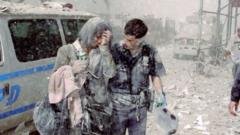
9/11 Toxic Air Documents Reveal Decades of Deception
A massive cache of newly unsealed 9/11 toxic air documents has laid bare a devastating, multi-decade institutional cover-up regarding the lethal atmospheric conditions in lower Manhattan following the September 11, 2001, terrorist attacks. Announced by New York City Mayor Zohran Mamdani alongside veteran 9/11 survivor advocate Jon Stewart, the release of 170,000 pages of internal memos, air-quality reports, and legal correspondence confirms what victims and advocates have long suspected: public officials prioritized economic normalcy and liability mitigation over human life. The revelation of these files, which were uncovered in 68 forgotten boxes following a protracted lawsuit by the advocacy group 9/11 Health Watch, marks a watershed moment in public health accountability. It exposes how municipal and federal leaders systematically downplayed the presence of airborne asbestos, heavy metals, and pulverized concrete, directly contributing to an ongoing epidemiological crisis that has now claimed more lives than the attacks themselves.
The newly released 9/11 toxic air documents confirm that New York City officials and federal agencies were aware of severe asbestos contamination and toxic air quality in lower Manhattan immediately after the September 11 attacks, yet publicly downplayed these risks to expedite the reopening of Wall Street, exposing thousands to lethal carcinogens.<\/p>
- Key Insight 1: The release of 170,000 previously suppressed documents proves that city officials knew of widespread asbestos contamination near Ground Zero as early as October 2001.
- Key Insight 2: The notorious 'Harding Memo' warned that the city faced up to 35,000 lawsuits for prematurely advising residents and workers to return to the disaster zone.
- Key Insight 3: Public health guidance actively misled citizens, instructing them to clean toxic dust with standard household tools instead of professional hazardous material protocols.
- Key Insight 4: The litigation settled by 9/11 Health Watch exposes a multi-decade institutional failure to protect public health in favor of economic and political stabilization.
1. Executive Summary & Strategic Importance
The disclosure of these long-hidden archives represents far more than a historical footnote; it is a profound indictment of crisis-era governance and public health communication. For nearly a quarter of a century, the official narrative surrounding the aftermath of the World Trade Center collapse maintained that while the air was harsh, the long-term health risks were minimized based on the best available data at the time. The newly released files shatter this defense, proving that internal testing consistently flagged hazardous levels of carcinogens while public advisories remained stubbornly optimistic.
The strategic importance of this disclosure lies in its potential to reshape the legal, medical, and political landscapes of disaster response. By establishing a clear paper trail of calculated risk-taking by public officials, these documents provide invaluable evidence for ongoing World Trade Center dust litigation. Furthermore, they offer a stark warning to modern policymakers regarding the catastrophic human and financial costs of withholding critical environmental data during industrial or municipal crises. As the city prepares to release more documents over the coming year, the global community is forced to confront the systemic failures that allowed thousands of first responders, residents, and office workers to be exposed to a lethal cocktail of airborne toxins.
2. Historical Background & Contextual Evolution
To understand the gravity of the newly released files, one must revisit the chaotic weeks following September 11, 2001. As the Twin Towers collapsed, they pulverized millions of tons of building materials, releasing a highly toxic plume containing asbestos, lead, mercury, dioxins, and polychlorinated biphenyls (PCBs) across lower Manhattan. Despite the visible, choking dust cloud, the prevailing political mandate was rapid recovery and economic resilience. Within days of the attacks, the U.S. Environmental Protection Agency (EPA), led by then-Administrator Christine Todd Whitman, issued reassuring public statements declaring that the air was safe to breathe. These EPA 9/11 air safety statements served as the green light for Wall Street to resume operations and for thousands of residents, office workers, and school children to return to the area.
However, independent scientists and local advocates immediately raised alarms about the severe asbestos exposure lower Manhattan residents were facing. For twenty-five years, the official narrative maintained that while the air was harsh, the long-term health risks were minimized based on the best available data at the time. However, the newly uncovered documents shatter this defense, showing that internal testing consistently flagged hazardous levels of carcinogens while public advisories remained stubbornly optimistic. The historical evolution of this crisis is marked by a transition from acute disaster response to a slow-motion public health catastrophe, with the World Trade Center Health Program eventually certifying over 100,000 responders and survivors suffering from chronic respiratory illnesses, gastrointestinal disorders, and dozens of certified cancers.
3. In-Depth Technical & Policy Breakdown
The newly released archive contains highly technical air-quality reports, internal municipal communications, and legal assessments that detail the exact mechanisms of the cover-up. Three specific documents within the cache highlight the calculated nature of the city’s public relations strategy and its disregard for established environmental safety protocols.
The Revelations of the 9/11 Toxic Air Documents
The core of the disclosure revolves around the systematic suppression of air-quality data that showed elevated levels of friable asbestos throughout lower Manhattan. Asbestos, a highly regulated carcinogen, was found “nearly everywhere” near Ground Zero. Under federal law, the presence of friable asbestos requires immediate isolation and professional abatement. Instead, the city’s internal reports were filed away while public-facing communications maintained that the levels of asbestos were negligible and posed no long-term threat to the general public.
The Harding Memo and Liability Mitigation
Among the most damning pieces of evidence is an October 2001 memorandum addressed to former Deputy Mayor Robert Harding. Written by a senior municipal aide, the “Harding Memo” explicitly warned that the city could face up to 35,000 legal claims due to its post-attack response. The memo noted that by encouraging residents and workers to return to lower Manhattan prematurely, the city was exposing itself to massive legal liability for “toxic exposure or emotional harm.” Rather than prompting a reassessment of the return-to-work timeline, this warning led to an intensification of legal and public relations strategies designed to shield the administration from future lawsuits.
The Ester Fuchs Memorandum and Political Public Relations
Another critical document is a memorandum attributed to Ester Fuchs, a special adviser to Mayor Michael Bloomberg. The memo addressed the growing concerns of Congressman Jerry Nadler, who had publicly challenged the city’s indoor air-quality testing. Fuchs acknowledged “potential problems for City Hall,” noting that “seemingly reputable scientists have come down on both sides of the argument.” Crucially, the memo admitted: “If Nadler’s concerns are justified, we are not informing people of the real health risks in lower Manhattan, the City may face major public relations problems and is leaving itself open to a barrage of lawsuits.” This document confirms that political survival and public relations management were prioritized over the physical well-being of the constituency.
Misleading Cleanup Protocols and Asbestos Exposure
The documents also reveal that city officials actively instructed residents and business owners to clean up toxic dust and debris using standard household tools like “wet mops and rags.” This directive directly violated federal hazardous materials guidelines, which mandate that asbestos and other toxic particulates must only be handled by licensed professionals wearing specialized personal protective equipment (PPE) and using high-efficiency particulate air (HEPA) vacuum systems. By advising untrained citizens to perform hazardous cleanups, the city directly contributed to the secondary inhalation of friable asbestos fibers, exacerbating the long-term health crisis.
4. Comparative Industry Framework
To contextualize the divergence between public assurances and internal realities, the following table compares the official public narrative presented by government agencies in 2001 with the internal data and legal concerns revealed in the newly unsealed documents.
| Dimension | Public Narrative (2001) | Internal Reality (Revealed in Documents) | Long-Term Consequence |
|---|---|---|---|
| Air Quality & Safety | The air is safe to breathe; public health risks are minimal. | Air-quality reports show widespread asbestos and toxic particulate contamination. | Thousands of preventable cases of cancer and respiratory illness. |
| Asbestos Contamination | Asbestos levels are low and confined to the immediate disaster site. | Asbestos is found “nearly everywhere” tested in lower Manhattan. | Widespread, long-term asbestos exposure lower Manhattan residents faced. |
| Liability & Legal Risk | The focus is entirely on recovery, unity, and rebuilding. | The “Harding Memo” warns of up to 35,000 potential lawsuits for toxic exposure. | Decades of legal battles and the creation of the Victim Compensation Fund. |
| Cleanup & Remediation | Citizens can safely clean dust using wet mops and household rags. | Internal memos acknowledge that cleanup protocols violate hazardous waste standards. | Secondary exposure of residents and janitorial staff to friable carcinogens. |
The comparative framework illustrates a systemic pattern of institutional deception. The stark contrast between the public-facing instructions and the internal legal panic demonstrates that municipal leaders were fully aware of the physical dangers but chose to manage the economic and political fallout rather than the actual health risks. This calculated negligence transformed a localized physical disaster into a widespread, generational epidemiological catastrophe.
5. Socio-Economic, Enterprise & Global Ramifications
The socio-economic consequences of this cover-up are vast and continue to reverberate through the healthcare and legal systems. The financial burden of treating 9/11-related illnesses has run into billions of dollars, funded largely by federal taxpayers through the James Zadroga 9/11 Health and Compensation Act. This massive expenditure represents a direct transfer of liability from the municipal and corporate entities that rushed the reopening to the federal government. The financial liabilities associated with environmental negligence have reshaped municipal risk management, as documented in various corporate governance analyses by Bloomberg.
The long-term health impacts of asbestos exposure are well-documented by the World Health Organization, which classifies all forms of asbestos as proven human carcinogens capable of causing mesothelioma and lung cancer decades after initial inhalation. The socio-economic impact also extends to the commercial real estate and insurance sectors. In the wake of the World Trade Center dust litigation, commercial insurers have drastically revised their environmental liability policies, implementing stricter exclusion clauses for toxic dust and airborne contaminants. For enterprises operating in major metropolitan areas, the 9/11 cover-up serves as a permanent case study in the catastrophic long-term costs of environmental non-compliance and deceptive public relations.
6. Strategic Outlook & What Comes Next
The release of these 170,000 documents is only the beginning of a prolonged legal and scientific reckoning. With more documents scheduled for release over the coming year, researchers, epidemiologists, and legal scholars will dissect the data to map specific exposure levels to the exact types of cancers and respiratory illnesses suffered by survivors. This granular mapping could provide crucial evidence for ongoing and future claims under the Victim Compensation Fund (VCF).
The primary risk moving forward is institutional inertia—the tendency for government agencies to wait out the news cycle. However, the involvement of high-profile advocates like Jon Stewart ensures sustained media pressure. The next major milestone will be the integration of these documents into peer-reviewed epidemiological studies, which will formally link the newly revealed air quality data with the specific clinical outcomes of Ground Zero responders. This will redefine how governments manage post-disaster zones globally, shifting the default protocol from “reopen and reassure” to “isolate, test, and remediate.”
7. Frequently Asked Questions (FAQ)
This section addresses the most common search queries and high-intent questions regarding the newly released 9/11 toxic air documents and their implications for public health and liability.
What are the primary Ground Zero health effects documented today?
The primary Ground Zero health effects include chronic respiratory illnesses, gastrointestinal disorders, and dozens of certified cancers, particularly mesothelioma, lung cancer, and thyroid cancer. These illnesses have collectively claimed more lives than the physical attacks on September 11, 2001.
What was the “Harding Memo” and why is it significant?
The “Harding Memo” was an October 2001 internal document sent to former Deputy Mayor Robert Harding. It warned that the city could face up to 35,000 legal claims because its public health advisories had encouraged individuals to return to the disaster area too soon, exposing them to severe toxic and emotional harm.
How did the EPA respond to the air quality concerns in 2001?
Days after the attacks, the EPA issued public statements declaring the air near Ground Zero safe to breathe. These EPA 9/11 air safety statements were later retracted, and former EPA Administrator Christine Todd Whitman apologized, admitting the agency did not fully disclose the risks based on the pressure to project normalcy.
Why were residents told to clean up asbestos with wet mops?
City officials advised residents to clean up toxic dust with wet mops and rags to maintain the illusion of a simple cleanup and avoid public panic. However, asbestos is a highly dangerous carcinogen that legally and medically requires specialized, licensed professionals for safe remediation and removal.
What is the significance of the 9/11 Health Watch lawsuit?
The lawsuit brought by 9/11 Health Watch forced the city to release 68 boxes containing 170,000 pages of suppressed documents. This resolved decades of institutional denial and established a transparent, public archive that allows researchers, survivors, and legal teams to examine the true extent of the post-9/11 environmental cover-up.
Latest Analytical Follow-up: For continuous developments on this subject, read our full investigation on LIV Golf Bankruptcy: Inside the $45M Player Debt Crisis.
