
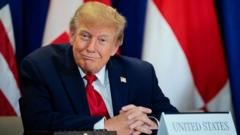
How Trump’s AI Rebrand Sparked a Slovenian Domain Gold Rush
When the White House announced Trump’s AI rebrand to “Super Intelligence,” few expected the immediate geopolitical ripple effect to land in Ljubljana. Yet, within days of the declaration, the official national registry of Slovenia found itself at the center of a digital land grab. Speculators, developers, and tech enthusiasts rushed to secure Slovenian domain names, transforming the quiet European country-code top-level domain (ccTLD) of “.si” into the hottest commodity on the internet.
Trump's AI rebrand to 'Super Intelligence' (SI) triggered an unprecedented 2,100% surge in registrations for Slovenian domain names (.si). Speculators rushed to acquire these web addresses, anticipating massive valuation increases after a White House executive order mandated the transition from 'AI' to 'SI' in all official US government communications.<\/p>
- Unprecedented Domain Surge: Slovenian domain registrations spiked by over 2,100% in September, jumping from under 2,000 to 44,000 names.
- The 'SI' Mandate: President Trump signed an executive order replacing the term 'AI' with 'Super Intelligence' (SI) across all federal agencies.
- Speculative Gold Rush: Domain investors are betting heavily that '.si' will become the new global standard for tech branding, mimicking the historic rise of '.ai' (Anguilla).
- Administrative Errors: The official executive order faced online mockery after observers noticed 'United States' was misspelled directly beneath the presidential signature.
The catalyst was simple linguistics. The US president declared that “Artificial Intelligence” is a flawed term. He wants it replaced with “Super Intelligence”—abbreviated as “SI.” For Slovenia, which has used the “.si” suffix since the early days of the web, this linguistic pivot triggered a gold rush. The scale of the migration is staggering, catching registry officials completely off guard and raising fundamental questions about the intersection of political rhetoric, domain speculation, and global tech branding.
The Anatomy of an Unprecedented Domain Spike
According to data released by Register.si, the organization responsible for managing Slovenia’s national domain registry, the numbers speak for themselves. In August, the registry processed fewer than 2,000 new registrations. By the end of September, that number had ballooned to over 44,000—a staggering increase of more than 2,100%.
Klara Herman, a spokeswoman for Register.si, described the late September activity as “unprecedented” compared to any period in the registry’s history. “The registrations in September stood out very clearly against any other month this year,” Herman noted, though she remained characteristically cautious about attributing every single registration directly to the White House‘s rhetorical shift. However, the timeline tells a highly compelling story.
The September Registration Surge
To understand the velocity of this digital migration, one only has to look at the daily registration velocity. The momentum built steadily throughout the month, culminating in a spectacular climax on the final day of September.
| Time Period | New .si Registrations | Percentage Change | Key Driver |
|---|---|---|---|
| August (Full Month) | < 2,000 | Baseline | Standard local registrations |
| September (Full Month) | 44,000 | +2,100% | UN Speech & Executive Order |
| September 30 (Single Day) | 11,000 | N/A | Speculative climax before policy implementation |
On September 30 alone, 11,000 new domains were registered. That is more than five times the typical volume of an entire average month, compressed into a single 24-hour window. This concentrated burst of purchasing suggests highly coordinated, programmatic buying by domain portfolio managers looking to corner the market on high-value tech terms combined with the “.si” extension.
The Rhetoric Behind the Rebrand: “It’s Not Fake”
The origin of this market frenzy can be traced back to September 11, when President Trump addressed the United Nations General Assembly in New York. During a wide-ranging speech that touched on trade, national sovereignty, and technological dominance, he took aim at the terminology defining the modern tech landscape.
“The use of the word artificial makes it sound fake,” Trump argued during his address. “It’s not fake, it’s actually amazing. But we have to be careful… welcome to the new world of super intelligence.”
The critique of the word “artificial” is not entirely unique to the president. For years, some computer scientists have argued that “artificial” diminishes the very real cognitive capabilities of advanced neural networks. However, translating this semantic critique into a sweeping policy mandate is a uniquely American administrative maneuver. By rebranding AI to “SI,” the administration is attempting to reshape the global narrative around technological supremacy.
For domain investors, the president’s words were a clear signal. If the world’s largest economy officially adopts “SI” as its preferred nomenclature, the commercial sector will inevitably follow. And in the domain industry, being early to a linguistic shift is the difference between making pennies and making millions.
The Mechanics of Super Intelligence Domain Speculation
To understand why investors are buying up Slovenian domain names, one must look at the history of internet domain investing. Domain names are the unique, human-readable addresses used to navigate the web. While generic top-level domains (gTLDs) like “.com” remain the gold standard, country-code domains (ccTLDs) have frequently been co-opted for branding purposes.
The most famous example is Anguilla’s “.ai” domain. Originally intended for the small Caribbean island, “.ai” became a multi-million dollar cash cow as tech startups rushed to secure names like “stability.ai” or “character.ai.” Anguilla now generates a significant portion of its national budget purely from domain registration fees. Investors in “.si” are betting that Slovenia is about to experience an identical economic windfall due to super intelligence domain speculation.
The Legend of the Domain King
This speculative behavior is a time-honored tradition in the tech world. Industry veterans often point to Rick Schwartz, widely known as “The Domain King.” In 1997, Schwartz purchased the domain name men.com for $15,000. While many mocked the purchase at the time, Schwartz proved his critics wrong seven years later when he sold the domain for a staggering $1.32 million.
Modern domain investors operate on the same principle, albeit at a much faster, algorithmically driven pace. They look for emerging cultural, political, or technological trends, identify the corresponding domain extensions, and buy up thousands of variations in bulk. If even one of those domains is later acquired by a major corporation or venture-backed startup, the return on investment can be astronomical.
It is important to distinguish this legitimate investment strategy from “cybersquatting.” While cybersquatting involves registering trademarked names in bad faith to extort established brands, modern domain investing focuses on generic, high-value keywords—such as “cloud.si,” “data.si,” or “compute.si”—which are perfectly legal to buy, hold, and sell to the highest bidder.
The Executive Order and the Typo Heard ‘Round the Web
The speculative frenzy reached a fever pitch following a high-profile meeting at the White House. On a Tuesday late in September, the president hosted what he described as “an extraordinary gathering” of top technology executives, characterizing them as the architects “building America’s Golden Age.” Industry insiders reported that the guest list included prominent venture capitalists, semiconductor executives, and defense tech founders.
During this summit, the president signed a sweeping White House executive order SI mandate. The document officially instructs all United States government departments and agencies to transition their terminology. Under the new guidelines, federal agencies are directed to:
- Cease using the term “AI” or “Artificial Intelligence” in all official correspondence.
- Update federal websites, reports, and public-facing databases to reflect “SI” or “Super Intelligence.”
- Refuse to acknowledge the term “AI” in official procurement contracts and grant applications.
The order is designed to force a top-down cultural shift. By leveraging the massive purchasing power of the federal government, the administration hopes to make “SI” the default terminology for the entire domestic tech sector. Reports from Bloomberg suggest that federal agencies are already scrambling to audit their digital assets to comply with the sudden directive.
However, the rollout was not without its administrative embarrassments. Shortly after the signing ceremony, images of the executive order began circulating on social media. Sharp-eyed observers quickly noticed a glaring error: the words “United States” were misspelled as “United Sates” directly underneath the president’s signature. The typo quickly became a viral sensation, drawing sharp criticism and mockery from political opponents who questioned the competence of an administration attempting to lead a “super intelligence” revolution while failing to spell its own country’s name correctly.
The Tech Industry’s Quiet Resistance
While domain speculators are thrilled by the policy shift, the broader technology sector has reacted with a mix of amusement and quiet frustration. Many engineers and researchers view the forced rebranding as an unnecessary political distraction that does nothing to solve the actual technical challenges of machine learning, alignment, or hardware bottlenecks.
“Rebranding AI to SI doesn’t change the underlying mathematics,” said one prominent Silicon Valley researcher who spoke on the condition of anonymity. “It’s a marketing campaign. We are still building neural networks, optimizing weights, and managing compute clusters. Calling it ‘Super Intelligence’ by executive decree is purely theatrical.”
Furthermore, there are practical concerns about international standardization. The global scientific community, international standards bodies, and foreign governments (including the European Union and China) have spent years codifying regulations around “AI.” The EU’s landmark AI Act, for instance, is deeply institutionalized. A unilateral move by the United States to abandon the term could create significant friction in international regulatory cooperation, trade negotiations, and collaborative research initiatives.
According to reports from Reuters, European diplomats are already privately expressing concern that the US policy shift could complicate ongoing talks regarding global safety standards for frontier models. If the US insists on using “SI” while the rest of the world sticks to “AI,” it could lead to a fragmented regulatory landscape where compliance becomes a semantic nightmare for multinational corporations.
What Lies Ahead for Slovenia’s Digital Real Estate?
As the dust settles on the historic September registration spike, the long-term value of these new Slovenian domain names remains highly uncertain. For Slovenia, the sudden influx of registration fees is undoubtedly a welcome economic boost. However, the registry must now navigate the technical and administrative challenges of managing a vastly expanded database, much of which is held by foreign speculators rather than local businesses.
For investors, the gamble hinges entirely on whether “SI” successfully displaces “AI” in the global lexicon. If the federal government’s mandate successfully forces the private sector to adopt the new terminology, those who secured prime “.si” domains in September will look like geniuses. If, however, the tech industry quietly ignores the executive order and continues to use “AI,” the Slovenian domain bubble could burst just as quickly as it inflated, leaving speculators holding thousands of worthless web addresses.
One thing is certain: the line between geopolitics and digital infrastructure has never been thinner. A single speech in New York and a stroke of a pen in Washington were all it took to reshape the digital landscape of a nation thousands of miles away. In the era of super intelligence, the world is more interconnected than ever—and sometimes, the biggest winners of American policy shifts are found in the registry offices of central Europe.
<button type="button" onclick="this.parentElement.innerHTML='✓ Thank you, we will refine our analysis!‘” style=”background:#ffffff; border:1px solid #cbd5e1; border-radius:6px; padding:4px 12px; font-size:12px; cursor:pointer; color:#334155;”>👎 No
