
France Riots Analysis: Political Fallout and Deep Divisions
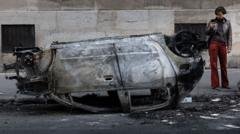
The morning light over Paris did little to soften the wreckage. Shattered glass from luxury storefronts rattled beneath the boots of municipal street sweepers along tree-lined boulevards, while crimson spray paint marked stone facades with circled ‘A’ symbols alongside the date of the chaotic weekend: 17 October. A comprehensive France riots analysis reveals that beneath the charred wreckage lies a nation tearing itself apart over identity, economic neglect, and an escalating political war ahead of the upcoming presidential contest.
This comprehensive France riots analysis demonstrates how recent street violence stems from a toxic blend of opportunistic youth looting, targeted radical agitators, and widespread institutional discontent. While political leaders trade blame ahead of upcoming presidential elections, intelligence findings and community testimonies highlight a growing rift between citizen grievances and state response.<\/p>
- Political Polarization: Key presidential contenders are weaponizing the unrest, with Marine Le Pen leveraging law-and-order rhetoric while Jean-Luc Mélenchon accuses the government of deliberate negligence.
- Dual Dynamics of Violence: Security reports indicate coordinated tactical strikes by ultra-left groups alongside widespread, viral-driven opportunistic looting by unaffiliated youth.
- Systemic Youth Disillusionment: Over 69% of French citizens report dissatisfaction with democracy, echoing broader European discontent over inflation, housing, and public services.
- Security & Policy Shifts: Proposed measures include parliamentary inquiries into intelligence failures and controversial proposals for targeted social media blackouts during civil unrest.
Standing outside a ransacked boutique, Elisabeth, a lifelong Parisian resident, could barely contain her grief. She pointed at the smashed windows and the graffiti insulting the national police force. “This is not the face of France!” she insisted, her voice trembling. “The media focuses entirely on the destruction of Saturday’s protests. But that isn’t the majority. It isn’t ‘us’. That is not France!” Her companion quietly remarked that the country felt on the precipice of civil war—a assessment Elisabeth vehemently rejected, arguing the violence was something else entirely. Yet, as shopkeepers swept away debris across dozens of French towns, nobody could offer a simple explanation for how peaceful student marches mutated into nationwide chaos within hours.
An Orchestrated Chaos or Opportunistic Rage?
Understanding the weekend chaos requires unpicking two distinct phenomena operating simultaneously on French streets: targeted, tactical violence against state symbols, and chaotic, widespread looting driven by social media viral trends. Intelligence documents obtained by national outlets reveal that security agencies had warned government ministers weeks prior regarding radical left-wing infiltration. A intelligence briefing dated 29 September, leaked to Le Figaro, detailed the systematic manipulation of peaceful student rallies by far-left networks. Investigators argue that groups affiliated with the radical left sought to leverage street disruption as an aggressive strategy ahead of the presidential cycle.
Video footage replayed incessantly on national news channels showed coordinated groups of young men dressed in black, faces obscured by folded kerchiefs, methodically attacking police vehicles with heavy hammers and bladed weapons. These were not spontaneous acts of emotional protest. They were executed with military precision. Prime Minister Sébastien Lecornu and Interior Minister Laurent Nuñez forcefully pointed the finger at the hard left, accusing extremist factions of “pouring oil onto the fire.” Lecornu spoke publicly of structured insurrections orchestrated by ultra-left cells targeting the democratic state.
Concurrently, the economic fallout spread across suburban districts. More than 3,000 businesses suffered break-ins, property damage, or total inventory theft over a forty-eight-hour window. According to law enforcement, much of this secondary wave was entirely opportunistic. Teenagers and young adults stormed disrupted commercial zones, looting designer footwear, electronics, and high-end fashion before immediately offering the stolen goods for sale on digital marketplaces. Many did not bother masking their faces, signaling a shocking disregard for law enforcement optics.
The Presidential Chessboard: 2027 Comes Early
With presidential elections fast approaching, France’s political class wasted no time turning street violence into partisan weapons. The immediate political calculus is intense, with high-profile figures utilizing the unrest to sharpen their campaign narratives. Far-right leader Marine Le Pen, currently leading opinion polls, released a polished address to the nation. Seated behind a formal desk flanked by the French tricolor, she accused radical left figure Jean-Luc Mélenchon and his movement, La France Insoumise (LFI), of attempting to throw the republic into anarchy.
“France is being held hostage between orchestrated street violence and governmental powerlessness. Citizens are offered a clear choice between perpetual chaos and the restoration of national authority.” — Marine Le Pen, National Rally
Le Pen’s intervention directly targeted voters seeking order, framing the current administration as exhausted and ineffective. Across the political aisle, Jean-Luc Mélenchon fiercely rejected accusations that his party masterminded the riots. Mélenchon, who actively joined Saturday’s authorized marches, countered by alleging that the administration intentionally allowed security conditions to deteriorate. According to Mélenchon, allowing street chaos suits a failing government desperate to reposition itself as the defender of public order while distracting from mounting national debt and public finance deficits. Reuters reporting indicates that France’s escalating borrowing costs have severely constrained the government’s fiscal flexibility, leaving little room for domestic concessions.
Meanwhile, figures within the centrist bloc offered drastic policy remedies. Former Prime Minister Gabriel Attal advocated for authority to impose selective social media blackouts during periods of civil unrest. Attal argued that digital platforms serve as primary accelerants for coordinated attacks against public infrastructure, echoing concerns raised in neighboring Belgium where officials warned of the “TikTokisation” of street violence among youth populations.
Voices from the Ground: Anger from the Bottom Up
Far away from the parliamentary chambers of Paris, community activists and residents tell a vastly different story about the origins of the unrest. In the working-class suburb of Saint-Denis, student union representative Lisa Cordat pushed back aggressively against claims that young protesters were mere pawns for political parties.
“To suggest that students are being manipulated or directed by political party bosses is completely insulting,” Cordat stated firming while organizing youth volunteers. “Student anger comes from the ground up. We are protesting because our classrooms are falling apart, public transport is unreliable, and our families cannot keep up with basic grocery bills. Politicians want to talk about party ideology so they don’t have to talk about state neglect.”
This sentiment resonates with many younger citizens who feel alienated by the national political discourse. Mar, a secondary school teacher who participated in initial peaceful rallies, expressed deep frustration over how quick media outlets and politicians were to erase the original motivations of the movement.
“The violence suits the political elite perfectly,” Mar observed. “It gives them an excuse to ignore weeks of disciplined, legitimate protests by teachers, students, and healthcare staff demanding functional public services. Instead of addressing why hospitals are understaffed or why young people cannot afford housing, politicians use smashed shop windows as campaign backdrop footage.”
Comparative Political Dynamics & Institutional Responses
The operational and political fractures opened by the unrest are reflected across multiple tiers of French governance and civil society:
| Political Faction / Institution | Primary Target of Blame | Proposed Strategic Solution | Underlying Political Objective |
|---|---|---|---|
| Government / Centrist Coalition | Ultra-left groups & radical student unions | Targeted social media blackouts & parliamentary inquiries | Position as the stable guardian of republican order ahead of elections |
| National Rally (Far-Right) | La France Insoumise & government weakness | Strict law enforcement, border controls, tough sentencing | Consolidate polling lead by emphasizing state failure and public safety |
| La France Insoumise (Radical Left) | Government economic policies & police mismanagement | Increased funding for public services & social support | Rally working-class voters against austerity and centrist rule |
| Grassroots Protesters & Unions | Institutional neglect & systemic inequality | Direct dialogue on living costs and public infrastructure | Force real policy concessions on education and basic services |
A European Malaise: Disillusionment Beyond Borders
The unrest unfolding in France is not an isolated national anomaly. It is part of a broader, systemic wave of youth-driven discontent sweeping western democracies. Similar violent clashes and mass demonstrations have erupted across Italy, Belgium, Portugal, and Albania over recent months. Analysts at Bloomberg analysis note that high inflation, combined with stagnant real wages, has severely degraded purchasing power across Western Europe, particularly impacting younger demographics entering the labor market.
Data compiled by major global research organizations highlights a profound structural crisis in democratic consent. Dissatisfaction with democratic governance has reached alarmingly high levels across several key nations:
- France: 69% of citizens express dissatisfaction with how democracy functions.
- Spain: 68% report deep skepticism toward state democratic institutions.
- Italy: 62% state that traditional political processes fail to represent their needs.
- United States: 69% express frustration with national democratic performance.
For Gen Z citizens, the grievances are compounding. They face an economic reality marked by skyrocketing housing costs, erratic energy prices driven by geopolitical conflicts in Europe and the Middle East, climate instability, and the looming threat of artificial intelligence disrupting entry-level employment. When traditional democratic channels appear indifferent or incapable of addressing these structural pressures, street protest becomes the primary outlet for collective frustration.
Policing Failures and the Road to Inquiry
Beyond the political rhetoric, the weekend unrest exposed glaring operational flaws within France’s security apparatus. Despite intelligence reports warning of potential high-level disruptions, police deployment was severely understrength in key urban corridors. Interior Minister Laurent Nuñez publicly acknowledged that security forces were outnumbered during the peak hours of Saturday evening, leaving precinct officers unable to simultaneously protect public monuments and commercial districts.
This admission has triggered sharp backlash from both municipal leaders and parliamentary figures. Conservative mayors complained that municipal police forces were left completely unsupported as violent groups targeted local infrastructure. In response to growing outrage, National Assembly President Yaël Braun-Pivet announced plans for a comprehensive parliamentary inquiry into the intelligence failures and law enforcement tactics utilized over the weekend.
The inquiry will examine why clear intelligence regarding extremist planning failed to translate into effective defensive deployment on the ground. Simultaneously, police oversight bodies face mounting scrutiny over earlier accusations of heavy-handed tactics during peaceful rallies, which critics argue alienated moderate student organizers and created an environment conducive to radicalization.
The Long Shadow Over French Democracy
As business owners board up damaged storefronts and municipal crews repair public landmarks, France faces a pivotal moment of reckoning. The fundamental question isn’t merely how to prevent another weekend of property destruction, but how to repair the frayed social contract between a governing elite and an increasingly alienated populace.
If the political class continues to view civil unrest purely through the lens of electoral leverage and partisan finger-pointing, the underlying drivers of anger will remain untreated. The volatile cocktail of rising living costs, decaying public services, and youth marginalization will continue to ferment. Without meaningful structural dialogue and genuine policy reforms, the glass swept from Parisian pavements this week may simply be a prelude to a far deeper institutional crisis.
<button type="button" onclick="this.parentElement.innerHTML='✓ Thank you, we will refine our analysis!‘” style=”background:#ffffff; border:1px solid #cbd5e1; border-radius:6px; padding:4px 12px; font-size:12px; cursor:pointer; color:#334155;”>👎 No
