
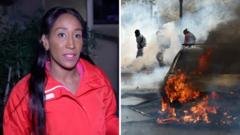
France protests erupt over living costs and education
When France protests spill over into the national consciousness, the reverberations are rarely confined to local street corners. On a Saturday that began with the familiar buzz of collective civic mobilization, an estimated 550,000 people took to the boulevards. They were not merely marching for the sake of friction. They were demanding a fundamental recalibration of priorities, pointing squarely at chronic underfunding in education and the suffocating weight of the rising cost of living in France.
France protests involve widespread demonstrations driven by public anger over the rising cost of living and demands for greater education investment. These events have frequently escalated into violent clashes, resulting in mass arrests, property damage, and intense political scrutiny for President Emmanuel Macron's administration.<\/p>
- Mass Mobilization: An estimated 550,000 citizens participated in nationwide demonstrations across major French urban centers.
- Economic Grievances: Protesters are primarily demanding immediate relief from the rising cost of living and increased funding for public education.
- Security Crackdown: Law enforcement arrested at least 1,200 individuals following clashes that involved tear gas, water cannons, and localized property destruction.
What started as a disciplined show of solidarity quickly mutated. By midday, the heavy atmosphere of grievance turned volatile. Tear gas mingled with the smoke of burning vehicles, and the fault lines of modern French politics cracked wide open.
A Pressure Cooker Years in the Making
To understand why the asphalt of Paris and other major cities became a battleground, one must look beyond the immediate flashpoints. For weeks, classrooms had emptied. Students organized strikes, venting their exhaustion over decaying facilities, teacher shortages, and an educational roadmap that many feel has abandoned the working class. These student grievances did not exist in a vacuum. They fused organically with the anxieties of working families squeezed by persistent inflation.
According to reports from outlets like Reuters, the synthesis of student activism and broader labor frustration created a uniquely potent political cocktail. The French education funding crisis became a proxy argument for a wider systemic failure. People simply cannot afford the basics anymore. Housing, energy, and groceries have outpaced wage growth by a staggering margin.
When Demonstrations Turn to Disorder
The transition from peaceful dissent to chaotic urban warfare happened with terrifying speed. Storefronts were ransacked. Rubbish bins became makeshift bonfires. Entire blocks were blanketed in acrid white smoke as riot police moved in with tactical precision.
The numbers tell a stark story of the government’s containment strategy. At least 1,200 people were arrested on Saturday alone. Water cannons blasted crowds attempting to hold strategic junctions, while batons and tear gas cleared the historic avenues. Yet, each intervention seemed to draw an equal and opposite reaction from splintered groups of agitators determined to clash with authorities.
“This is no longer just about policy. It is about a profound disconnect between the governing elite and the citizen trying to survive the month.”
Industry analysts observing the Emmanuel Macron economic crisis note that the administration finds itself trapped in a narrowing corridor of choices. Push too hard on fiscal restraint, and the streets erupt. Yield too easily to populist demands, and market confidence wobbles. It is a high-stakes balancing act with very little margin for error.
The Economic Toll and Political Fallout
Beyond the immediate human and physical cost, the long-term economic implications for the Fifth Republic are severe. Small business owners, already battered by previous years of economic turbulence and pandemic-era disruptions, now face staggering repair bills. Insurance premiums are expected to spike, and consumer confidence—already fragile—takes another direct hit every time glass shatters on the Rue de Rivoli.
To put the scale of recent civil unrest into perspective, consider the following historical and contemporary breakdown:
| Protest Metric | Estimated Figures | Core Driver |
|---|---|---|
| National Turnout | 550,000+ participants | Cost of living & education |
| Law Enforcement Detentions | 1,200+ arrests | Property destruction & clashes |
| Primary State Response | Tear gas, water cannons, riot units | Restoring public order |
President Macron, utilizing social media to broadcast his response, did not mince words. He denounced the violence unequivocally, making it clear that vandals and looters would be hunted down, prosecuted and punished. But critics argue that punitive rhetoric misses the forest for the trees. Law enforcement can clear a square, but it cannot legislate away economic desperation.
Where Do We Go From Here?
As the smoke clears and municipal workers sweep up the shattered glass, the core questions remain entirely unresolved. The government insists on fiscal discipline and structural reform. The streets demand immediate redistribution and an end to austerity measures that disproportionately impact the vulnerable.
Observers tracking the Paris riots and arrests warn that until the root causes of economic disenfranchisement are seriously addressed, these weekend flare-ups will likely become a recurring feature of French civic life. The social contract is fraying at the edges. Whether it can be stitched back together before the next wave of mobilization depends entirely on political agility that has, thus far, remained frustratingly out of reach.
<button type="button" onclick="this.parentElement.innerHTML='✓ Thank you, we will refine our analysis!‘” style=”background:#ffffff; border:1px solid #cbd5e1; border-radius:6px; padding:4px 12px; font-size:12px; cursor:pointer; color:#334155;”>👎 No
