
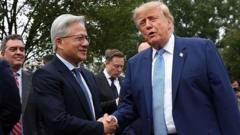
Push for Jensen Huang Nvidia Reinstatement Hits Board Resistance
SANTA CLARA, Calif. — Silicon Valley thrives on resurrection stories. From Steve Jobs’ triumphant return to Apple to Sam Altman’s whirlwind 72-hour reinstatement at OpenAI, the tech sector holds a deep-seated belief that visionary founders are irreplaceable. Yet, as pressure builds for a Jensen Huang Nvidia reinstatement, the world’s most valuable semiconductor titan is drawing a firm line in the sand.
The movement for a **Jensen Huang Nvidia reinstatement** centers on a high-stakes campaign by tech executives, investors, and political allies—including Donald Trump—to return Huang to his role as CEO following his sudden resignation. However, Nvidia's board remains firmly opposed to his return amid ongoing national security and corporate governance investigations.<\/p>
- Board Refusal: Despite market turbulence and political pressure, the Nvidia board of directors currently refuses to consider reinstating former CEO Jensen Huang.
- High-Profile Support: Donald Trump, Elon Musk, and leading institutional investors have publicly supported Huang's return, citing supply chain fragility and market stability.
- National Security Shadow: Ongoing FBI probes and upcoming Congressional testimony regarding Huang's affair with alleged Chinese intelligence operative Alice Huang complicate any potential return.
- Escalating Controls: The White House concurrently unveiled stricter AI chip export restrictions targeting third-party data hubs in Southeast Asia and South America.
Over the weekend, a groundswell of support coalesced around a campaign dubbed “Stand with Jensen.” Backed by an open letter bearing more than 175,000 signatures—including prominent Wall Street managers and Silicon Valley titans—the effort reached the highest corridors of global power when former U.S. President Donald Trump publicly lent his voice to the cause. Still, insiders familiar with the board’s thinking confirm that directors have no intention of walking back the decision that sent shockwaves through global markets last week.
The Silicon Rebellion: Who Wants Huang Back?
The campaign to reinstate Huang was born out of sheer market panic and founder loyalty. When news broke last Thursday that Huang had resigned following revelations of two extramarital affairs—one involving a subordinate executive and another with Alice Huang, an alleged intelligence operative linked to Chinese GPU host Megaspeed—the market reaction was swift. Hundreds of billions of dollars in enterprise value evaporated almost overnight.
For many stakeholders, the immediate loss of Huang’s operational genius poses a far greater existential threat to Nvidia than the governance lapses that prompted his exit.
“Jensen drove supply chain brilliantly at Nvidia, but many of those deals were a handshake with Jensen, not a written contract. Without Jensen, at least some of those critical deals will be lost.”
— Elon Musk, CEO of SpaceX and Tesla
Musk is far from alone. Tim Sweeney, chief executive of Epic Games, signed the petition, while OpenAI CEO Sam Altman labeled Huang a “hero” during a recent industry summit. On Wall Street, prominent asset managers have begun lobbying the board directly. Brad Gerstner, founder of Altimeter Capital, along with Atreides Management boss Gavin Baker, penned an urgent letter urging interim management to keep “all options on the table, including the potential return of Jensen Huang.” Across the Atlantic, Lord Sarfraz of the UK House of Lords reached out directly to Nvidia’s newly appointed chairman, Harvey Jones, advocating for a formal pause until internal investigations conclude.
| Stakeholder | Entity / Institution | Position on Reinstatement | Primary Rationale / Stated Concern |
|---|---|---|---|
| Donald Trump | U.S. Executive Branch | Favorable | Doubts security breach; prioritizes commercial leadership against foreign competition. |
| Scott Bessent | U.S. Treasury Department | Opposed | Demands institutional cleanup and an external candidate to restore regulatory trust. |
| Elon Musk | SpaceX / xAI / Tesla | Favorable | Warns critical supply chain handshake agreements will collapse without Huang. |
| Harvey Jones & Board | Nvidia Board of Directors | Firmly Opposed | Focusing on fiduciary compliance, ethics violations, and federal regulatory exposure. |
| Brad Gerstner & Gavin Baker | Altimeter / Atreides | Favorable | Urge board to keep options open to preserve enterprise valuation and operational continuity. |
A Wall Street Titan Shaken by Espionage Shadows
While tech executives view Huang through the lens of product roadmaps and wafer allocations, Washington sees a sprawling national security nightmare. The Alice Huang Megaspeed scandal has sparked intense friction between the U.S. Department of Commerce and the U.S. Treasury Department, raising uncomfortable questions about whether cutting-edge Blackwell and Hopper architectures bypassed federal restrictions.
Federal investigators are examining whether high-end processing units shipped to third-party data hubs in Southeast Asia ultimately found their way into Chinese military labs. Huang has agreed to testify before the House Select Committee on China to address whether his personal relationship compromised foreign policy interests. Concurrently, the FBI has opened a inquiry into the matter.
Despite the brewing regulatory storm, President Trump offered surprisingly relaxed Donald Trump Nvidia comments to reporters outside the White House on Monday, signaling a clear rift between his political instincts and the hardline stance taken by his own cabinet members.
“They say she’s a spy. I don’t know that she was a spy at all. I mean, I really don’t… China plays games with us. So we play games with China. But I would certainly not mind seeing Jensen back.”
— Donald Trump, addressing reporters at the White House
Trump’s position stands in sharp contrast to Treasury Secretary Scott Bessent, who has privately urged the Nvidia board of directors to conduct a global search for an external chief executive completely untainted by the current probe. The conflict highlights an unresolved tension inside Washington: balancing the commercial dominance of America’s tech champions against the imperative of total national security compliance.
Tightening the Belt: The Broader AI Chip Export Restrictions
As the drama surrounding Huang unfolds, federal policy is accelerating in a distinctly hawkish direction. Coinciding with Trump’s public remarks, the administration announced a sweeping expansion of AI chip export restrictions designed to block backdoor access to high-performance computing power.
Under the updated regulatory framework, semiconductor manufacturers must secure explicit export licenses before transferring advanced chips to commercial data centers operating across several intermediary nations, including:
- Singapore: Historically a primary transit and hosting hub for Asia-Pacific data infrastructure.
- Malaysia & Indonesia: Emerging centers for hyperscale data facility expansion.
- Thailand: A rapidly growing market for foreign direct investment in cloud server farms.
- Brazil: South America’s primary gateway for high-density compute infrastructure.
By closing regional re-export channels, the U.S. government aims to ensure that hardware cannot be rented remotely by foreign entities subject to trade blockades. The timing of the announcement—coming just days ahead of a high-stakes bilateral summit with Chinese President Xi Jinping—underscores how deeply embedded Nvidia’s hardware has become in sovereign geopolitics.
Inside Santa Clara: Why the Board Isn’t Budging
For Chief Financial Officer Colette Kress, who has stepped into the operational vacuum ahead of this week’s high-stakes earnings call, the mandate is clear: stabilize the ship. Industry analysts note that despite the public clamor for Huang’s return, the board faces structural constraints that make reinstatement practically impossible under current conditions.
1. Governance and Fiduciary Duty
Huang did not depart solely because of geopolitical speculation. The discovery of a secondary extra-marital affair with an executive within Nvidia who directly reported to him created an unambiguous breach of corporate policy. For a publicly traded entity holding a multi-trillion-dollar evaluation, ignoring clear conflict-of-interest guidelines would expose directors to overwhelming shareholder litigation.
2. Criminal and Regulatory Exposure
With an active FBI investigation underway and Congressional subpoenas issued, keeping Huang at the helm would leave Nvidia vulnerable to administrative sanctions. If federal authorities discover that state-sponsored actors leveraged personal relationships to access proprietary architecture designs, corporate tolerance for executive leniency disappears overnight.
3. Customer Relationships Beyond the Founder
While Musk rightly pointed out that Huang personally negotiated critical supply agreements with TSMC and major memory manufacturers, Nvidia is no longer a mid-sized challenger. The company operates as a pillar of global technology infrastructure. Hyperscalers like Microsoft, Alphabet, and Meta rely on institutional continuity, not charismatic individualism.
The Founder Dilemma in Modern Tech Governance
The push for a Jensen Huang Nvidia reinstatement represents a pivotal moment in corporate history. It tests whether an iconic founder, having propelled a company from a Denny’s diner booth to a $3.8 trillion valuation, can ever truly be separated from the enterprise he built.
For now, Nvidia’s board remains resolute. The directors are betting that the company’s hardware moat, CUDA software ecosystem, and engineering talent are durable enough to survive the loss of their visionary founder. Whether Wall Street and Washington allow them to make that break cleanly remains an open question.
<button type="button" onclick="this.parentElement.innerHTML='✓ Thank you, we will refine our analysis!‘” style=”background:#ffffff; border:1px solid #cbd5e1; border-radius:6px; padding:4px 12px; font-size:12px; cursor:pointer; color:#334155;”>👎 No
Latest Analytical Follow-up: For continuous developments on this subject, read our full investigation on Nvidia quarterly sales double amid Jensen Huang exit drama.
Latest Analytical Follow-up: For continuous developments on this subject, read our full investigation on Nvidia quarterly sales double despite Jensen Huang exit.
