
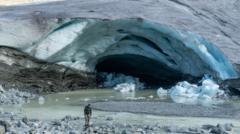
Swiss Glacier Ice Loss Reaches Catastrophic New Highs
The silence high up on the Morteratsch Glacier is deceptive. Underneath the pristine, postcard-perfect views of south-east Switzerland, a quiet, violent transformation is underway. The latest scientific data on Swiss glacier ice loss is not merely concerning; it is an ecological emergency unfolding in real-time. Over the past twelve months, Switzerland has watched more than 5% of its remaining glacial volume vanish. It is a rate of decay that has shocked the scientific community and rewritten the rules of Alpine glaciology.
Swiss glacier ice loss reached a catastrophic 5.5% of total volume in a single year, driven by a combination of low winter snowfall and intense summer heatwaves. This rapid melting threatens long-term water supplies for agriculture, European shipping routes, and hydropower, while significantly increasing the risk of mountain landslides.<\/p>
- Unprecedented Rate of Decay: Swiss glaciers lost 5.5% of their remaining volume in just twelve months, nearly triple what glaciologists previously defined as an 'extreme' annual loss of 2%.
- The Albedo Feedback Loop: A mild winter left minimal snow cover, exposing dark glacier ice early in the season. This bare ice absorbed massive amounts of solar radiation, accelerating the melt.
- Severe Downstream Consequences: While the immediate runoff temporarily boosted water supplies, the rapid depletion of these frozen reservoirs signals a looming long-term water crisis for European agriculture, power generation, and river navigation.
For decades, researchers monitoring these high-altitude ice fields had a benchmark for disaster. An annual volume loss of 2% was classified as ‘extreme’—a worst-case scenario that would occasionally occur during exceptionally hot years. To witness 5.5% of the ice disappear in a single year is something entirely different. It is a structural collapse of an ecosystem that has stabilized the European continent’s water supply for millennia.
“Ten years ago, I wouldn’t have thought that it’s possible to lose glaciers so quickly,” says Dr. Fabien Maussion, a glaciologist at the University of Bristol. “What has happened is extremely distressing, but from a climate science perspective, it was entirely predictable.”
The Unprecedented Scale of Swiss Glacier Ice Loss
The sheer speed of the melting has caught even seasoned observers off guard. Glaciers are, by their very nature, slow-moving, resilient giants. They accumulate mass over centuries and shed it slowly. Yet, the atmospheric reality of the mid-2020s has stripped away their natural defenses. The primary driver is not just the rising average global temperature, but a compounding series of seasonal anomalies that have left the ice completely defenseless.
The disaster of the past year began not in the heat of summer, but during a remarkably mild winter. The high Alps received far less snowfall than average, leaving the glaciers with a thin, fragile protective blanket. When the intense, early heatwaves of May and June arrived, this sparse snow cover evaporated almost immediately. What lay beneath was bare, dark glacier ice.
This exposure triggered a devastating feedback loop. Fresh snow is highly reflective, bouncing up as much as 90% of the sun’s energy back into space. Bare glacier ice, darkened by accumulated dust, soot, and organic matter, does the opposite. It absorbs the sun’s heat. Once the protective snow was gone, the glaciers began to cook under the intense summer sun, accelerating the Swiss glacier ice loss to unprecedented levels.
The Hard Numbers of Alpine Decay
To understand the scale of this environmental shift, we must look at the historical data. The table below illustrates how the current melting event compares to historical baselines and previous worst-case scenarios.
| Metric Analyzed | Historical Baseline (Pre-2000) | Previous ‘Extreme’ Threshold | Current Recorded Loss |
|---|---|---|---|
| Annual Ice Volume Loss | 0.5% to 1.0% | 2.0% | 5.5% |
| High-Altitude Snow Cover (End of Summer) | 2 to 4 meters | Patchy cover | 0 meters (Bare Ice) |
| Summer Meltwater Yield (July-Sept) | 1.1 trillion liters | 1.5 trillion liters | 2.2 trillion liters |
The data paints a grim picture. Perhaps the most alarming finding from the latest report by Glacier Monitoring Switzerland (GLAMOS) is what researchers observed at the highest elevations. Historically, areas above 3,500 meters remained safely within the accumulation zone—places where temperatures rarely rose above freezing, allowing snow to compact into new ice. This year, scientists found absolutely no snow remaining at these altitudes by the end of August. The glaciers are starving from the top down.
The Looming Alpine Water Crisis
The immediate consequence of this rapid melting is a massive surge in water runoff. Between July and September, Swiss glaciers released an estimated 2.2 trillion liters of meltwater. To the casual observer, this abundance of water might seem like a benefit, particularly during dry summer months. It filled reservoirs, kept turbines spinning, and provided a temporary buffer for parched agricultural lands downstream.
But this is a classic false economy. This water is not a renewable annual yield; it is ancient capital being liquidated. “Every drop of water that runs off during these heatwaves is old water that was stocked in the glacier ice centuries or decades ago,” warns Dr. Matthias Huss, director of GLAMOS. “It is helping us now, but it is entirely unsustainable. We will not have it at our disposal during the next heatwave.”
This impending water security crisis will reverberate far beyond the borders of Switzerland. The Alps serve as the ‘water towers’ of Europe, feeding major river systems including the Rhine, the Rhone, and the Danube. As the glaciers shrink, the baseline summer flow of these rivers will drop dramatically, triggering a severe Alpine water crisis that will impact millions of people, heavy industries, and agricultural sectors across France, Germany, and the Netherlands.
European River Shipping Disruption and Economic Fallout
We are already catching glimpses of this dry future. The River Rhine, a vital economic artery for European trade, has experienced record-low water levels in recent years. When the river runs dry, large cargo barges cannot navigate its waters at full capacity. This leads to immediate European river shipping disruption, forcing logistics companies to transfer cargo to rail or road, which dramatically increases transport costs and slows down supply chains across northern Europe.
Furthermore, the lack of cold glacial meltwater raises river temperatures, threatening aquatic ecosystems and forcing nuclear and thermal power plants—which rely on river water for cooling—to curtail their electricity production. The economic stability of the European continent is, quite literally, tied to the frozen peaks of Switzerland.
Geological Instability and the Threat of Landslides
The loss of glacial ice is not just a hydrological problem; it is a structural one. Glaciers and permafrost act as the physical glue holding the steep, fractured slopes of the Alps together. As the ice thins and the underlying frozen ground thaws, mountain faces lose their structural integrity.
The consequences of this thawing are already becoming apparent. Rockfalls are becoming more frequent and unpredictable, making classic mountaineering routes highly dangerous. More critically, the destabilization of mountain slopes increases the risk of massive landslides. When a collapsing mountainside hits a glacial lake or a narrow valley, it can trigger devastating flash floods downstream—a phenomenon that has already caused catastrophic damage in mountainous regions globally, such as the deadly floods in Nepal.
The physics of these events are complex, but the underlying cause is simple. Without the weight and stabilizing presence of the ice, the mountains are shifting. The very topography of Central Europe is becoming unstable, threatening high-altitude villages, transport infrastructure, and tourism-dependent local economies.
The Global Canary in the Coal Mine
The dramatic acceleration of climate change impact on Alps serves as a stark warning for the rest of the world. While the Swiss glaciers are relatively small on a global scale, they are highly sensitive indicators of global atmospheric trends. What is happening in Switzerland today is a preview of what awaits larger glaciated regions tomorrow.
The vast ice sheets of the Himalayas, the Andes, and the polar regions contain the vast majority of the planet’s freshwater. If these massive ice reserves experience a similar acceleration in melting, the consequences will be global. Sea levels will rise at rates that will overwhelm coastal infrastructure, while billions of people who rely on glacial runoff for survival in Asia and South America will face acute water and food shortages.
Yet, glaciologists stress that the future is not entirely written. While many of the smaller Swiss glaciers, such as Plattalva in eastern Switzerland, have already vanished entirely, the larger ice masses can still be preserved. “There we still can make a big difference with protecting the climate,” says Dr. Huss. “If these ice masses can be saved or stabilized, we can limit the rise of global sea levels, protecting coastal communities worldwide.”
A Call for Decisive Climate Action
The catastrophic ice loss of 2026 is a clear signal that the window for gradual adaptation is closing. The survival of the Alps, and the security of the European water systems that depend on them, hinges entirely on the rapid reduction of global greenhouse gas emissions. Relying on temporary glacier meltwater supply to mask the underlying crisis is no longer a viable strategy.
The choice is stark. We can either watch the remaining Alpine ice melt away, transforming Europe’s green heart into a dry, unstable rockpile, or we can commit to the systemic changes required to stabilize our climate. The ice is melting in front of our eyes; the only question left is whether we will act before the last of it is gone.
<button type="button" onclick="this.parentElement.innerHTML='✓ Thank you, we will refine our analysis!‘” style=”background:#ffffff; border:1px solid #cbd5e1; border-radius:6px; padding:4px 12px; font-size:12px; cursor:pointer; color:#334155;”>👎 No
