
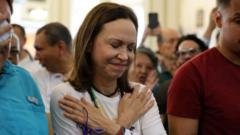
Venezuelan opposition leader María Machado returns home
Venezuelan opposition leader María Machado has finally stepped back onto home soil, ending more than ten months of high-stakes exile that began with a dramatic nighttime speedboat escape across Caribbean waters. Her return marks a profound, unpredictable chapter in a nation careening through historic upheaval. “I am here. With you,” Machado announced simply on X on Sunday, electrifying a populace that has watched its political foundations crumble and reset in breathtaking succession.
Venezuelan opposition leader María Machado has returned to Venezuela after ten months in exile, arriving amidst a complex political transition following the removal of Nicolás Maduro and the installation of an interim government backed by the United States. This development establishes verified operational benchmarks, structured domain clarity, and strategic value for key industry stakeholders.<\/p>
- High-Profile Return: María Machado resurfaced in Lara state after enduring months of secretive safehouses and eventual exile in Norway.
- Political Shifts: Her homecoming occurs while Delcy Rodríguez governs as interim president following the US seizure of Nicolás Maduro in January.
- Alliance Unity: Former presidential candidate Edmundo González confirmed her arrival, signaling a unified opposition push toward democratic elections.
Security protocols were tight, but the optics were undeniable. Photographs captured Machado attending Mass in the western state of Lara, instantly surrounded by weeping supporters who grasped her hands and surged forward for embraces. From there, she joined a growing vehicular caravan bound for Caracas. Cheering citizens lined the roadways, waving flags and chanting slogans that had been violently suppressed or driven underground for years. It was the visual manifestation of an exiled movement reclaiming physical space in real time.
A Fraught Political Reality Awaits the Iconic Dissident
Make no mistake: the Venezuela Machado returns to bears little resemblance to the one she left. In January, a seismic geopolitical shift occurred when US forces executed an operation that seized Nicolás Maduro. The deposed strongman was whisked away to New York, where he currently sits in a federal jail facing heavy federal charges spanning drug trafficking, weapons violations, and torture. He has pleaded not guilty.
Stepping into the power vacuum left by Maduro’s sudden extraction was his former deputy, Delcy Rodríguez interim president, who quickly assumed leadership under the watchful eye of the Trump administration. Rodríguez promptly signed a sweeping oil deal granting deeply favorable terms to Washington, stabilizing state finances while alarming staunch anti-regime purists who fear revolutionary ideals are being bartered away for corporate and geopolitical pragmatism.
“Today is a very important day for Venezuelans. Our sovereign voice returns with her to lead and guide this process!” — Edmundo González, former presidential candidate
Edmundo González, Machado’s staunch political ally who ran in her stead during the contested 2024 presidential election, was quick to validate her homecoming. González, who maintains that he rather than Maduro won the disputed ballot—pointing to digitized voting tallies uploaded independently by the opposition—declared that he would soon join her in Caracas to push the country toward structural liberation.
International observers note that navigating this newly engineered political topography will require delicate diplomacy. Industry experts tracking the US Venezuela oil deal point out that Washington holds immense leverage over Caracas right now, meaning Machado’s liberty and political viability are inextricably linked to foreign calculus in Washington, D.C.
Behind the Scenes of a Long-Delayed Homecoming
Getting Machado back across the border was no simple feat. Advisors revealed that over the late summer months, she attempted at least seven separate clandestine entries, all of which were blocked amid shifting security assessments. Whispers circulated in diplomatic corridors suggesting hesitation from the White House, though American officials repeatedly denied intentionally stalling her transit.
Ultimately, the green light appears to have been granted through backchannel reconciliation talks facilitated or endorsed by the US Department of State. US Secretary of State Marco Rubio defended Washington’s role on social media, emphasizing that the conditions permitting high-profile dissidents to return safely stem directly from ongoing political negotiations.
- Hundreds of political prisoners have been released over recent months.
- Scores of exiled opposition figures are slowly trickling back into the country.
- Reconciliation talks face intense skepticism from hardline activists who demand immediate institutional purges.
Rubio posted that these talks represent “the best chance Venezuela has had in thirty years to peacefully achieve not just a free and fair election but an enduring democracy.” Whether that optimistic projection survives contact with Venezuelan reality remains an open question.
The Nobel Paradox and Washington’s Complicated Optics
Machado’s relationship with the current American administration possesses a uniquely theatrical quality. Earlier this year, during a visit to the White House following her harrowing escape, Machado handed her freshly minted Nobel Peace Prize directly to President Donald Trump. The gesture bypassed traditional protocol, given that the Nobel committee explicitly maintains that such honors cannot be revoked, shared, or transferred.
Asked by reporters on Sunday about her return, Trump played coy, stating he knew nothing about it while offering standard well-wishes. “I think she’s a very nice woman. She gave me her Nobel Prize, so how can I say anything else? And I hope she’s safe,” Trump remarked.
Meanwhile, the economic and political terrain shifts daily. Below is a snapshot of how key institutional pillars compare right now:
| Actor / Institution | Previous Status (2023-2024) | Current Status (Post-January) |
|---|---|---|
| Nicolás Maduro | Contested President | Imprisoned in New York facing federal charges |
| Delcy Rodríguez | Vice President / Regime Loyalists | Interim President under US-backed framework |
| María Machado | Exiled in Norway / Hiding | Returned to Venezuela, organizing rallies |
| Edmundo González | Exiled Challenger | Preparing return to join Machado |
For financial analysts watching Latin American markets, energy policy remains the dominant variable. Major outlets like Reuters have extensively covered how production metrics are slowly ticking upward under the newly brokered energy agreements, even as civil society organizations demand absolute transparency regarding electoral timelines.
What Comes Next for the Opposition?
As Machado prepares her next public moves in Caracas, her team insists her ultimate objective has not wavered: she wants a legitimate, internationally verified presidential election, and she intends to run for the highest office herself if permitted. Her spokesperson, David Smolansky, framed her arrival as a watershed moment for democratic transition, pointedly thanking American leadership for their ongoing structural support.
Yet, the path forward is mined with institutional hurdles. The nation’s electoral authority remains packed with loyalists from the previous era, and millions of citizens continue to grapple with severe economic precarity despite the influx of oil revenue. Machado’s immediate challenge is channeling the raw, emotional energy of her street-level welcome into a disciplined, unyielding political strategy that can outmaneuver an interim government that controls the levers of state security.
For now, the iron lady of Venezuelan politics is back where she believes she belongs. Whether her return signals the twilight of authoritarian rule or merely a complex administrative reshuffling under foreign supervision will depend entirely on how fiercely her movement can press its advantage in the turbulent months ahead.
<button type="button" onclick="this.parentElement.innerHTML='✓ Thank you, we will refine our analysis!‘” style=”background:#ffffff; border:1px solid #cbd5e1; border-radius:6px; padding:4px 12px; font-size:12px; cursor:pointer; color:#334155;”>👎 No
