
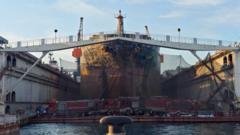
Qingdao Cargo Ship Fire Triggers Heavy Casualties in China
A devastating cargo ship fire China has left a trail of heavy casualties and ignited urgent safety investigations at a major eastern port. The tragic incident unfolded on a foreign-flagged vessel docked for routine maintenance in the industrial coastal hub of Qingdao, drawing immediate high-level intervention from Beijing’s top leadership.
A catastrophic cargo ship fire in Qingdao, China, resulted in heavy casualties while the foreign-flagged vessel was undergoing routine maintenance. The incident has prompted high-level directives from President Xi Jinping and Premier Li Qiang, triggering intensive search-and-rescue operations and a formal safety investigation.
- High Casualties Confirmed: A foreign-flagged cargo ship fire in Qingdao, China, resulted in numerous casualties during shipyard maintenance operations.
- Top-Level Intervention: President Xi Jinping and Premier Li Qiang issued immediate directives prioritizing rescue operations and the prevention of secondary disasters.
- Regulatory Scrutiny: The incident underscores critical safety gaps in ship maintenance protocols across major Chinese industrial and maritime hubs.
- Global Supply Chain Impact: The tragedy raises pressing questions regarding international vessel maintenance standards and shipyard safety compliance in East Asian ports.
1. Executive Summary & Strategic Importance
The catastrophic blaze, which erupted at 11:15 local time (03:15 GMT), has thrust maritime safety protocols back into the international spotlight. As emergency responders scrambled to secure the vessel, the scale of the disaster prompted direct intervention from President Xi Jinping, who called for an immediate and comprehensive search-and-rescue operation. Simultaneously, Premier Li Qiang underscored the critical necessity of locating trapped crew members and contractors while enforcing strict measures to prevent secondary explosions or structural collapses.
This event is not merely an isolated industrial accident; it carries profound implications for global shipping operations, shipyard accountability, and regulatory oversight in East Asia. Because the vessel was foreign-flagged and undergoing complex technical maintenance, international maritime bodies and insurance underwriters are closely monitoring the unfolding narrative. The incident highlights the inherent vulnerabilities present within global supply chain maintenance nodes, where heavy machinery, combustible materials, and tight turnaround schedules frequently intersect.
2. Historical Background & Contextual Evolution
To understand the gravity of the Qingdao shipyard disaster, one must examine the rapid evolution of China’s shipbuilding and maritime maintenance sectors over the past three decades. China has cemented its position as the undisputed global leader in commercial shipbuilding, dry-docking, and vessel conversion. However, this exponential growth has periodically outpaced safety compliance frameworks, leading to historical industrial accidents that have tested regulators.
Historically, maritime disasters in Chinese ports—ranging from the 2015 Tianjin explosions to various shipyard scaffolding collapses—have served as catalysts for sweeping regulatory overhauls. Each major incident forces the Ministry of Transport and local maritime safety administrations to reevaluate hot-work permits, toxic gas monitoring, and fire suppression readiness. The current cargo ship fire China disaster echoes past structural failures where maintenance protocols were either inadequately supervised or compromised by time constraints.
Furthermore, the presence of a foreign-flagged vessel introduces complex jurisdictional and regulatory layers. Shipyards handling international tonnage must balance domestic safety codes with international conventions established by the International Maritime Organization (IMO). When fatal accidents occur on these vessels, diplomatic sensitivities often accompany technical investigations, requiring transparent cooperation between flag states, port states, and classification societies.
3. In-Depth Technical & Policy Breakdown
Industrial maritime fires during dry-docking or afloat maintenance are among the most complex emergencies emergency responders face. Understanding the mechanics of the Qingdao incident requires examining the specific operational hazards associated with shipboard overhauls.
Combustible Hazards During Ship Maintenance
During maintenance, cargo ships frequently become industrial zones fraught with hazards. Welding, cutting, and grinding operations generate extreme heat and sparks, which can easily ignite residual cargo residues, hydraulic fluids, insulation materials, or fuel lines. When ventilation is restricted—as is often the case within deep cargo holds or engine rooms—smoke accumulation and flashovers can occur within minutes, trapping workers before they can navigate labyrinthine escape routes.
Regulatory Frameworks and Accountability
According to reports from Reuters, maritime safety watchdogs are increasingly scrutinizing subcontractor oversight at major shipyards. Maintenance projects often involve a tiered network of specialized contractors working simultaneously. Without rigorous coordination by shipyard safety officers, communication breakdowns inevitably occur. Premier Li Qiang’s specific warning to prevent “secondary disasters” points directly to the risk of structural compromise, chemical leaks, or re-ignition during firefighting operations—hazards that demand specialized damage-control expertise.
4. Comparative Industry Framework
To evaluate how different maritime nations handle shipyard safety, regulatory oversight, and emergency response, we must examine key operational dimensions across major global shipbuilding hubs.
| Operational Dimension | Chinese Shipyards (Qingdao Model) | European Shipyards (Rotterdam Model) | South Korean Shipyards (Ulsan Model) |
|---|---|---|---|
| Regulatory Enforcement | Centralized state mandates with localized provincial enforcement | Strict EU maritime directives and independent safety audits | Rigorous corporate safety boards backed by national labor laws |
| Hot-Work Permitting | Mandatory permits with varying degrees of digital tracking | Strict digital authorization with mandatory atmospheric gas testing | Automated sensor-based monitoring and restricted access zones |
| Emergency Response Time | Rapid deployment of municipal and port authority fire brigades | Integrated port-city emergency services with specialized marine units | Dedicated on-site industrial fire departments with advanced containment |
| Subcontractor Oversight | Complex tiered contracting requiring enhanced supervision | Highly regulated labor compliance with mandatory safety certifications | Standardized internal training programs for all external personnel |
SEEUY INTELLIGENCE
Cargo Ship Fire China – Analytical Overview
Regulatory Enforcement
Centralized state mandates with localized provincial enforcement
Hot-Work Permitting
Mandatory permits with varying degrees of digital tracking
Emergency Response Time
Rapid deployment of municipal and port authority fire brigades
Subcontractor Oversight
Complex tiered contracting requiring enhanced supervision
Analytical Takeaway: While Chinese shipyards boast unmatched capacity and rapid turnaround times, incidents like the recent Qingdao shipyard disaster illustrate the urgent need to standardize subcontractor oversight and real-time gas monitoring to match the stringent preventive measures seen in European and South Korean facilities.
5. Socio-Economic, Enterprise & Global Ramifications
The human toll of the Qingdao fire is immeasurable, but the economic and geopolitical ripples are equally significant. Major maritime accidents in key trading nations inevitably trigger temporary suspensions of operations at affected berths, creating localized port congestion and delaying scheduled vessel redeliveries.
Global shipping lines, facing already constrained capacity and volatile freight rates, monitor such incidents closely. Any prolonged investigation that halts work across Qingdao’s extensive dry-dock infrastructure can disrupt regional maintenance schedules. Furthermore, international insurance markets—such as Lloyd’s of London—will likely reprice hull and machinery underwriting risks for foreign-flagged vessels undergoing major overhauls in East Asian ports if safety protocols are perceived to be lagging.
According to analyses published by Bloomberg, industrial safety enforcement in China has tightened considerably over the past decade following high-profile manufacturing disasters. However, balancing economic velocity with uncompromising safety standards remains an ongoing challenge for enterprise operators. The tragedy serves as a stark reminder that cost-cutting or compressed maintenance schedules in maritime engineering carry devastating human and financial costs.
6. Strategic Outlook & What Comes Next
As search-and-rescue operations conclude and forensic investigators comb through the charred remains of the cargo vessel, attention will pivot toward accountability and systemic reform. The immediate priority for port authorities in Qingdao is stabilizing the vessel and ensuring zero environmental contamination from bunker fuel or hazardous cargo residues.
In the medium term, we can anticipate a sweeping wave of safety inspections across all major Chinese shipyards. The Ministry of Transport is expected to issue stricter compliance guidelines concerning hot-work operations on foreign-flagged vessels. For shipowners and operators, the primary takeaway is clear: rigorous vetting of maintenance yards and independent verification of onboard safety protocols are no longer optional—they are critical risk-mitigation imperatives.
7. Frequently Asked Questions (FAQ)
-
What caused the cargo ship fire in China?
While formal investigations by state agencies are ongoing, the blaze ignited during maintenance operations on a docked foreign-flagged vessel in Qingdao.
-
How many casualties were reported in the Qingdao shipyard fire?
State media confirmed heavy casualties, though detailed breakdowns of injuries and fatalities are updated as rescue operations conclude.
-
What response did Chinese leadership take following the incident?
President Xi Jinping ordered immediate search and rescue efforts, while Premier Li Qiang emphasized the urgency of rescuing trapped individuals and preventing secondary disasters.
-
Where did the maritime accident take place?
The fire occurred at a shipyard in the major eastern Chinese port city of Qingdao, located in Shandong province.
-
What are the broader implications for international shipping?
The tragedy highlights critical maintenance risks and is expected to drive stricter safety audits and compliance standards across shipyards handling foreign-flagged tonnage.
