
Egypt-Sudan Border Strikes: Dozens Dead in Gold Mine Attack
A devastating air attack on informal gold diggers in northern Africa has re-ignited tense regional rivalries. Recent Egypt-Sudan border strikes have left at least 72 civilian prospectors dead, leveling makeshift encampments and burying workers beneath collapsed earth in Sudan’s River Nile state. The dawn raid, which involved multiple high-yield missile strikes, marks one of the deadliest single incidents targeting informal labor along the volatile frontier this year.
The recent Egypt-Sudan border strikes refer to targeted aerial bombardments on informal gold mining encampments in Sudan's River Nile state. Occurring near the northern frontier, the strikes killed at least 72 civilian prospectors, destroyed excavation pits, and exposed severe international law violations amid heightened geopolitical friction over illicit cross-border resource flows.<\/p>
- Mass Casualty Event: At least 72 civilian gold prospectors were killed in targeted missile strikes in Sudan's River Nile state.
- Escalating Regional Tensions: Unilateral military actions along the border highlight growing friction over informal resource extraction and border sovereignty.
- Humanitarian Law Violations: Legal advocacy groups warn that strikes on unarmed civilian miners may amount to international war crimes.
- Economic Desperation: Sudan's civil war has forced thousands into hazardous artisanal mining as formal governance structures collapse.
It was barely 06:00 local time when the sound of jet engines pierced the early morning silence over the desert extraction site. Eyewitnesses reported that aircraft fired more than five heavy missiles directly into sprawling miners’ camps and excavation shafts. Earth-moving equipment was blown to pieces. Tents caught fire within seconds. Dozens of workers were entombed inside unstable pits as the surrounding terrain caved in under the concussive force of the explosions.
The Massacre in River Nile State
The immediate human cost is staggering. According to statements released by Emergency Lawyers, a respected legal monitoring collective based in Khartoum, at least 72 body counts have been verified locally. Yet, rights advocates stress that this figure remains provisional. Survivors speaking to regional media outlets suggest the final tally could easily surpass initial estimates as search efforts continue through shredded canvas and scorched earth.
Short, brutal, and calculated. That is how survivors described the raid. “The deliberate targeting of unarmed civilians violates international humanitarian law and the right to life,” Emergency Lawyers declared in a formal dispatch detailing the massacre. “These acts may constitute war crimes.”
Neither Cairo nor the de facto military junta in Port Sudan has officially accepted responsibility or provided clarification regarding the aircraft involved. However, the operational footprint mirrors previous military interventions designed to neutralize illegal border activity. The region has long served as a wild-west corridor where desperate civilians, armed smugglers, and regional traders converge.
“The sheer force of the bombardment flattened the entire settlement in minutes. These were not military installations; they were hand-dug trenches filled with laborers trying to feed their families amid a devastating civil war.”
Unpacking the Geopolitical Escalation Behind Egypt-Sudan Border Strikes
Tensions along this desert perimeter have simmered for months. As reported by Reuters, security along Egypt’s southern flank has tightened drastically as regional instability threatens trade corridors. Similar aggressive incursions were reported earlier this summer. In June, reports surfaced that Egyptian forces utilized drones and artillery to strike artisanal mining operations in the exact same desert swath, following sporadic clashes where border guards torched temporary shelters and deployed live ammunition to scatter mine workers.
Shortly after those earlier summer operations, Egypt’s border authority announced a massive, sweeping military campaign aimed at curbing human trafficking, narcotics movements, and unregistered precious metal extraction. Egyptian authorities previously revealed the seizure of over 86 tonnes of gold ore alongside crude prospecting machinery along the southern line. From Cairo’s perspective, unchecked smuggling damages state revenues and feeds black-market liquidity directly into insurgent coffers.
Yet, the legal standing of unilateral cross-border aerial bombardments remains deeply precarious. Humanitarian groups argue that national security imperatives do not grant carte blanche to incinerate civilian settlements in neighboring territory without oversight or operational accountability.
The Economic Engine of Conflict: Artisanal Gold Mining
Why are thousands of civilians risking violent death in the remote desert? The answer lies in Sudan’s catastrophic collapse. The ongoing civil conflict between rival military factions has shattered formal state infrastructure, annihilated the national currency, and displaced millions from urban centers like Khartoum and Darfur.
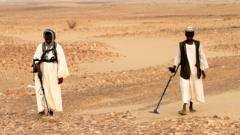
For many, Sudan artisanal gold mining has become the absolute sole means of survival. Armed with little more than metal detectors, shovels, and toxic mercury processing tools, informal prospectors flock to mineral-rich veins in River Nile state. It is grueling, dangerous, and unregulated labor. Shafts collapse frequently. Mercury poisoning is common. Yet, the promise of unearthing even a few grams of gold keeps thousands rooted in these isolated outposts.
- Informal Employment: Over 1.5 million Sudanese rely directly on informal mining to survive the current economic crisis.
- Unregulated Trade: Estimates suggest over 80% of gold extracted in northern Sudan is traded through informal channels, bypassing state banks.
- Porous Frontiers: Smuggling networks push unrefined bullion through ancient desert tracks into neighboring countries, flooding shadow markets.
This shadow economy creates an intricate dilemma. While poor laborers dig to buy food, armed factions and illicit cartels skim profits off the top. Analysts tracked by Bloomberg highlight that high-purity gold remains the primary liquid asset keeping regional proxy warfare funded. Consequently, gold pits have transformed from economic refuges into high-priority military targets.
Comparative Analysis: Security Metrics and Incident Impact
To understand the structural shift in border enforcement, consider how security operations have escalated over recent months:
| Incident Timeframe | Primary Location | Target Classification | Reported Tactics Used | Civilian Impact Level |
|---|---|---|---|---|
| Early Summer 2024 | Egypt-Sudan Perimeter | Smuggling Outposts | Ground warning shots, equipment burning | Moderate; displacement of camp labor |
| Mid Summer 2024 | Northern River Nile State | Artisanal Pits | Artillery barrages, drone strikes | Severe; localized casualties reported |
| Recent Air Attack | River Nile Border Zone | High-density Miner Camps | Air-launched precision missiles (>5 strikes) | Catastrophic; 72+ confirmed dead |
Sovereignty Void and the Silence of Port Sudan
The political silence following the strike is deafening. Neither the Egyptian Ministry of Foreign Affairs nor Sudan’s de facto military leadership under General Abdel Fattah al-Burhan has issued explicit official statements clarifying the chain of command. This silence underscores a stark geopolitical reality: the Sudanese armed forces currently lack effective territorial control over immense stretches of their northern desert expanse.
Human rights advocates with Emergency Lawyers Khartoum stress that this power vacuum allows foreign powers to act unilaterally inside Sudanese borders with zero diplomatic repercussions. When a government cannot safeguard its air space or defend its citizenry from high-altitude strikes, the concept of national sovereignty exists purely on paper.
Furthermore, informal gold smuggling Sudan routes intersect directly with regional financial hubs. Smuggled gold undermines legitimate exchange markets, creates price distortions, and bypasses international compliance standards. For neighboring state treasuries struggling with foreign exchange reserves, unchecked informal mining along their doorstep is viewed not just as illegal trade, but as a direct national security risk.
Humanitarian Implications and International Law
Under international humanitarian law—specifically Article 3 common to the 1949 Geneva Conventions—the targeting of individuals not actively taking part in hostilities is strictly prohibited. Civilian prospectors working in open pits fall squarely under protected status, regardless of the legality of their mining permits or their proximity to international borders.
- Distinction: Belligerents must at all times distinguish between civilian populations and military objectives.
- Proportionality: Launching an attack which may be expected to cause incidental loss of civilian life excessive to the concrete military advantage is illegal.
- Precaution: Constant care must be taken in the conduct of military operations to spare civilian populations.
Reports that aircrews fired heavy munitions into crowded tents and actively worked excavation sites indicate a complete disregard for these basic principles. If confirmed to be state-sanctioned cross-border actions, the incident could prompt formal international inquiries via the United Nations Human Rights Council.
The Wider Context: A Escalating Regional Firestorm
The tragedy in River Nile state mining camps cannot be viewed in isolation. It is a symptom of a broader, systemic collapse across Northeast Africa. As war destroys institutions in Khartoum, rural peripheral zones are turning into stateless frontiers. Gold is both the prize and the curse driving this kinetic escalation.
Local community leaders in River Nile state have begun calling for an immediate stand-down of foreign flight operations over civilian territories. However, given the immense financial incentives tied to gold flow control, peace remains distant. Unless international observers enforce accountability for actions taken along the frontier, the desert gold fields will continue to yield more bodies than bullion.
<button type="button" onclick="this.parentElement.innerHTML='✓ Thank you, we will refine our analysis!‘” style=”background:#ffffff; border:1px solid #cbd5e1; border-radius:6px; padding:4px 12px; font-size:12px; cursor:pointer; color:#334155;”>👎 No
Latest Analytical Follow-up: For continuous developments on this subject, read our full investigation on RJ Mitte Death: Remembering The Breaking Bad Star at 34.
Latest Analytical Follow-up: For continuous developments on this subject, read our full investigation on Russian Strikes Hit Kyiv Power Plant Amid Ceasefire Collapse.
Latest Analytical Follow-up: For continuous developments on this subject, read our full investigation on Houthi Missile Attack Rocks Aden Presidential Palace.
