
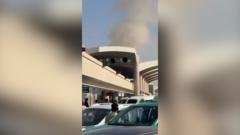
Riyadh Airport Attack Leaves 12 Dead in Mass Escalation
A fatal Riyadh airport attack has left at least 12 people dead and more than 300 injured, sending shockwaves through international aviation networks and threatening to plunge the Arabian Peninsula into a far deeper conflict. Explosions ripped through passenger areas at King Khalid International Airport, transforming a bustling commercial terminal into a scene of panic, shattered glass, and emergency triage within seconds.
At least 12 people were killed and 309 injured following a violent strike on King Khalid International Airport in Riyadh. The attack, attributed to Yemen's Houthi movement, hit passenger terminal gates, prompting an immediate suspension of operations and sparking widespread flight cancellations and international condemnation.<\/p>
- Mass Casualties: At least 12 civilians killed—including foreign national citizens from the US, Bangladesh, and Jordan—with 309 injured.
- Aviation Halt: Operations at King Khalid International Airport stand suspended, triggering cascading flight disruptions across the Middle East.
- Diplomatic Response: US and Western officials forcefully condemned the attack, while the Saudi-led coalition vowed military retaliation.
- Escalation Phase: The strike marks a drastic expansion of the Yemen conflict beyond tactical border friction into major Gulf infrastructure hubs.
Sirens blared across the tarmac as dozens of ambulances surged toward the terminal perimeter. Civil aviation authorities quickly shut down air traffic control, suspending all flight operations and turning away approaching long-haul jetliners mid-flight. The attack strikes directly at the heart of Saudi Arabia’s primary international gateway, underscoring a stark escalation in regional security risks.
Terminal Havoc: How the Riyadh Airport Attack Unfolded
Chaos erupted during a peak transit hour when projectile impacts severely damaged civilian infrastructure near active departure gates. Witnesses described sudden shockwaves blowing through glass facades, causing structural debris to collapse onto passengers queueing at gate 401.
“Everyone was running,” one witness trapped inside the domestic terminal told reporters shortly after escaping the concourse. “Injured people were falling right in front of my eyes. The sound was deafening, and smoke filled the gate area instantly.”
According to official statements from the Saudi Civil Aviation Authority, the deceased include four Saudi citizens, two Bangladeshi nationals, and individual citizens from the United States, Jordan, Palestine, Syria, Sudan, and Egypt. Medical teams on the scene confirmed that dozens among the 309 injured remain in critical condition, prompting urgent appeals for blood donations across capital hospitals.
Immediate Impact on Civil Infrastructure
Operational disruption was instantaneous. Flight-tracking radar feeds showed dozens of long-haul flights performing sudden holding patterns before diverting to neighboring Gulf states. Regional carriers, including Kuwait Airways and major international airlines, canceled all service to the Saudi capital, citing an unsustainable risk environment.
The economic footprint of the stoppage is massive. King Khalid International Airport serves as a vital arterial hub for passenger traffic and air freight moving between Europe, Asia, and Africa. Grounding flights completely chokes critical supply links and stranded thousands of international passengers across regional connections.
Escalation Dynamics and Regional Security
The strike represents a pivotal turn in the long-running Yemen conflict escalation. While tactical cross-border exchanges have occurred periodically, targeting a major capital airport marks a deliberate effort to inflict structural economic damage on Saudi infrastructure. The strike follows days after a projectile fell near King Fahd International Airport in Dammam, along with earlier strikes targeting secondary regional airfields.
“Targeting civilian terminal facilities crosses every established threshold of military confrontation. This is not a tactical skirmish—it is an explicit assault on international trade networks and commercial movement.”
The Saudi-led coalition spokesman, Maj Gen Turki al-Maliki, issued a stern response within hours of the strike, confirming that terminal facilities had been hit and describing the incident as a “full-fledged war crime.” Coalition forces pledged an forceful military response against launch sites and command posts responsible for directing the strikes.
Comparative Impact on Saudi Aviation Targets
To understand the sudden escalation in scope, the table below outlines recent security incidents affecting civil air hubs across the kingdom:
| Facility Targeted | Location | Primary Impact | Operational Status |
|---|---|---|---|
| King Khalid International Airport | Riyadh | 12 Fatalities, 309 Injured; Concourse Damage | Operations Suspended |
| King Fahd International Airport | Dammam | Perimeter Impact; Minimal Infrastructure Damage | Normal Operations |
| Regional Border Airfields | Southern Provinces | 6 Fatalities; Aircraft & Runway Damage | Restricted Access |
The shift toward high-capacity hubs indicates an intentional strategy to strain Saudi Arabia airport security posture. Defense analysts note that while tactical defense systems intercept many incoming threats, saturation tactics aimed at sprawling civil airports present unique operational challenges.
Geopolitical Fallout: From Washington to the Red Sea
The international reaction was immediate and uncompromising. US Secretary of State Marco Rubio issued a scathing critique of the strikes after state officials confirmed that an American citizen was among those killed inside the terminal concourse. Western embassies across Riyadh updated security posture alerts, warning foreign nationals away from transport hubs and advising non-essential diplomatic staff to remain indoors.
The strike comes against the backdrop of deteriorating maritime security along crucial global trade lanes. Following the unraveling of a informal 2022 ceasefire, Houthi forces announced a “maritime embargo” on Red Sea shipping lanes, disrupting movement through the Bab al-Mandab Strait—a choke point through which a significant portion of world trade passes.
Industry analysts at Bloomberg note that repeated airborne strikes combined with maritime blockades dramatically raise logistics costs, insurance premiums, and transit delays for global supply chains passing through the Middle East.
What Lies Ahead for Regional Stability
The geopolitical fallout from this strike will likely ripple across multiple strategic sectors. Military analysts expect the Saudi-led coalition to launch targeted air operations aimed at neutralizing long-range missile and drone launch sites in northern Yemen. However, deep-seated regional tensions mean diplomatic efforts to restore the 2022 truce face nearly insurmountable hurdles in the short term.
For international travelers and logistics operators, the immediate focus remains on safety. Re-opening King Khalid International Airport will require extensive structural damage assessments, heightened perimeter security protocols, and international aviation safety certifications before commercial flight schedules can resume normal rhythms.
<button type="button" onclick="this.parentElement.innerHTML='✓ Thank you, we will refine our analysis!‘” style=”background:#ffffff; border:1px solid #cbd5e1; border-radius:6px; padding:4px 12px; font-size:12px; cursor:pointer; color:#334155;”>👎 No
Latest Analytical Follow-up: For continuous developments on this subject, read our full investigation on Houthi Strike on Riyadh Airport Escalates Regional Crisis.
